
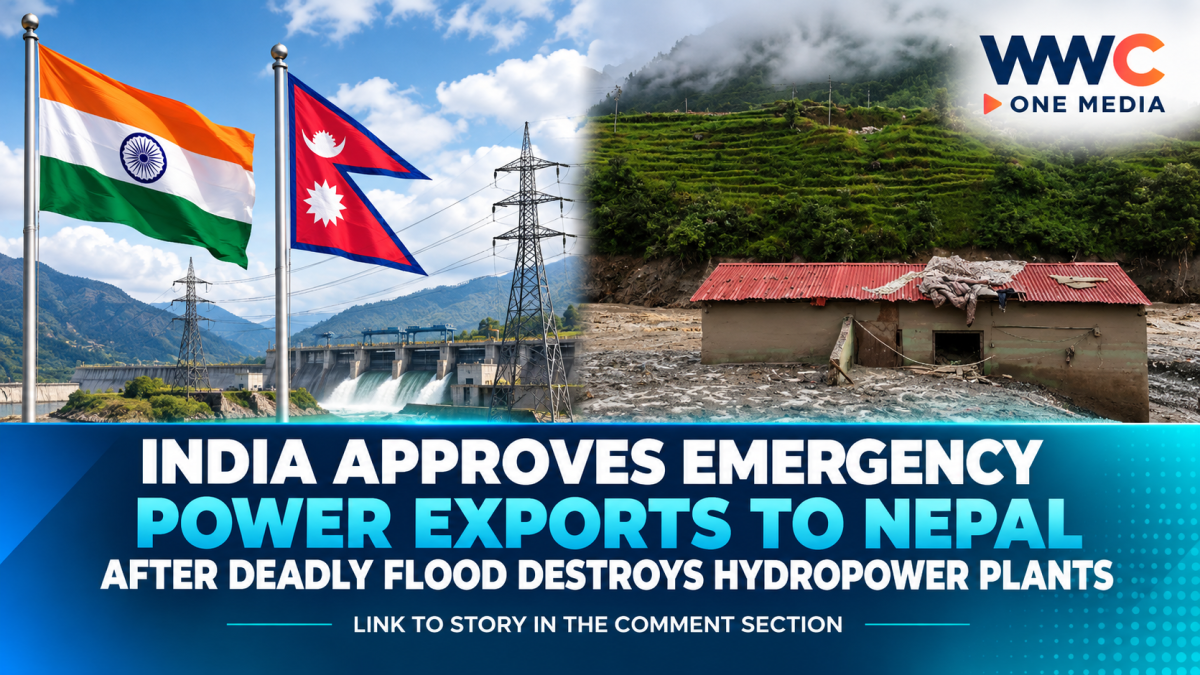
India has approved emergency electricity exports to Nepal for up to 18 hours a day until the end of 2026, helping its neighbour cope with a devastating flood that destroyed major parts of the country’s hydropower infrastructure.
The decision comes after a catastrophic glacier-triggered flood killed nearly 1,400 people across Nepal and Tibet, while more than 5,300 people remain missing.
The disaster also swept away or severely damaged more than a dozen hydropower plants, sharply reducing Nepal’s ability to generate electricity at a time when the country is already dealing with widespread damage to roads, homes and other infrastructure.
India to supply up to 654MW
Under the arrangement, India will export up to 654 megawatts of electricity to Nepal for 18 hours each day from Sept 13 through Dec 31.
Up to 600MW will be supplied through the Muzaffarpur-Dhalkebar transmission line, while another 54MW will be sent through the Tanakpur-Mahendranagar line.
The arrangement will largely use India’s surplus daytime generation, particularly when solar power production is high.
The agreement is expected to be reviewed in December, with the possibility of extending the arrangement into January 2027 depending on Nepal’s recovery and electricity requirements.
Flood wipes out a major part of Nepal’s power capacity
Nepal relies heavily on hydropower for its electricity generation, making the destruction of power plants particularly damaging.
The flood wiped out roughly a tenth of the country’s electricity generation capacity, according to India’s power ministry.
More than 12 hydropower plants were swept away or badly damaged, while hundreds of workers involved in the country’s power sector are among those still missing.
The disaster struck areas containing some of Nepal’s most important hydropower infrastructure, leaving the country dependent on electricity imports to make up the shortfall.
Before the disaster, Nepal had increasingly positioned hydropower as a major source of export revenue, selling electricity to neighbouring countries including India and Bangladesh.
Nepal was forced to reverse its electricity trade
The flood has dramatically altered Nepal’s position in the regional electricity market.
Nepal had been expanding its electricity exports as hydropower production increased, with India becoming a major buyer of Nepalese power.
Following the disaster, however, Nepal was forced to halt some exports and turn to India for additional electricity to meet domestic demand.
The reversal illustrates the scale of the damage caused by the flood.
A country that had been seeking to become a major regional electricity exporter now needs emergency imports to keep its own power system operating.
Thousands remain missing after catastrophic flood
The energy crisis is only one part of a much larger humanitarian disaster.
The flood, triggered by a glacier collapse along the Himalayan region, sent torrents of water through communities in Nepal and neighbouring Tibet.
Nearly 1,400 people have been reported killed, while more than 5,300 remain missing.
Around 900 power-sector workers are among those unaccounted for, underscoring the enormous human toll on the country’s energy industry.
Thousands of homes have also been destroyed or damaged, while roads, bridges and other critical infrastructure have been washed away.
The economic cost is expected to be enormous as Nepal begins the process of reconstruction.
Nepal seeks billions in international aid
The scale of the disaster has prompted Nepal to appeal for major international assistance.
The government has sought around US$5 billion in financial support for reconstruction and recovery, arguing that the catastrophe demonstrates the disproportionate impact of climate-related disasters on vulnerable countries.
Nepal contributes only a small share of global greenhouse-gas emissions but is highly exposed to the effects of rising temperatures in the Himalayas.
Rapid glacier melt, unstable mountain slopes and increasingly unpredictable weather patterns are raising the risks faced by communities across the region.
India-Nepal energy ties gain importance
India’s emergency power decision also strengthens the longstanding energy relationship between the two countries.
India has increasingly become a key market for Nepal’s hydropower exports, while cross-border transmission links have allowed electricity to flow in both directions when required.
The latest arrangement demonstrates the importance of those connections during a crisis.
For Nepal, access to Indian electricity provides an immediate way to compensate for lost generation while damaged hydropower plants are assessed and reconstruction begins.
For India, supplying its neighbour also reinforces its role as a major regional energy hub.
Disaster highlights Nepal’s dependence on hydropower
Nepal’s heavy dependence on hydropower has helped it expand clean electricity generation and develop a potentially lucrative export industry.
But the latest disaster has also exposed the vulnerability of that model to extreme weather and climate-related events.
When hydropower plants, transmission lines and access roads are concentrated in mountainous regions, a single major flood or landslide can disrupt several parts of the electricity system simultaneously.
Rebuilding the damaged plants could therefore take years rather than months.
Until then, imports from India may remain essential to maintaining Nepal’s electricity supply.
A lifeline while Nepal rebuilds
India’s decision is ultimately more than an electricity trade arrangement.
For Nepal, the additional power provides a critical lifeline as the country confronts one of its worst natural disasters in decades.
The immediate priority will be restoring basic services and repairing damaged infrastructure, while longer-term efforts will focus on rebuilding hydropower capacity and making critical infrastructure more resilient to future disasters.
As the Himalayan region faces accelerating environmental risks, the flood has also become a stark reminder that energy security, climate resilience and regional cooperation are increasingly interconnected.
For now, India’s emergency electricity exports give Nepal one less crisis to manage as it begins the enormous task of rebuilding after the deadly flood.




Leave a Reply