
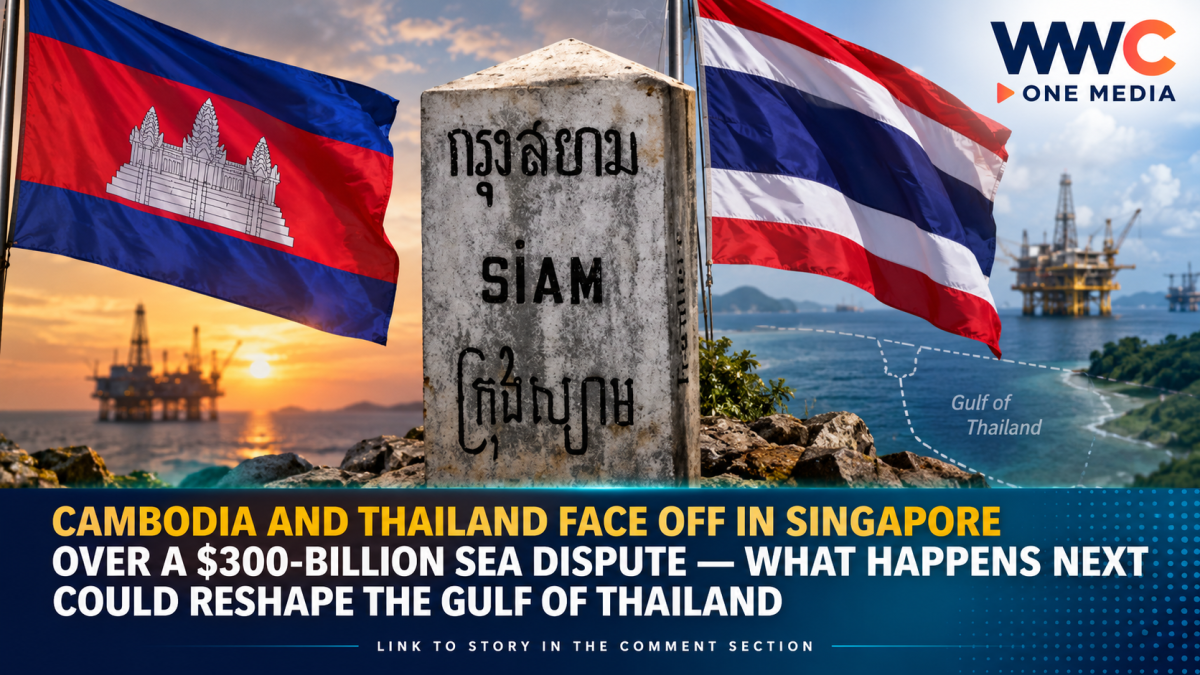
SINGAPORE — A long-running maritime dispute between Cambodia and Thailand has entered a new international phase, with the two Southeast Asian neighbors appearing before a United Nations-backed conciliation commission in Singapore over overlapping claims in the resource-rich Gulf of Thailand.
The proceedings, which began this week and run from Sept. 14 to 16, 2026, mark a major diplomatic development after Thailand withdrew from a 2001 framework that had governed negotiations over the disputed maritime area.
The case is being handled through a conciliation process under the United Nations Convention on the Law of the Sea (UNCLOS), with the Permanent Court of Arbitration serving as the registry. Opening statements from both sides are scheduled for Sept. 15.
A disputed sea area covering about 27,000 square kilometers
At the heart of the dispute is an approximately 27,000-square-kilometer area in the Gulf of Thailand where Cambodia and Thailand have overlapping maritime claims.
The zone is potentially significant for offshore oil and natural gas development. Thailand’s Energy Ministry has estimated that the disputed area’s future oil and gas resources could generate revenues of around US$300 billion.
The dispute therefore involves far more than competing lines on a maritime map. Any eventual agreement could determine how the two countries manage access to potentially valuable offshore energy resources.
Why the dispute moved to international conciliation
The latest escalation followed Thailand’s decision on May 5, 2026, to terminate the 2001 Memorandum of Understanding, commonly known as MoU 44, which had provided a framework for negotiations over their overlapping continental-shelf claims.
Cambodia objected to the move and subsequently invoked the compulsory conciliation mechanism under UNCLOS, arguing that the international process could provide a structured, rules-based avenue for resolving the disagreement.
Thailand, meanwhile, says it is prepared to participate in the process and protect its national interests.
Thailand’s Foreign Ministry said its delegation includes officials and specialists from the country’s Foreign Ministry, Hydrographic Department, Royal Thai Navy and Department of Mineral Fuels. Bangkok has also said the process is expected to take roughly 12 months.
A maritime dispute unfolding amid wider tensions
The timing is especially sensitive because Cambodia and Thailand are still dealing with the fallout from deadly clashes along their land border in 2025.
Those clashes killed dozens of people and displaced more than one million people before a truce was reached, according to AFP reporting carried by The Straits Times and other regional outlets.
The maritime case is legally separate from the land-border dispute, but the deterioration in relations has added political pressure to negotiations between the two governments.
That broader tension has also spilled into international diplomacy. In recent weeks, both sides have continued presenting competing claims over developments along the land frontier while maintaining their respective positions on sovereignty and security.
Thailand and Cambodia take different approaches
Cambodia says the UNCLOS process is designed to prevent the maritime dispute from becoming another source of confrontation.
Phnom Penh has described the proceedings as a peaceful, rules-based mechanism intended to help the two countries reach a fair and lasting solution while protecting Cambodia’s maritime rights.
Thailand has likewise said it is ready to cooperate with the commission, but Bangkok has emphasized that it will defend its national interests.
Thai Foreign Minister Sihasak Phuangketkeow is leading Thailand’s delegation, while Cambodian Deputy Prime Minister and Foreign Minister Prak Sokhonn is heading Cambodia’s team.
The panel cannot simply impose a settlement
One of the most important details is that the conciliation commission is not a court issuing a binding judgment.
According to Thailand’s Foreign Ministry, the process is expected to last approximately one year, after which the commission will issue a report containing its conclusions or recommendations. Those recommendations are not legally binding on either country.
That means the Singapore meetings are unlikely to produce an immediate winner or a final maritime boundary.
Instead, the commission is expected to help Cambodia and Thailand negotiate a possible settlement under an internationally recognized legal framework.
Why the outcome matters beyond Cambodia and Thailand
The stakes extend beyond the two governments.
A successful settlement could eventually unlock opportunities for offshore exploration and energy development in an area believed to have significant oil and natural-gas potential.
But the dispute also carries a broader regional significance.
After years of tension, border clashes and competing territorial claims, the international conciliation process provides both countries with a diplomatic channel that could help prevent their maritime disagreement from becoming another flashpoint.
For Cambodia, it represents an attempt to move the dispute into a formal international legal process. For Thailand, it provides an opportunity to defend its maritime position while maintaining that its national interests must be protected.
The first meeting in Singapore is therefore only the beginning.
The bigger question is whether the two neighbors can eventually turn a decades-old maritime disagreement — involving sovereignty, energy resources and national politics — into a negotiated settlement.
And with an estimated $300 billion in potential oil and gas revenues hanging over the disputed waters, the eventual outcome could prove far more consequential than the diplomatic proceedings now taking place in Singapore.




Leave a Reply