
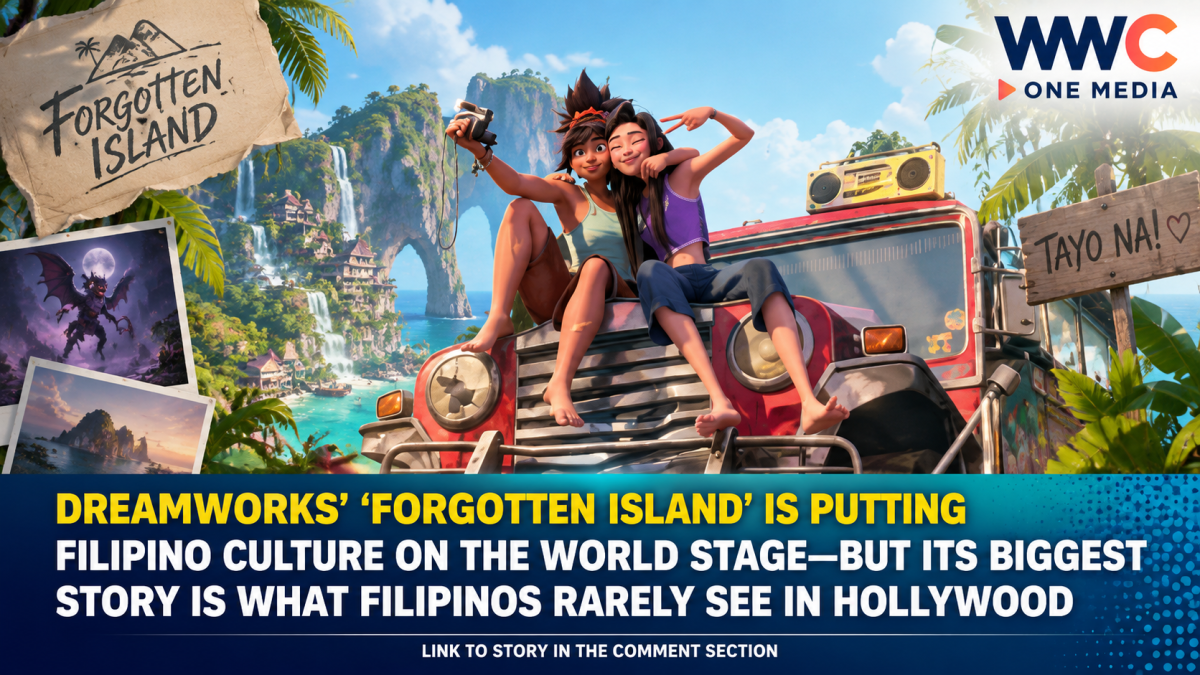
That is the question surrounding DreamWorks Animation’s “Forgotten Island,” a new animated feature that places Philippine folklore, mythology, family traditions and Filipino identity at the center of a major Hollywood production.
Directed and co-written by Joel Crawford and Filipino-American filmmaker Januel Mercado, the film follows lifelong best friends Jo and Raissa, voiced by Grammy and Academy Award winner H.E.R. and Filipino actress Liza Soberano, whose final night together takes an unexpected turn when they are transported to the mysterious island of Nakali.
There, the friends encounter mythical creatures they grew up hearing about from their Filipino families—including the terrifying Manananggal, voiced by Tony Award-winning Filipino actress Lea Salonga.
But beneath the fantasy and adventure is a deeply personal story about friendship, separation, memory and what it means to hold on to one’s cultural roots.
More Than Just Filipino Mythology
“Forgotten Island” is being positioned as a significant moment for Filipino representation in mainstream Hollywood animation.
ABC News described the project as the first time a major Hollywood studio has backed a full-length feature centered on Filipino folklore and mythology. The film has already generated strong reactions from Filipino audiences, with Soberano saying viewers who saw screenings told her they felt more proud of being Filipino afterward.
The movie does not simply use Filipino mythology as a backdrop.
Its creators deliberately incorporated details of everyday Filipino life—from food and family gatherings to Filipino mannerisms, school experiences and traditions.
Philstar reported that Mercado and Crawford even incorporated the distinctly Filipino habit of pointing with one’s lips into the film. Other recognizable details include Filipino homes, classrooms, jeepneys and the way families gather around food.
The filmmakers also drew on the concept of bayanihan, emphasizing Filipino community spirit and hospitality.
One of the film’s standout cultural sequences is a Filipino despedida, a farewell gathering that reflects the warmth—and sometimes the playful gossip—of Filipino family and community life.
A Filipino Story About Leaving Home
At the heart of “Forgotten Island” is something particularly familiar to many Filipinos: the pain of watching someone you love leave.
Raissa is preparing to leave for the United States to attend the California Institute of Technology, while Jo fears that their lifelong friendship will never be the same.
Their journey to Nakali transforms that fear into a fantastical adventure where memories themselves become the price of finding a way home.
That emotional premise gives the film a connection beyond mythology.
It touches on migration, family separation, growing up and the complicated Filipino experience of building a life somewhere far from home.
ABC News noted that the storyline can resonate with Filipinos who have experienced friends or family members leaving the country in search of opportunities abroad.
Philippine Folklore Takes Center Stage
The film’s fantastical world is populated by creatures drawn from Filipino mythology and folklore.
Among the most prominent is the Manananggal, portrayed as Nakali’s most feared creature and voiced by Lea Salonga.
The official trailer also introduces audiences to Raww, a weredog voiced by Dave Franco, alongside other supernatural figures.
For international audiences unfamiliar with Philippine mythology, the movie offers an introduction to creatures and traditions that have traditionally received far less exposure in mainstream global entertainment.
But the filmmakers have also made the cultural references accessible rather than presenting them simply as exotic monsters.
The mythology is woven into a story about friendship and memory.
Filipino Talent Is Everywhere
The film’s Filipino representation extends well beyond its setting.
Alongside Soberano and H.E.R., the voice cast includes Lea Salonga, Dolly de Leon, Manny Jacinto, Jo Koy and Amielynn Abellera, while international stars including Dave Franco, Jenny Slate and Ronny Chieng are also part of the ensemble.
Mercado’s personal connection to the material is particularly important.
The Filipino-American filmmaker has spoken about wanting the movie to become a celebration of Filipino identity and an inspiration for younger Filipino storytellers.
Crawford also has a personal connection to the culture through his Filipino wife, Kathy, whose experiences of leaving the Philippines and navigating identity in the United States helped inform the emotional themes of the story.
Even the Animation Reflects Filipino Influences
The cultural ambition of “Forgotten Island” extends to its visual style.
According to Philstar, the filmmakers blended traditional hand-drawn animation with CG animation, while drawing visual inspiration from the colorful aesthetic and anime-influenced styles familiar to artists who grew up during the 1990s.
The film also received animation work from Snipple Animation Studios in Quezon City, giving Filipino artists a direct role in bringing the world of Nakali to life.
That connection makes the project more than a Hollywood film about the Philippines—it also involves Filipino creative talent behind the scenes.
Filipino Music Adds Another Layer
The Filipino identity of “Forgotten Island” also extends into its soundtrack.
GMA News reported that the movie’s music includes Filipino artists and songs, with SB19, BINI, Lea Salonga, Ruby Ibarra and KATSEYE’s Sophia Laforteza among the artists connected to the soundtrack.
BINI contributes “A Parallel World,” while SB19 performs a cover of Francis Magalona’s “Mga Kababayan.” Ruby Ibarra also appears with “Salbahae Ako,” while Sophia Laforteza performs a new version of INXS’ “Never Tear Us Apart.”
The result is an unusually broad representation of Filipino culture across the film’s story, visuals, characters and music.
Hollywood Is Taking Notice
The film’s cultural impact is already extending beyond the Philippines.
The Manila International Film Festival selected “Forgotten Island” for a special advance screening as part of its 2026 lineup, placing the DreamWorks production alongside Filipino and Filipino-diaspora cinema being showcased in Hollywood.
The film has also inspired collaborations outside the movie industry.
Jollibee announced its first-ever global DreamWorks Animation collaboration around “Forgotten Island,” with themed meals, collectible friendship charms and other activities tied to the film’s September theatrical release.
That partnership is particularly significant because it connects two global brands with Filipino roots and gives the film another way to introduce elements of Filipino culture to audiences outside the Philippines.
But Representation Comes With Expectations
The excitement surrounding “Forgotten Island” has also come with an important conversation: Can Hollywood represent Filipino culture without reducing it to stereotypes?
ABC News spoke with Filipino cultural observers and media scholars who acknowledged the significance of seeing Philippine mythology and Filipino characters receive this level of attention, while also noting longstanding concerns about how Hollywood has historically simplified cultures for international audiences.
That tension makes “Forgotten Island” particularly important.
For many Filipino viewers, the question isn’t simply whether Filipino culture is appearing on a Hollywood screen.
It is whether audiences around the world will finally see Filipino culture as complex, emotional, funny, imaginative and deeply human—not merely exotic.
A Story That Could Open the Door
DreamWorks’ “Forgotten Island” arrives at a time when Filipino stories and Filipino talent are increasingly gaining international attention.
And perhaps its biggest achievement may not be the monsters, the animation or even the Hollywood star power.
It may be the simple act of telling the world that Filipino stories do not need to be stripped of their cultural identity to become universal.
As Mercado has emphasized, the invitation is essentially “Tayo Na!”—let’s go.
This time, the journey begins with Filipino mythology.
And if audiences embrace it, the destination could be much bigger than Nakali.
“Forgotten Island” is scheduled to open in theaters on September 25, 2026.




Leave a Reply