
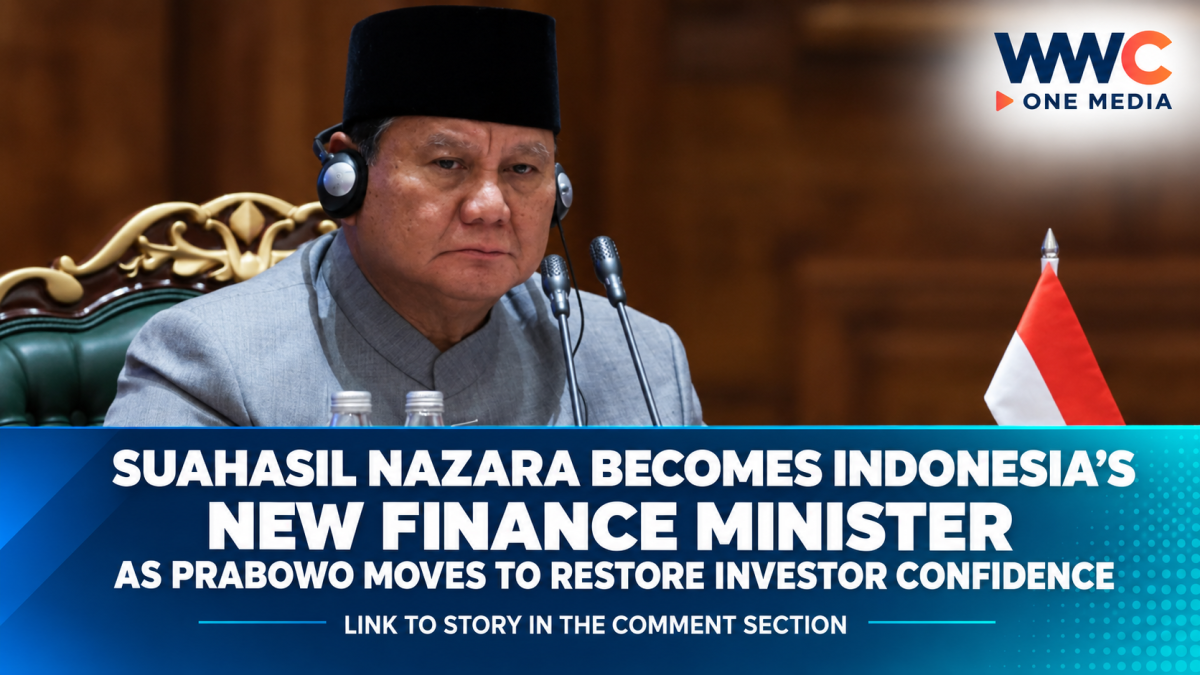
Indonesian President Prabowo Subianto has appointed veteran economist Suahasil Nazara as the country’s new finance minister, turning to an experienced technocrat as his government faces growing pressure to restore confidence in its fiscal management.
Suahasil, 55, was sworn in at the State Palace in Jakarta on Sept 14, replacing Purbaya Yudhi Sadewa.
His appointment makes him the third person to lead Indonesia’s Finance Ministry under Prabowo, who took office in October 2024.
The abrupt change comes as investors have become increasingly concerned about Indonesia’s fiscal direction, the weakening rupiah and uncertainty surrounding government economic policies.
From deputy minister to finance chief
Suahasil brings extensive experience inside Indonesia’s economic policymaking establishment.
He joined the Finance Ministry’s advisory team in 2009, later headed the Fiscal Policy Agency from 2015 and became deputy finance minister in 2019.
He served as deputy minister through the administrations of both Joko Widodo and Prabowo, giving him years of experience in preparing the state budget and managing fiscal policy.
Unlike Purbaya, who was known for his outspoken and more interventionist approach to economic policy, Suahasil is viewed as a technocrat with deep institutional knowledge.
His appointment therefore signals an emphasis on continuity and fiscal credibility rather than a complete change in direction.
Prabowo demands a ‘healthy and credible’ budget
After taking the oath of office, Suahasil said Prabowo had instructed him to protect the health and credibility of Indonesia’s state finances.
His immediate priorities include maintaining a credible state budget, communicating fiscal policy clearly and ensuring government spending supports Prabowo’s priority programmes.
Suahasil also pledged to keep the fiscal deficit below Indonesia’s legal limit of 3 per cent of gross domestic product.
The government has projected a deficit of about 2.85 per cent of GDP for 2026, equivalent to roughly 734.3 trillion rupiah.
Investors looking for greater policy stability
The appointment comes after a period of heightened uncertainty in Indonesian financial markets.
Purbaya’s tenure was marked by concerns over wide fiscal deficits, controversial policy decisions and tensions surrounding the government’s management of liquidity and state funds.
Credit-rating agencies Fitch and Moody’s have also moved Indonesia’s outlook to negative, citing concerns over policy uncertainty and fiscal management.
The change in finance minister was initially accompanied by sharp market volatility, but Indonesian shares recovered after Suahasil’s appointment.
Investors appear to view his long experience in the Finance Ministry as potentially reassuring because he is familiar with the government’s fiscal machinery and is considered more predictable than his predecessor.
Purbaya’s short tenure ends abruptly
Purbaya had been finance minister for only about a year.
He was appointed in September 2025 after Prabowo replaced Sri Mulyani Indrawati, one of Indonesia’s most internationally respected economic officials.
Purbaya’s departure came unexpectedly, with reports showing him leaving a parliamentary hearing on the same day that the cabinet reshuffle was announced.
His tenure coincided with the government’s push to accelerate economic growth and finance major programmes, including Prabowo’s flagship free school meals initiative.
That agenda has created a difficult balancing act for the Finance Ministry, which must find funding for ambitious programmes while keeping debt, deficits and investor confidence under control.
Suahasil faces a difficult 2027 budget
One of Suahasil’s first major tasks will be helping finalise Indonesia’s 2027 state budget.
The government unveiled its draft budget in August, but the new finance minister will now oversee the remaining negotiations and implementation planning.
He said the Finance Ministry would use the remaining weeks of September to organise funding for the government’s priority programmes.
The challenge will be ensuring that Prabowo’s ambitious economic and social agenda can be financed without putting excessive pressure on public finances.
Economists have also warned that rising global oil prices could increase the cost of maintaining domestic fuel prices and put additional pressure on the budget.
Balancing growth with fiscal discipline
Prabowo has set ambitious economic goals for Indonesia, including a long-term target of achieving annual growth of up to 8 per cent.
But faster growth requires significant public and private investment, while the government is simultaneously funding major social programmes.
Suahasil will therefore have to balance two competing demands: supporting economic expansion while convincing markets that Indonesia will not abandon fiscal discipline.
His pledge to maintain the deficit below the 3 per cent legal ceiling is likely to be closely watched by investors.
The credibility of that commitment will depend not only on the headline deficit but also on how government spending is financed and whether major programmes deliver the economic returns promised by the administration.
A familiar face at a critical moment
Suahasil has described his appointment as a continuation rather than a dramatic policy shift.
His familiarity with the Finance Ministry could help reduce disruption following Purbaya’s sudden removal, particularly with the 2027 budget still being finalised.
But the new minister will have little room for error.
Indonesia needs to reassure investors that its fiscal policies are predictable while still delivering Prabowo’s ambitious economic agenda.
For now, Suahasil’s technocratic reputation offers the government a chance to stabilise markets and rebuild confidence.
Whether that confidence lasts will ultimately depend on whether he can turn his promise of a healthy, credible budget into concrete fiscal policy while supporting one of Indonesia’s most ambitious government programmes in years.




Leave a Reply