
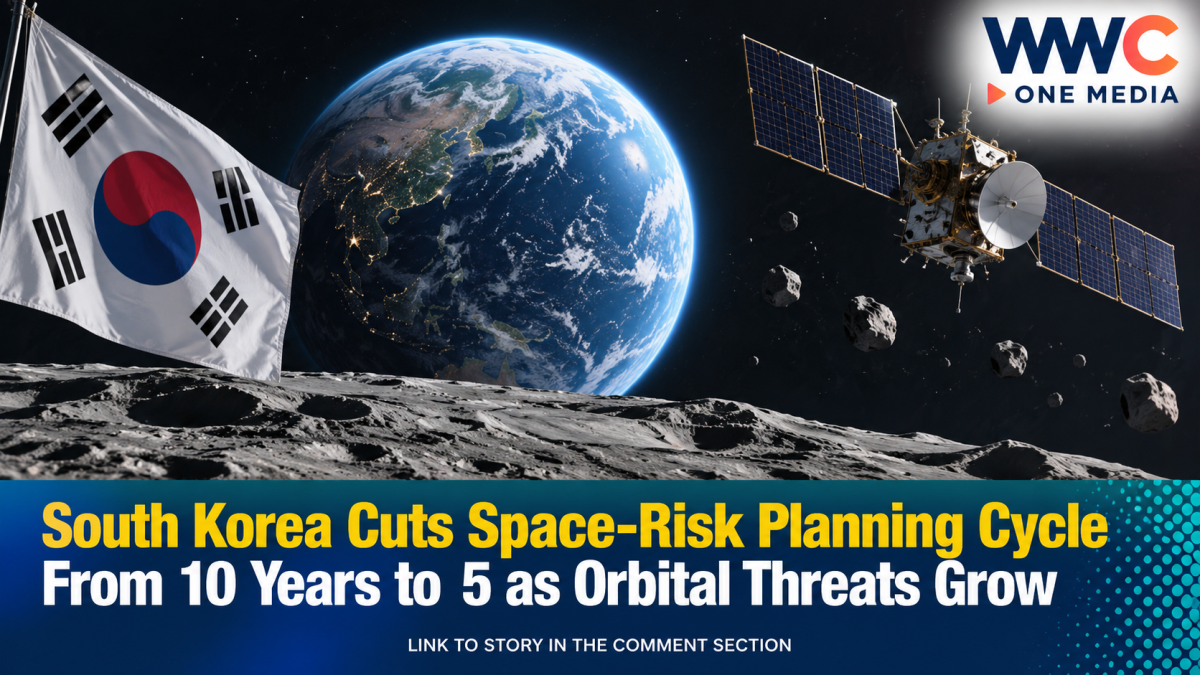
SEOUL — South Korea is dramatically shortening the time it gives itself to prepare for space hazards, cutting the review cycle for its national Space Hazard Preparedness Master Plan from 10 years to just five.
The change took effect September 15, 2026, following an amendment to the country’s Space Development Promotion Act, as Seoul responds to a rapidly changing orbital environment marked by increasing satellite deployments, expanding private-sector space activity and growing concerns over collisions and space debris.
The move signals a broader shift in South Korea’s space policy: long-term planning alone may no longer be enough when conditions in orbit can change within a few years.
Why South Korea Is Moving Faster
The number of satellites operating in low Earth orbit has increased sharply, while commercial satellite constellations are expanding.
That creates more opportunities for communications, Earth observation and other services—but it also means more objects sharing increasingly crowded orbital paths.
South Korean science officials say the growing number of satellites and space debris raises the possibility of collisions. Changes in solar activity are another concern because space weather can affect satellites and the broader space environment.
The European Space Agency has similarly warned that Earth’s orbital environment is becoming increasingly crowded, with commercial satellite constellations continuing to expand and debris posing long-term risks to spacecraft.
The Next Plan Is Now Due in 2029
Under the revised system, South Korea’s space-hazard preparedness planning will be updated every five years instead of every decade.
The change also affects the existing planning schedule. The country’s second Space Hazard Preparedness Master Plan, established in 2024, will be followed by a third plan in 2029 under the shortened cycle.
That gives policymakers more frequent opportunities to reassess emerging threats and update national responses as the space environment changes.
Korea’s Space Ambitions Are Growing, Too
The timing is significant because South Korea is simultaneously expanding its ambitions in space.
The Korea Aerospace Administration (KASA) was established in 2024 to coordinate national space policy, research and development, industrial promotion and international cooperation. By June 2026, South Korea ranked 10th globally in satellite ownership, according to the OECD, with commercial satellites accounting for about 38% of its satellite fleet.
Korea is also pursuing major projects including next-generation launch vehicles and lunar exploration. Its broader space strategy includes a planned uncrewed lunar lander and efforts to develop a stronger domestic commercial space industry.
That makes space safety increasingly important not only as a scientific issue but also as an economic and national-infrastructure concern.
Space Is Becoming More Crowded—and More Valuable
Satellites now support communications, navigation, weather monitoring, Earth observation and other services that modern economies increasingly depend on.
At the same time, debris can remain in orbit for years, decades or even much longer depending on altitude. NASA notes that debris in higher orbits can remain around Earth for extremely long periods, increasing the importance of preventing additional debris and managing existing objects.
For South Korea, the five-year planning cycle therefore represents more than a bureaucratic adjustment.
It is an attempt to make national space-safety policy move at a pace closer to the rapidly changing environment above Earth.
A Faster Space Race Requires Faster Safety Planning
South Korea’s decision comes as the country seeks to establish itself as a major space power while private companies and satellite operators transform the orbital economy.
The challenge is increasingly two-sided: Korea wants more satellites, more launches and more space capabilities—but it also needs stronger systems to manage the risks created by that growth.
By cutting its planning cycle in half, Seoul is acknowledging that the space environment of 2031 may look very different from the one policymakers assessed in 2026.
And as orbital traffic continues to grow, the question may no longer be whether space becomes more crowded—but how quickly governments can adapt before that crowding creates serious safety problems.




Leave a Reply