
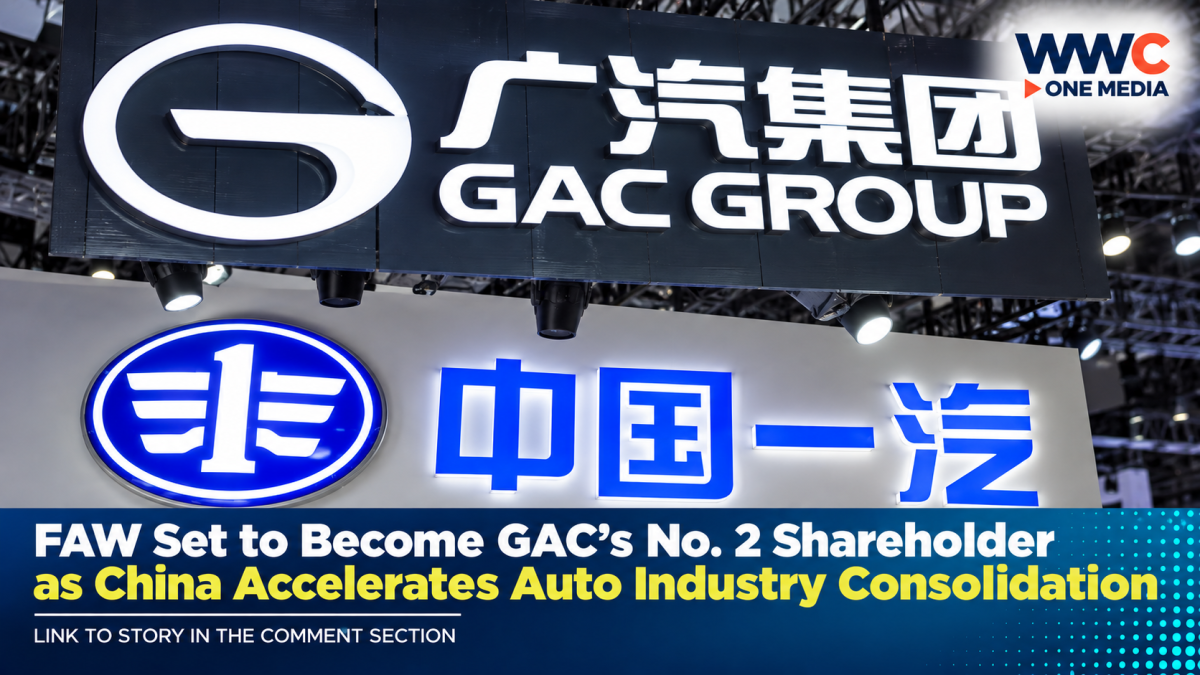
BEIJING — China’s automotive industry is entering another major phase of consolidation after two of the country’s major state-owned automakers, China FAW Group and Guangzhou Automobile Group (GAC), announced a proposed transaction that could reshape their relationship and strengthen cooperation across their vehicle businesses.
GAC said it signed a letter of intent with FAW Group on September 14 to acquire part of FAW’s stake in a vehicle-manufacturing joint venture through a share issuance, alongside a proposed capital increase.
If completed, the transaction would make FAW GAC’s second-largest shareholder, giving the northeastern Chinese automaker what GAC described as strategic influence in the company.
The announcement comes as Beijing pushes China’s auto industry toward greater consolidation, efficiency and technological competitiveness amid intense competition — particularly in the rapidly expanding new-energy vehicle sector.
A deal that could reshape two major state automakers
GAC has not yet publicly disclosed the name of the joint venture involved, saying the information is being temporarily withheld because the target involves an overseas-listed company. The proposed transaction is also not final: no definitive agreement has been signed, and the deal remains subject to internal and regulatory approvals.
China’s state-owned Economic Daily, however, has reported that the undisclosed venture is FAW Toyota, citing sources.
That possibility is particularly significant because FAW and GAC are both major Chinese partners of Toyota Motor Corp. FAW operates FAW Toyota, while GAC operates GAC Toyota, giving the proposed restructuring implications beyond the two Chinese automakers themselves.
Toyota connection adds another layer
According to Reuters, the proposed arrangement could form part of a broader effort to consolidate Toyota’s operations in China.
Under a reported structure being advocated by Toyota’s Japanese side, the two existing Toyota joint ventures could eventually be integrated under a unified sales company. Toyota would reportedly hold 50%, with FAW and GAC each holding 25%.
The proposed structure would also integrate dealer networks so the combined operation could sell and service Toyota vehicles across China more efficiently. These details remain part of the reported restructuring discussions rather than a completed transaction.
For Toyota, such a move could help simplify its distribution structure in one of the world’s largest automobile markets as Chinese consumers rapidly shift toward electric and hybrid vehicles.
Why China is pushing automaker consolidation now
The FAW-GAC development comes against a broader policy backdrop.
China’s authorities have been calling for greater restructuring among automakers, including mergers and cross-regional cooperation, as manufacturers face excess capacity, fierce price competition and a rapidly changing market dominated increasingly by new-energy vehicles.
A nine-government-department plan released in September called for accelerated mergers and restructuring in the intelligent connected new-energy vehicle industry, including efforts to eliminate outdated capacity and improve utilization of industrial resources.
That makes the FAW-GAC proposal potentially much bigger than a simple shareholder transaction.
It could become another example of China’s state-owned automotive groups combining resources to compete more effectively in a market where domestic EV makers have become increasingly powerful.
FAW and GAC bring different strengths
FAW, headquartered in Changchun in northeastern China, is behind brands including Hongqi and FAW Jiefang, while Guangzhou-based GAC operates brands including GAC Trumpchi and Aion.
The two groups also have different geographic footprints, potentially giving cooperation between them a wider industrial reach.
A stronger relationship could allow the companies to share resources, technology, manufacturing capabilities and distribution networks while reducing duplication in an increasingly competitive market.
But the exact scope of any future cooperation remains unclear.
GAC’s announcement specifically describes the current proposal as a major asset restructuring and related-party transaction. It also says the transaction would not change GAC’s ultimate controller and would not constitute a backdoor listing.
Markets immediately reacted
The announcement followed a dramatic trading halt.
GAC’s Shanghai-listed A-shares were suspended from September 14, with the company saying the suspension could last for no more than 10 trading days. Its Hong Kong-listed shares had risen sharply before trading was halted, amid speculation about a potential FAW investment and restructuring.
The market reaction shows how closely investors are watching consolidation among China’s traditional automakers.
The country’s established manufacturers are under increasing pressure to adapt to a market where electric vehicles, intelligent driving technologies and aggressive pricing strategies are changing the competitive landscape.
A bigger shake-up may be coming
The FAW-GAC proposal could therefore become an important test of China’s broader strategy for its automotive industry.
Rather than allowing manufacturers to compete indefinitely with overlapping capacity and resources, Beijing appears increasingly interested in encouraging stronger alliances, restructuring and more efficient use of industrial assets.
For GAC and FAW, the immediate question is whether the letter of intent can be converted into a completed transaction.
For Toyota, the potential restructuring of its Chinese joint ventures could offer a way to simplify its operations and strengthen its competitiveness.
And for China’s broader auto industry, the development may signal that the next stage of the country’s automotive revolution will not only be about electric vehicles — it could also be about deciding which automakers are strong enough to stand alone.




Leave a Reply