
MANILA, Philippines — Indian airport heavyweight GMR Group is preparing for what could become its biggest Philippine aviation bet yet, targeting the massive Sangley Point International Airport in Cavite while exploring regional airports and cargo projects that could dramatically expand its footprint across the country.
The company, which helped transform Mactan-Cebu International Airport and build Clark International Airport’s new passenger terminal, discussed its Philippine expansion plans with President Ferdinand Marcos Jr. and Cabinet officials during meetings in New Delhi on September 12.
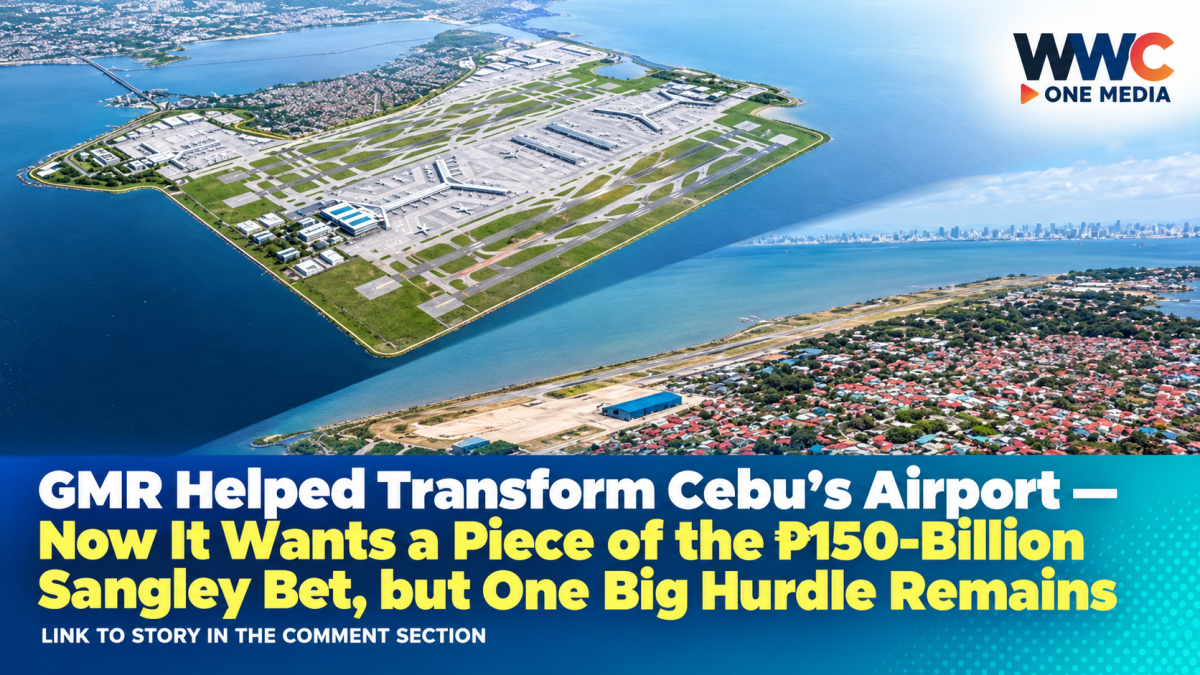
At the center of those discussions was Sangley Point International Airport, a proposed multi-runway gateway on Manila Bay envisioned as another major airport serving the Greater Capital Region.
Government estimates cited during the investment discussions put potential direct investment at more than ₱150 billion, with approximately ₱500 billion in indirect economic impact, between $300 million and $500 million in government revenues, and an estimated 10,000 to 15,000 jobs.
But GMR is looking beyond Sangley.
The Indian infrastructure group is also studying possible involvement in regional airport projects involving Bacolod, Tacloban, Busuanga and Laoag, as well as logistics facilities at Clark designed to serve international cargo operators.
Taken together, the plans signal something much larger than another airport investment.
GMR appears to be positioning itself for a second major chapter in Philippine aviation.
Sangley could be GMR’s biggest Philippine airport opportunity
Sangley sits on a strategically important peninsula in Cavite, just across Manila Bay from Metro Manila.
The long-planned airport is intended to provide additional aviation capacity for the capital region, support passenger and cargo growth and reduce pressure on Ninoy Aquino International Airport.
President Marcos’ government has increasingly treated Sangley as a priority.
Administrative Order No. 44 directed national agencies and Cavite local governments to expedite permits, clearances and other approvals needed for the airport.
A joint technical working group co-chaired by the Department of Transportation and Philippine Reclamation Authority was also created to address issues that could delay implementation.
The urgency reflects a familiar problem.
Greater Manila is heading toward a future in which several airports—not a single gateway—will need to handle expanding passenger, tourism and cargo demand.
That system is expected to include a modernized NAIA, Clark International Airport, San Miguel Corp.’s New Manila International Airport in Bulacan and, if development proceeds as planned, Sangley.
For GMR, getting into Sangley could therefore give the Indian company a stake in one of the country’s most important emerging aviation corridors.
But Sangley has not reached construction yet
This is where the hype needs some restraint.
Despite years of planning, Sangley Point International Airport remains in the pre-construction phase.
The project’s advisers said in September that financial arrangements were still being finalized and construction was targeted to begin in the third quarter of 2027.
The first phase is expected to take about 17 quarters—roughly four years and three months—with initial commercial operations targeted around 2031.
That timeline remains subject to the project clearing the remaining government and technical requirements.
Among the issues still being addressed are approval of the final reclamation configuration by the Philippine Reclamation Authority, land-access arrangements involving the Department of National Defense and airspace clearances from the Civil Aviation Authority of the Philippines.
Those are not minor details.
Sangley occupies land associated with the Philippine Navy, while a large portion of the future airport must be created through reclamation.
That means military requirements, environmental compliance, reclamation engineering, financing and aviation regulation all have to converge before heavy construction can proceed.
The first phase alone is roughly a $2-billion build
The immediate airport development is expected to cost about $2 billion.
According to the latest project presentation, Phase 1 would involve approximately 251 hectares of reclamation, extension of Sangley’s existing runway from about 2.1 kilometers to 3.2 kilometers, construction of a new passenger terminal, aprons, cargo facilities and associated landside infrastructure.
Eventually, the reclaimed and existing airport area could expand into a much larger aviation complex as demand grows.
Earlier versions of the full Sangley development have been valued at around $11 billion, reflecting the much larger long-term buildout rather than merely the first construction phase.
That distinction matters.
A $2-billion initial airport is very different from committing the entire $11 billion upfront.
The project is designed to be developed in stages as passenger and cargo demand materialize.
Sangley is supposed to be more than an airport
Its ambitions extend beyond runways and terminals.
Plans call for a 4.4-kilometer Sangley Boulevard, designed as a high-speed expressway and causeway linking the airport directly with the Manila-Cavite Expressway and onward to the Cavite-Laguna Expressway.
Construction of the road is targeted to start in the first quarter of 2027 and finish around the first quarter of 2029.
The broader project also includes a roughly 190-hectare Cargo City intended for logistics, warehousing, aviation support and e-commerce fulfillment.
That cargo component could prove particularly important.
Airports generate substantially more economic activity when they become logistics platforms rather than simply passenger terminals.
Warehouses, freight forwarders, aircraft services, cold-chain facilities and e-commerce operations can turn an airport district into an employment and industrial cluster.
That helps explain why GMR is simultaneously looking at logistics opportunities at Clark.
The company’s Philippine strategy increasingly appears to connect airports, cargo and regional connectivity, rather than treating each terminal as an isolated investment.
GMR already knows the Philippine airport business
GMR is hardly a newcomer.
Its most visible Philippine venture began in 2014, when GMR and Megawide Construction Corp. won the 25-year public-private partnership for Mactan-Cebu International Airport.
The consortium paid a ₱14.4-billion premium to government and undertook the airport’s expansion and operation.
Its work included development of Cebu’s Terminal 2 and rehabilitation of Terminal 1, helping transform MCIA into one of the country’s most modern gateways.
GMR eventually sold its equity interest in the Cebu airport venture.
The final portion of its stake was transferred in 2024, and Mactan-Cebu is now operated by Aboitiz InfraCapital Cebu Airport Corp.
GMR nevertheless remained involved as a technical-services provider, with its current company materials highlighting its continuing technical relationship with the airport.
That background is important because describing GMR today simply as “the operator of Cebu airport” would no longer be accurate.
It helped build and operate the transformed airport—but no longer owns the concessionaire.
Clark was a different kind of GMR project
GMR also worked with Megawide on the new passenger terminal at Clark International Airport, but its role there was different.
The Megawide-GMR joint venture won the engineering, procurement and construction contract to design and build Clark’s new terminal under a hybrid PPP model.
The approximately ₱9.36-billion construction contract involved a terminal initially designed to accommodate eight million passengers annually.
GMR did not become Clark’s long-term airport operator.
Clark’s operations and maintenance concession went separately to Luzon International Premier Airport Development Corp., or LIPAD, whose partners include Filinvest Development Corp., JG Summit Holdings, Philippine Airport Ground Support Solutions and Changi Airports Philippines.
Megawide subsequently bought GMR’s remaining interest in their Clark construction joint venture in 2025.
That makes Sangley potentially significant for GMR.
Unlike Clark, it could give the company another opportunity to become involved not only in construction expertise but in the broader development and operation of a major Philippine aviation asset.
GMR’s exact Sangley role still needs watching
Another distinction is critical.
The Sangley airport concession was originally awarded in 2022 to the SPIA Development Consortium, associated with Cavitex Holdings and House of Investments.
Public project documents have listed participants including Cavitex Holdings, House of Investments, Samsung C&T, MacroAsia Corp., Munich Airport International and Ove Arup & Partners Hong Kong.
The Philippine Competition Commission approved the joint venture between Cavite province and the Cavitex-House of Investments-led consortium in October 2024.
GMR was not among the originally listed members in that earlier consortium structure.
More recent government announcements, however, say GMR is working with Cavitex Holdings and House of Investments on the airport and has committed to pursue participation in the project. President Marcos again met GMR and Cavitex representatives in New Delhi this September specifically to advance Sangley’s development.
That suggests GMR could become a major strategic, technical, investment or operating partner.
But until final agreements and financing arrangements are publicly disclosed, it would be premature to state that GMR has already taken ownership of or formally replaced any existing consortium member.
The United States is also paying attention to Sangley
Sangley has attracted interest beyond Philippine and Indian investors.
In May, the U.S. Trade and Development Agency announced funding for a feasibility study supporting development of the airport.
USTDA said the study would examine the project’s development while helping define security measures needed to protect direct flights between Sangley and major U.S. aviation hubs.
That adds another layer to the project.
A future airport serving Greater Manila has obvious commercial importance, but aviation infrastructure also carries national-security implications—particularly when it involves international routes, military-adjacent land and critical transportation systems.
The combination of Philippine, Indian and American engagement makes Sangley more strategically significant than an ordinary provincial airport expansion.
Regional airports could be GMR’s next frontier
Sangley may be the headline project, but GMR’s interest in Bacolod, Tacloban, Busuanga and Laoag could ultimately spread its Philippine presence much more widely.
Each airport serves a different tourism and economic market.
Bacolod is an important gateway to Negros.
Tacloban serves Eastern Visayas.
Busuanga is the principal air gateway to Coron and northern Palawan.
Laoag connects Ilocos Norte with Manila and international tourism markets.
Modernizing these gateways could support tourism growth while allowing more passengers to travel directly to regional destinations rather than relying heavily on Manila connections.
GMR has publicly said it is willing to look at additional Philippine airport opportunities following its experience in Cebu and Clark.
The company is also considering logistics opportunities at Clark, potentially giving it exposure to both passenger and cargo infrastructure.
Why foreign airport operators keep looking at the Philippines
The investment logic is straightforward.
The Philippines is an archipelago of more than 7,000 islands, making air transport unusually important for domestic mobility.
Tourism growth increases international demand.
A large overseas Filipino population sustains international travel.
And economic development outside Metro Manila is increasing the need for stronger regional gateways.
At the same time, building and modernizing airports requires enormous capital, engineering expertise and decades of operating experience.
That is why Manila has increasingly turned to long-term public-private partnerships.
Mactan-Cebu became one of the landmark examples.
NAIA has since moved under private operation through the San Miguel-led concession.
Bohol-Panglao and Laguindingan have also been awarded through PPP arrangements.
Sangley could become one of the largest tests of that model yet.
Sangley will also have to compete for airlines
Building the airport is only half the challenge.
By the time Sangley begins commercial operations, the Greater Capital Region could have several major gateways competing for airlines and passengers.
NAIA is undergoing modernization.
Clark continues expanding its international network.
San Miguel’s enormous New Manila International Airport in Bulacan is being developed north of Metro Manila.
Sangley would enter that market from the south.
That could be a major advantage for millions of residents and businesses in Cavite and southern Metro Manila.
But airports do not automatically become hubs just because terminals and runways are available.
They need airlines.
They need accessible ground transport.
They need connecting passengers.
They need competitive charges.
And they need enough destinations to persuade travelers that using the airport is more convenient than going elsewhere.
GMR’s experience developing airport networks and commercial operations could therefore matter as much as its ability to build infrastructure.
The bigger story
For GMR, Sangley represents something much larger than another overseas airport project.
The Indian group entered Philippine aviation more than a decade ago through Cebu.
It later helped construct Clark’s new terminal.
It has since exited its equity stakes in those original ventures, but it never completely walked away from the Philippine market.
Now it is trying to come back on a potentially much larger scale.
Sangley could give GMR a foothold in the Greater Manila aviation market. Regional airport projects could extend that presence to the Visayas, Palawan and northern Luzon. Cargo investments at Clark could add a logistics business alongside passenger infrastructure.
And the Philippine government appears eager to keep the conversation moving, offering qualified strategic projects access to its Green Lane for Strategic Investments and potential incentives under the CREATE MORE Act.
Still, the most important word for now is could.
Sangley remains in pre-construction. Financing is still being finalized. Key clearances remain outstanding. Heavy construction is currently targeted for 2027 rather than underway today.
GMR’s interest is substantial, but the final structure of its participation still has to be translated from meetings and commitments into binding agreements, financing and concrete on the ground.
If that happens, Sangley could mark GMR’s return to the center of Philippine airport development—and turn a company that once helped transform Cebu into one of the most influential foreign players in the country’s next aviation expansion.




Leave a Reply