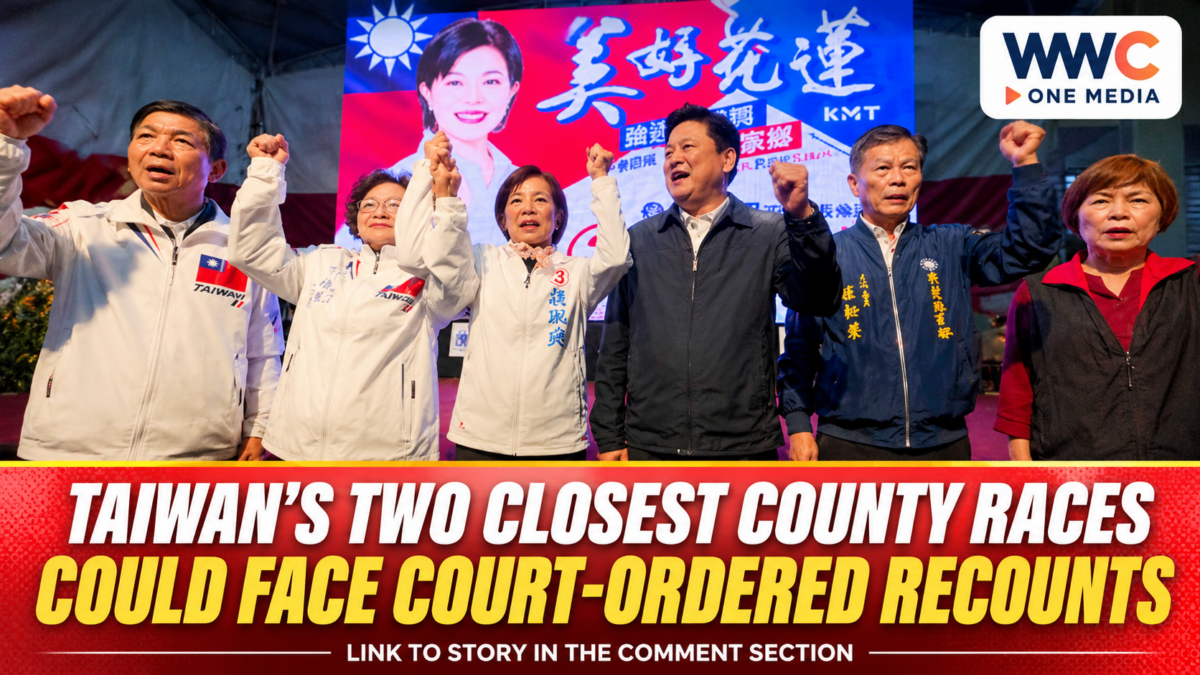
Two of Taiwan’s closest county-chief contests ended with margins of just 357 votes in Hualien and 173 in Yunlin after the Nov. 28 local elections, placing both races within the country’s statutory threshold for a court-supervised ballot recount. The Central Election Commission’s results pages show all polling stations reported in both counties, with Kuomintang candidate Yu Shu-chen leading in Hualien and Democratic Progressive Party candidate Liu Chien-kuo ahead in Yunlin.
The narrow margins have put the legal process for checking ballots in focus. Taiwan’s election law allows the second-place candidate in a county-chief election to petition a competent court for a recount when the difference between the top two candidates is no more than 0.3% of valid votes. Meeting that threshold does not automatically trigger a recount, invalidate a result or establish that ballots were mishandled.
Taiwan election recount rules put both counties within the threshold
The numbers explain why the two contests have attracted attention.
In Hualien, the Central Election Commission’s results page records Yu with 63,013 votes and independent candidate Chang Chun with 62,656. The difference is 357 votes. The same results page lists 41,013 votes for independent candidate Wei Chia-hsien and 620 for Taiwan Labor Party candidate Luo Pei-chin. All 344 polling stations are recorded as having reported.
The four candidates together received 167,302 valid votes. The 357-vote difference represents approximately 0.213% of that total, below the legal limit of 0.3%.
Yunlin’s margin is narrower still. The commission lists DPP candidate Liu Chien-kuo with 178,357 votes and KMT candidate Chang Chia-chun with 178,184. The difference is 173 votes. Independent candidates Wu Ping-hui and Lin Chia-yu received 3,103 and 2,829 votes respectively. All 638 polling stations are recorded as having reported.
The four candidates received 362,473 valid votes in total. Liu’s 173-vote lead represents approximately 0.048% of valid votes.
Both results therefore meet the numerical condition in Article 69 of Taiwan’s Public Officials Election and Recall Act. The calculation uses valid ballots, not the total number of ballots cast or the number of invalid ballots.
What Article 69 actually allows candidates to do
Article 69 sets out a specific legal route for a close county-chief election. When the difference between the first- and second-place candidates is within 0.3% of valid ballots, the candidate in second place may petition the court with jurisdiction within seven days after election day.
The petition is not simply a request for the election commission to recount every ballot. The law provides for the court to order the sealing of voter lists and ballots from all or selected polling stations identified in the application.
The court-supervised recount of sealed polling stations must be completed within 20 days. Its results are then reported to the responsible election commission, which must re-examine the election outcome within seven days after receiving the recount result.
That distinction is important. The law establishes eligibility to apply; it does not say that every close contest must automatically undergo a recount. A candidate must use the legal procedure, identify the polling stations concerned and meet the applicable requirements.
The provision also does not declare the original count unreliable merely because the margin is small. It creates a formal mechanism for checking specified ballots where the statutory conditions are met.
Why the Hualien and Yunlin results remain separate cases
Although both counties fall within the same legal threshold, their election outcomes and candidates are different.
In Hualien, Yu Shu-chen, the KMT candidate, leads Chang Chun, who ran as an independent. The commission’s displayed results mark Yu as elected in the current count. The contest involved four candidates, with the two leading candidates separated by 357 votes.
In Yunlin, Liu Chien-kuo of the DPP leads Chang Chia-chun of the KMT by 173 votes. The commission’s displayed result marks Liu as elected in the current count.
The legal process must be considered separately for each county. A petition in one contest would not automatically affect the other, and a court’s decision would concern the polling stations and ballots covered by that particular application.
For readers following the wider election, WWC has already reported on the KMT’s retention of Taipei’s mayoralty. The two county contests illustrate why the nationwide result should not be understood only through the largest cities: close local races can require additional legal steps after the initial count.
A recount is a verification process, not proof of wrongdoing
A narrow margin can make a small number of ballots consequential, but it does not by itself demonstrate fraud, manipulation or administrative failure.
A recount is designed to verify the ballots covered by the court’s order. It may confirm the original result or produce a different tally. The legal framework allows the election commission to reassess the outcome after the court-supervised process is completed.
The distinction matters for public confidence. Candidates and supporters may question a close result, but the proper test is the evidence examined through the procedures established by law. Claims of misconduct require separate evidence and should not be inferred from a close vote.
Taiwan’s election administration also operates across multiple levels of local government. WWC’s earlier overview of the 2026 local election timetable and the positions at stake explained the scale of the nine-in-one vote. The recount mechanism is one part of the process that follows polling day, alongside the formal review and announcement of elected candidates.
The wider information environment is another issue, but it should not be confused with the ballot-counting question. WWC previously examined concerns about artificial intelligence and election-related information manipulation. Evidence of online manipulation risks does not establish that either Hualien or Yunlin’s vote count was affected.
What happens next
The immediate question is whether the second-place candidates submit court petitions within the statutory period and whether the courts accept applications that meet the legal requirements.
If a court orders a recount, the process will cover the polling stations identified in the application and sealed under the court’s direction. The recount must then follow the time limits set out in Article 69, after which the relevant election commission must review the outcome.
Until such proceedings are confirmed through official records, the published results should be described as the current commission count. The available results pages show Yu leading in Hualien and Liu leading in Yunlin, but they do not establish that a court has ordered either recount.
The final outcome in each county will depend on the applicable legal process and any formal review that follows. For now, the central fact is that both margins are inside Taiwan’s legal threshold for seeking a recount, not that either election has been overturned.
Frequently asked questions
Can Taiwan’s county election results be recounted if the margin is very small?
Yes. Article 69 allows the second-place candidate in a county-chief election to petition the competent court for a recount when the gap is within 0.3% of valid ballots.
How close was the Hualien county election?
The commission’s results page lists Yu Shu-chen with 63,013 votes and Chang Chun with 62,656, a difference of 357 votes.
How close was the Yunlin county election?
Liu Chien-kuo received 178,357 votes and Chang Chia-chun received 178,184, a difference of 173 votes.
Does being within the 0.3% threshold automatically trigger a recount?
No. The second-place candidate must petition the competent court within seven days after election day. The procedure is court-supervised.
Can a recount change the declared election result?
It can lead the election commission to re-examine the result. Under Article 69, if the review shows that a different candidate should have been elected, the previous public notice can be rescinded or a new result announced.