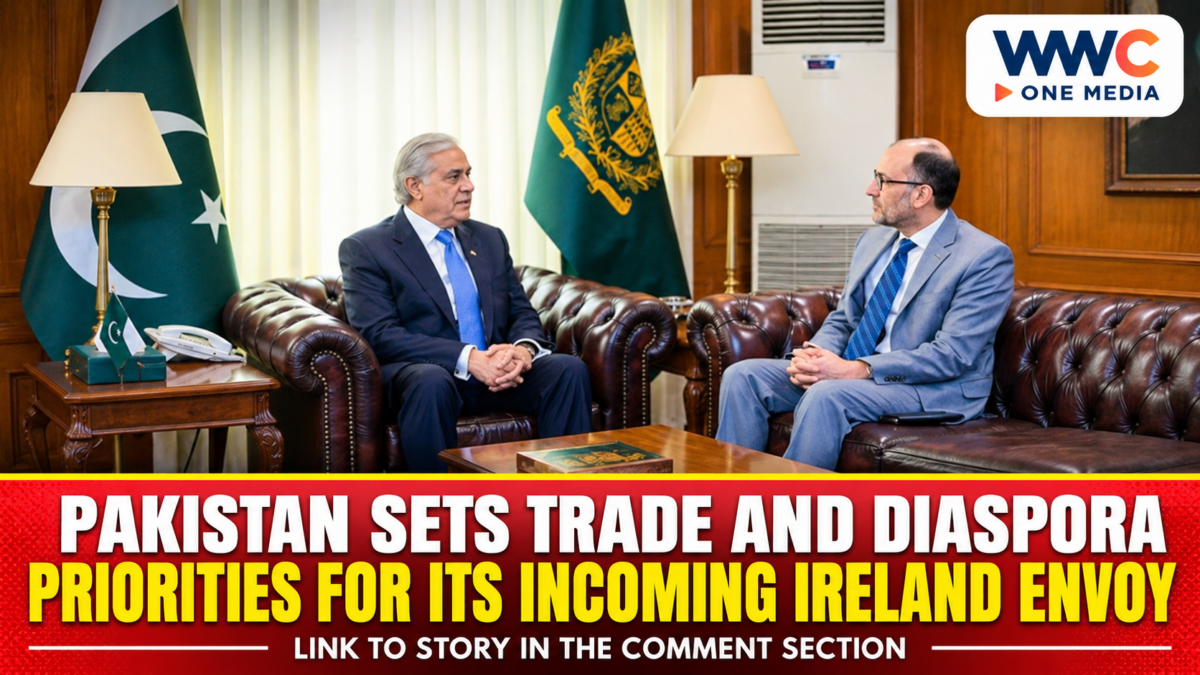
Pakistan has placed trade, investment, education and overseas-community welfare at the centre of the brief for Afaq Ahmed, its ambassador-designate to Ireland, following meetings with the country’s president and deputy prime minister in Islamabad in November. The discussions set out the priorities expected of the incoming envoy, but the public announcements do not record a new bilateral agreement or a specific investment commitment arising from the meetings.
The Pakistan Ireland envoy assignment comes as Islamabad seeks to give its relationship with Dublin a stronger economic and people-to-people dimension. The government’s stated priorities range from business engagement and university cooperation to visa-related concerns affecting Pakistani nationals in Ireland. Whether those objectives translate into measurable outcomes will depend on the work carried out after the diplomatic appointment proceeds through the formal accreditation process.
Economic diplomacy is at the centre of the assignment
President Asif Ali Zardari met Ahmed at Aiwan-e-Sadr on Nov. 19. The government’s published account said the president called for a more active approach to bilateral relations, with particular attention to trade, investment, education and cultural cooperation.
Zardari identified information technology, pharmaceuticals, biotechnology, agriculture and renewable energy as sectors in which Pakistani officials should engage Irish businesses and investors. He also pointed to investment opportunities under Pakistan’s Special Investment Facilitation Council, or SIFC.
The presidential statement described bilateral trade as remaining below its potential. It did not, however, provide a trade value, a growth target or a list of companies expected to invest.
That distinction is important. Identifying sectors for commercial engagement is a policy direction, not evidence that an investment has been secured. Businesses still need to assess market demand, operating costs, regulation, financing and the commercial case for entering either country.
For Ahmed, the practical task will be to turn broad sector priorities into sustained contacts between companies, business organisations and relevant government agencies.
Ishaq Dar adds education and community welfare to the brief
The assignment was discussed again on Nov. 28, when Deputy Prime Minister and Foreign Minister Senator Mohammad Ishaq Dar met Ahmed.
The government’s announcement said Dar emphasised expanding cooperation in trade, investment, education and people-to-people exchanges. He also identified the welfare of the Pakistani community in Ireland as a priority.
Dar acknowledged Ahmed’s service at Pakistan’s Ministry of Foreign Affairs and expressed confidence that his experience would contribute to stronger bilateral relations. The public statement did not provide a detailed account of Ahmed’s previous diplomatic postings or specify a timetable for taking up the Ireland assignment.
The two meetings give the incoming envoy a fairly broad agenda. Trade and investment require business-facing diplomacy, while education and people-to-people exchanges depend on practical cooperation between universities, professional bodies, cultural organisations and other institutions.
Community welfare also involves day-to-day consular work. Issues raised by nationals abroad can include documentation, access to consular assistance and the ability to communicate with their diplomatic mission. Dar’s statement establishes that Pakistan wants this area prioritised, but it does not identify a new service, policy change or dedicated programme announced at the meeting.
A relationship with an established diplomatic foundation
Pakistan and Ireland established diplomatic relations in 1962, according to the Pakistan Embassy in Dublin. Pakistan opened a resident ambassador-level mission in Dublin in February 2001, while Ireland opened its first resident embassy in Islamabad in 2024.
The diplomatic relationship therefore has an established institutional presence in both countries. The next phase is not simply about maintaining official contact; it is about whether the existing channels can support more regular commercial, educational and community engagement.
That work can involve government-to-government consultations, business introductions, university partnerships and consular coordination. Each requires follow-through by institutions beyond the ambassador’s office.
The importance of formal accreditation should also be kept clear. Ireland’s presidency explains that newly appointed ambassadors are officially accredited from the moment the president accepts their Letters of Credence. Its published Jan. 13, 2026 credentials record identifies Mariam Aftab as Pakistan’s ambassador at that ceremony. The material reviewed for this report does not establish that Ahmed has since presented his own credentials or formally begun his assignment in Dublin.
WWC has previously examined the distinction between an ambassador’s appointment and the formal start of diplomatic duties in its report on a Philippine envoy’s presentation of credentials in Pyongyang. The same distinction matters here: an ambassador-designate should not be described as an accredited ambassador until the receiving state completes the relevant protocol.
The commercial opportunity needs measurable follow-through
Pakistan’s stated interest in Irish investment spans several sectors, but the government’s announcements do not identify a specific transaction, project location, financing package or participating Irish company.
That leaves room for diplomatic engagement, but it also creates a clear test for the assignment. Progress will be easier to assess if future announcements identify concrete business missions, signed cooperation documents, university partnerships or investment proposals with named participants and defined next steps.
For companies, broad statements of interest are only an opening. An Irish investor considering Pakistan would need reliable information about regulations, market access, infrastructure, business partners and the operating environment. Pakistani exporters seeking Irish customers would similarly need to meet buyer requirements, demonstrate product quality and establish dependable distribution arrangements.
The same principle applies to education. A call for scholarships and university partnerships becomes meaningful when institutions identify programmes, funding, eligibility rules and timelines.
Pakistan’s wider diplomatic agenda has also emphasised the link between political engagement and economic cooperation, as explored in WWC’s coverage of the country’s regional diplomacy and trade agenda. But an international policy message does not replace the country-specific work required to build a durable Pakistan-Ireland commercial relationship.
What happens next
The next developments to watch are formal confirmation of Ahmed’s accreditation and any public announcements detailing his programme in Ireland.
Further evidence of progress could include meetings with Irish government departments, business groups, universities and representatives of the Pakistani community. Any new trade initiative, investment commitment or education arrangement should be assessed against the official document announcing it, including its participants, scope and implementation schedule.
For now, the public record establishes the priorities set out by Pakistan’s president and foreign minister: stronger trade and investment links, education and cultural cooperation, and attention to the welfare of Pakistani nationals in Ireland. It does not yet establish a new bilateral deal or a completed diplomatic handover.
The assignment’s success will ultimately be measured not by the number of courtesy calls, but by whether those priorities lead to practical and documented cooperation.
Frequently asked questions
Who is Pakistan’s ambassador-designate to Ireland?
Afaq Ahmed was identified as Pakistan’s ambassador-designate to Ireland in official Pakistani government announcements dated Nov. 19 and Nov. 28, 2026.
What priorities did Pakistan set for its incoming envoy?
The stated priorities include trade, investment, education, cultural cooperation, people-to-people exchanges and the welfare of the Pakistani community in Ireland.
Which sectors did President Zardari identify for investment engagement?
The presidential statement named information technology, pharmaceuticals, biotechnology, agriculture and renewable energy.
Has Afaq Ahmed formally taken up the ambassador’s post in Ireland?
The government announcements reviewed identify him as ambassador-designate. The records reviewed for this article do not confirm that he has presented Letters of Credence to Ireland’s president.
Did Pakistan and Ireland announce a new investment agreement?
No specific investment agreement, project value or participating Irish company was identified in the public announcements about the November meetings.