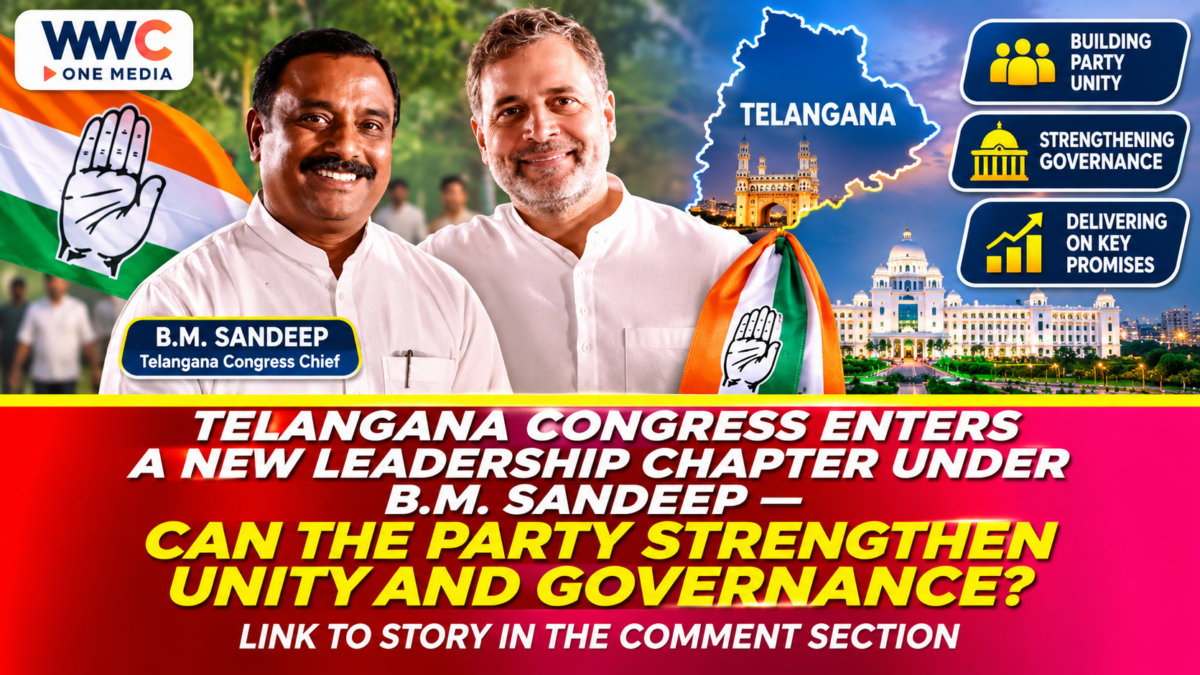
HYDERABAD, INDIA — The Indian National Congress has entered a new phase of organisational leadership in Telangana following the appointment of B.M. Sandeep Kumar as the All India Congress Committee’s in-charge for the southern Indian state.
Announced on Nov. 14, 2026, the Telangana Congress leadership appointment places Sandeep in an important organisational position as the party continues governing the state under Chief Minister A. Revanth Reddy.
The leadership transition brings renewed attention to the relationship between the Congress national leadership, its state organisation and elected representatives.
For the governing party, the broader challenge is maintaining organisational coordination while addressing the responsibilities of public administration and delivering its development commitments.
Telangana Congress Leadership Enters a New Chapter
B.M. Sandeep Kumar’s appointment establishes a new point of coordination between the national Congress organisation and its Telangana unit.
The party’s official leadership directory identifies Sandeep as its Telangana in-charge, while B. Mahesh Kumar Goud continues serving as president of the Telangana Pradesh Congress Committee, commonly known as TPCC.
These positions are separate from the office of chief minister, which remains held by Revanth Reddy.
The distinction is important because changes within a political party’s organisational structure do not automatically result in changes to the composition of the state government.
An AICC appointment does not, by itself, constitute a cabinet reshuffle or the replacement of a chief minister.
Similar distinctions between political organisation and government leadership are explored in WWC ONE MEDIA’s coverage of the Bharatiya Janata Party’s unresolved leadership question in Uttar Pradesh.
Although the two states involve different political circumstances, both demonstrate why internal party appointments must be distinguished from formal government decisions.
Congress Already Has an Established Framework for Political Coordination
Sandeep’s appointment follows earlier efforts by the Congress national leadership to strengthen its organisational structure in Telangana.
On May 29, 2025, Congress president Mallikarjun Kharge approved the establishment of several committees within the Telangana Pradesh Congress Committee.
These included the Political Affairs Committee, Advisory Committee, Delimitation Committee, Samvidhan Bachao Program Committee and Disciplinary Action Committee.
The committees provide organisational mechanisms through which the party can address political planning, institutional responsibilities and internal disciplinary matters.
Their establishment predates Sandeep’s latest appointment.
Consequently, the leadership transition takes place within an existing organisational framework rather than creating an entirely new party structure.
The effectiveness of that framework will depend on how party officials coordinate their responsibilities and address disagreements through established procedures.
An internal consultation, however, should not automatically be interpreted as evidence of a leadership crisis or impending disciplinary action.
Such conclusions require independently documented decisions or authenticated statements.
District-Level Organisation Remains an Important Priority
The Congress party has also undertaken organisational development through its district-level leadership structure.
On Nov. 22, 2025, Kharge approved appointments of District Congress Committee presidents across Telangana.
District-level organisations provide an additional connection between state party officials and local political representatives.
For a governing political party, communication across these organisational levels can help identify local concerns and develop policy priorities.
However, internal party discussions should remain distinct from formal decisions involving public expenditure, infrastructure approvals and government appointments.
The latter must follow applicable administrative and legal procedures.
Questions surrounding the relationship between elected representatives and government institutions have also featured in WWC ONE MEDIA’s coverage of reported protocol complaints involving Telangana’s Bharat Rashtra Samithi legislators.
That separate controversy highlights the importance of distinguishing political disagreements from independently established violations of administrative rules.
Revanth Reddy’s Government Faces Its Own Development Priorities
While the Congress reorganises its political leadership, Telangana’s state government continues pursuing its public administration and development responsibilities.
During a recent public programme at Achampet in Nagarkurnool district, Chief Minister Revanth Reddy announced plans to fill another 25,000 government jobs within the following year.
The announcement outlined a target of bringing total government recruitment under his administration to 100,000 appointments.
Reddy also laid foundation stones for development projects valued at ₹450 crore, equivalent to ₹4.5 billion.
These announcements provide measurable policy commitments against which future government performance can be assessed.
However, announced recruitment targets should not be confused with completed appointments, just as foundation-stone ceremonies do not establish that infrastructure projects have already been completed.
The government must also address more complex development challenges, including the management of shared water resources.
WWC ONE MEDIA previously examined these issues in its coverage of Telangana’s Krishna River water allocation dispute with Andhra Pradesh.
The state’s development agenda illustrates why political organisation and administrative implementation must be evaluated separately.
Why Political Accountability Extends Beyond Party Leadership
Internal political coordination can help a governing party organise its priorities, but it cannot substitute for constitutional accountability.
Government decisions must be evaluated against applicable laws, official administrative records and the actual implementation of public programmes.
Political parties may disagree over resource allocation, electoral strategy and policy priorities without those disagreements necessarily establishing misconduct.
The importance of maintaining this distinction is also examined in WWC ONE MEDIA’s coverage of India’s Constitution Day political debate and the responsibilities of democratic institutions.
For international observers across the Asia-Pacific, developments in Telangana provide another opportunity to examine how political parties operate within India’s system of state-level government.
The stability of administrative processes, transparency of public decisions and implementation of development commitments remain important considerations for citizens and businesses.
Political leadership changes may influence these priorities, but their actual consequences must be assessed through subsequent official decisions.
What Happens Next for Telangana Congress?
The next meaningful developments will come from formal party resolutions, authenticated leadership statements and documented government decisions.
Sandeep’s appointment provides the Congress with a new organisational leadership arrangement in Telangana.
Whether that arrangement results in stronger internal coordination, changes to party strategy or additional organisational appointments remains to be established.
For the Revanth Reddy administration, employment commitments, infrastructure projects and public welfare programmes provide separate measures of government performance.
The broader political question is whether the Congress can maintain effective coordination between its national leadership, state organisation and elected representatives while fulfilling its responsibilities in government.
The appointment of a new AICC in-charge establishes the beginning of another organisational chapter. Its significance will ultimately depend on the decisions and measurable outcomes that follow.
Frequently Asked Questions
Who is the new AICC in-charge for Telangana?
B.M. Sandeep Kumar is the All India Congress Committee’s in-charge for Telangana. His appointment was announced on Nov. 14, 2026.
Who is the Telangana Congress president?
B. Mahesh Kumar Goud serves as president of the Telangana Pradesh Congress Committee.
Who is the current chief minister of Telangana?
A. Revanth Reddy serves as the chief minister of Telangana.
Does Sandeep’s appointment mean Telangana will have a new chief minister?
No. The AICC appointment concerns the Congress party’s organisational leadership and does not automatically change the leadership of the state government.
What are Telangana’s latest government employment commitments?
Chief Minister Revanth Reddy announced plans to fill another 25,000 government jobs within the following year. This represents an announced target rather than completed recruitment.