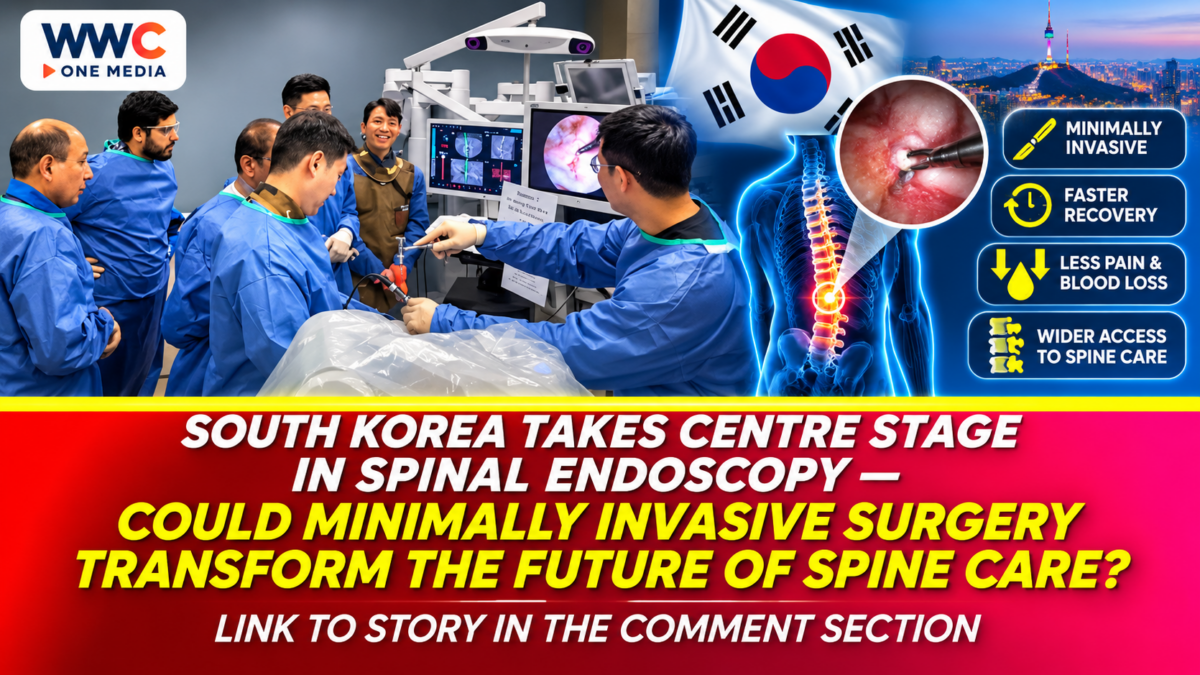
INCHEON, SOUTH KOREA — South Korea is bringing international spine specialists together for the inaugural World Spinoscopy Congress (WSC 2026), strengthening its position in minimally invasive spinal surgery research, medical education and healthcare technology development.
Running from Nov. 27 to 29, 2026, the congress coincides with the 25th International Symposium of the Korean Minimally Invasive Spine Surgery Society (KOMISS), with approximately 700 domestic and international specialists expected to participate.
The South Korea spinal endoscopy initiative also provides an opportunity for Korean medical equipment manufacturers to introduce their technologies to international healthcare professionals.
Beyond the scientific presentations and surgical demonstrations, the gathering raises an important medical question: can minimally invasive procedures deliver meaningful improvements in patient care without compromising safety?
South Korea Spinal Endoscopy Gains International Attention
The inaugural World Spinoscopy Congress represents a major international collaboration dedicated to advancing endoscopic spinal surgery.
Scientific sessions are being held at Songdo ConvensiA in Incheon, while additional practical training activities are scheduled in Seoul.
Jin-Sung Kim serves as the inaugural president of the World Spinoscopy Congress, while Hyeun-Sung Kim is the 19th president of KOMISS.
The congress provides a platform for surgeons and researchers to discuss clinical techniques, emerging technologies and opportunities for international cooperation.
Its programme includes contributions from specialists representing South Korea, China, Thailand, Brazil and other countries.
International medical conferences provide opportunities to exchange clinical knowledge across different healthcare systems, as also demonstrated in WWC ONE MEDIA’s coverage of Asian Pacific Digestive Week 2026 and its international specialist education programme.
Although digestive endoscopy and spinal endoscopy involve different medical disciplines, both illustrate the importance of specialist training when introducing advanced medical procedures.
What Makes Endoscopic Spine Surgery Different?
Endoscopic spinal surgery uses specialised cameras and surgical instruments inserted through small openings, allowing surgeons to examine and treat selected spinal conditions without the larger surgical exposure associated with conventional open procedures.
Two approaches receiving considerable attention are uniportal and biportal endoscopy.
Uniportal endoscopy uses a single access channel for visualisation and surgical instruments.
Biportal endoscopy uses two openings, allowing separate access for the camera and surgical equipment.
South Korean spine specialists have contributed extensively to the development and clinical investigation of biportal techniques.
These approaches have been applied to selected patients with lumbar disc herniation and spinal stenosis, a condition involving narrowing of spaces through which spinal nerves pass.
However, the size of a surgical incision is not the only consideration when selecting a treatment.
The patient’s diagnosis, anatomical characteristics, medical history and the surgeon’s experience remain important factors.
Minimally invasive techniques should not automatically be regarded as superior to every conventional surgical approach.
Korean Clinical Trial Reveals an Important Finding
A multicentre randomised clinical trial published in February 2026 examined whether biportal endoscopic surgery produces equivalent functional outcomes to microscopic surgery for patients with lumbar spinal stenosis.
The investigation involved 120 patients across six South Korean medical centres.
Researchers randomly assigned 60 patients to biportal endoscopic laminectomy and 60 to microscopic laminectomy.
At the 12-month assessment, the researchers analysed outcomes from 54 patients in the endoscopic group and 52 in the microscopic group.
The study found equivalent functional outcomes between the two surgical approaches.
However, its authors cautioned that the observed differences did not demonstrate clinically meaningful advantages that patients would necessarily experience.
They recommended against widespread adoption until stronger evidence establishes important additional benefits for patients.
The findings illustrate why technological innovation must be evaluated through clinical outcomes rather than the novelty of surgical equipment alone.
Similar considerations surrounding appropriate patient selection and specialised medical technology are examined in WWC ONE MEDIA’s coverage of cross-border access to proton therapy and its potential benefits for selected cancer patients.
The two technologies address different medical conditions, but both require careful evaluation of their clinical suitability.
South Korean Medical Equipment Manufacturers Eye International Growth
The congress also carries commercial significance for South Korea’s medical technology industry.
The Ministry of Health and Welfare and the Korea Health Industry Development Institute are supporting educational programmes designed to increase international familiarity with Korean-manufactured medical devices.
The initiative involves cooperation with regional medical equipment training centres supported by Incheon Technopark and the Seongnam Industry Promotion Agency.
Equipment featured in the programme includes surgical monitors, lighting systems, electrosurgical instruments and spinal implants.
The Nov. 27 programme included a scheduled demonstration of uniportal endoscopic surgery using a human anatomical model.
On Nov. 28, international healthcare professionals are scheduled to receive practical training involving Korean spinal endoscopy equipment and surgical simulators.
These activities are intended to help international specialists evaluate equipment performance and its potential application within their healthcare institutions.
However, participation in a demonstration does not establish that a hospital has purchased the equipment or that a manufacturer has secured an overseas sales contract.
Commercial adoption will depend on regulatory requirements, clinical evidence, procurement decisions and healthcare budgets.
Artificial Intelligence and Robotics Enter the Spine Surgery Discussion
The scientific agenda extends beyond established endoscopic techniques.
The Nov. 28 programme includes discussions involving artificial intelligence, robotics, minimally invasive lumbar fusion and surgical approaches to cervical spine conditions.
Research presentations are also scheduled to explore selected applications of endoscopic techniques in spinal tumour treatment.
These subjects reflect the expanding scope of research into computer-assisted and minimally invasive surgery.
Nevertheless, inclusion in a scientific conference does not establish that an emerging procedure has become an approved or universally accepted standard of treatment.
New surgical applications require appropriate clinical evaluation, specialist education and safety monitoring.
For healthcare institutions, investment in medical technology must be accompanied by investment in the professionals responsible for using it.
The importance of developing specialist medical expertise is also highlighted in WWC ONE MEDIA’s coverage of the World Gastroenterology Organisation’s regional specialist training initiative.
Building healthcare capacity requires both access to suitable equipment and the clinical expertise necessary to use it responsibly.
What Happens Next for Endoscopic Spine Surgery?
The congress is scheduled to continue on Nov. 29 with practical surgical education at the Catholic International Surgical Skill Institute in Seoul.
The final day’s programme includes supervised training using donated human bodies, allowing participating specialists to develop and refine their technical skills in an educational environment.
The scientific programme also lists a closing and handover ceremony involving Taiwan, indicating plans for continued international collaboration.
For healthcare systems across the Asia-Pacific, the development of endoscopic spinal surgery presents opportunities for medical research, professional education and technology partnerships.
However, the long-term success of these procedures will depend on reliable evidence concerning patient outcomes, complication rates, recovery and treatment costs.
South Korea is establishing itself as an important contributor to international spinal endoscopy development.
The next challenge is demonstrating which patients benefit most from these techniques and ensuring that technological progress translates into measurable improvements in healthcare.
Frequently Asked Questions
What is the World Spinoscopy Congress 2026?
It is an inaugural international scientific gathering dedicated to endoscopic spinal surgery, taking place in South Korea from Nov. 27 to 29, 2026.
What is endoscopic spine surgery?
It is a minimally invasive surgical approach that uses specialised cameras and instruments to treat selected spinal conditions through small openings.
What is the difference between uniportal and biportal spine surgery?
Uniportal surgery uses one access channel, while biportal surgery uses two separate openings for visualisation and surgical instruments.
Is endoscopic spine surgery better than conventional surgery?
Not necessarily. A South Korean randomised clinical trial published in 2026 found equivalent functional outcomes between biportal endoscopic and microscopic surgery for lumbar spinal stenosis at 12 months.
Why is South Korea investing in spinal endoscopy?
South Korean institutions are supporting clinical research, specialist education, international medical cooperation and greater international exposure for domestically manufactured surgical technologies.
Individual treatment decisions should be made in consultation with qualified medical specialists.