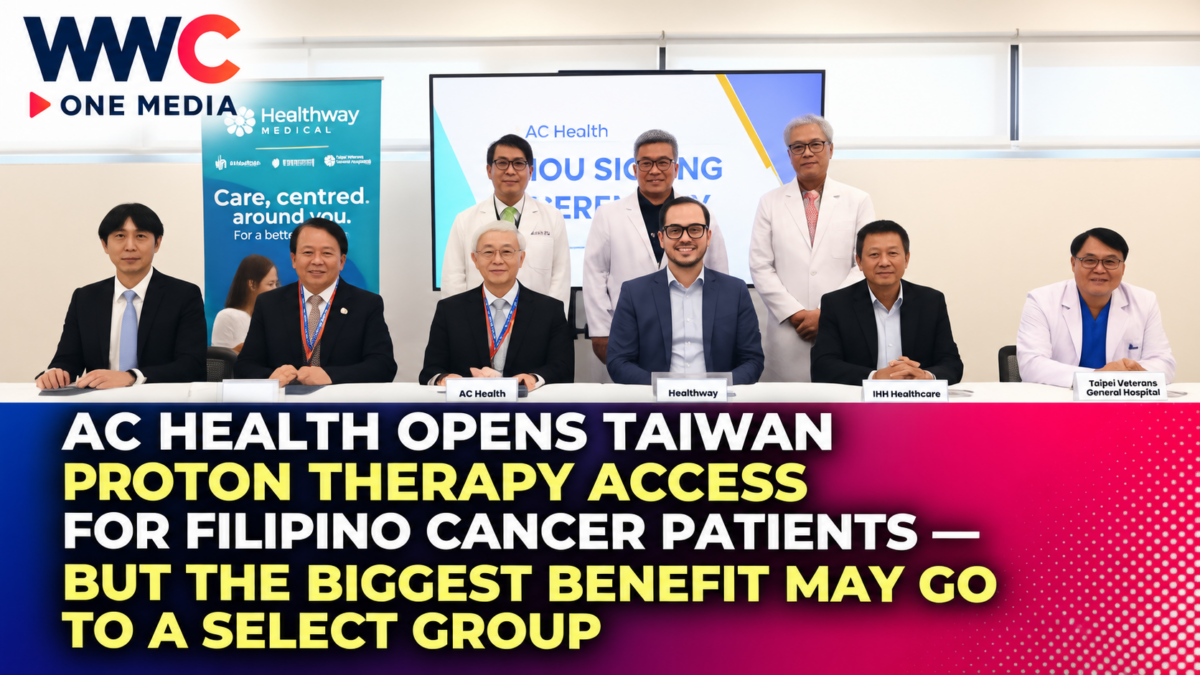
MANILA — Filipino cancer patients who need highly specialized radiation treatment now have a cross-border pathway to one of Taiwan’s leading proton therapy centers through AC Health’s partnership with Chang Gung Memorial Hospital, expanding treatment options for cases where protecting nearby healthy organs is especially important.
Under the partnership, eligible patients of Healthway Cancer Care Hospital, or HCCH, can be referred to Chang Gung Memorial Hospital in Taiwan for proton beam therapy, an advanced form of radiation treatment designed to concentrate radiation more precisely on tumors while reducing exposure to surrounding healthy tissue.
The collaboration also goes beyond sending patients overseas.
Doctors from the two institutions can hold virtual case conferences and multidisciplinary tumor boards, while HCCH physicians can undergo clinical rotations and observerships at Chang Gung, particularly in radiation oncology and proton therapy. The hospitals also plan to share de-identified patient outcomes for clinical review and research.
For Filipino patients, that creates a more structured route into a treatment that remains difficult to access locally.
But proton therapy is not automatically better for every cancer.
Its biggest advantage is often seen when doctors need to minimize radiation to critical organs or reduce long-term radiation exposure—particularly in children and in tumors near the brain, spinal cord, heart, lungs or other sensitive structures.
The Partnership Is Not New — But the Access It Creates Still Matters
The timing of the story requires clarification.
AC Health and Chang Gung Memorial Hospital signed their memorandum of understanding on September 17, 2025 at Healthway Cancer Care Hospital in Taguig.
AC Health publicly announced the partnership in early October 2025.
Bilyonaryo published a fresh article on October 3, 2026 highlighting the same cross-border referral arrangement.
So this is not a newly signed 2026 partnership.
It is an existing collaboration that continues to give selected Filipino cancer patients access to proton therapy in Taiwan.
That distinction matters because it changes the story from “new deal signed” to something potentially more useful for patients:
a treatment pathway that is already established.
What Exactly Is Proton Therapy?
Most traditional external-beam radiation therapy uses photons, or high-energy X-rays.
Those beams enter the body, deliver radiation to the tumor and continue through tissue beyond it.
Proton therapy behaves differently.
Protons can be programmed to release most of their radiation energy at a specific depth and then stop, reducing the so-called exit dose beyond the tumor.
That means doctors may be able to give an effective radiation dose to the cancer while exposing less healthy tissue nearby.
The principle is particularly useful when the tumor is close to structures where radiation damage could have serious consequences.
The Brain, Heart and Spinal Cord Are Key Examples
AC Health specifically highlighted tumors near the:
brain,
heart,
lungs,
and spinal cord
as situations where the added precision of proton therapy may be valuable.
The American Cancer Society similarly lists certain:
brain tumors,
head and neck cancers,
lung cancers,
spinal tumors,
eye cancers,
liver cancers,
and childhood cancers
among the diseases where proton therapy may sometimes be considered.
The word sometimes is important.
Cancer treatment depends on tumor type, stage, location, prior therapy and the individual patient.
Proton therapy is one tool—not a universal replacement for ordinary radiation.
Children May Have One of the Strongest Cases for Proton Therapy
Pediatric cancer is one of the areas where specialists are particularly interested in reducing unnecessary radiation exposure.
Children have many decades of life ahead after successful treatment.
Radiation reaching healthy tissue can contribute to long-term complications involving:
growth,
development,
hormones,
cognition,
organ function,
and potentially second cancers later in life.
The National Cancer Institute is actively studying whether proton therapy reduces later secondary-cancer risks in childhood cancer survivors compared with photon radiation.
Taiwan itself expanded national insurance coverage for proton therapy for eligible pediatric cancer patients starting in January 2026, citing its potential to reduce side effects and secondary-cancer risk.
That makes pediatric oncology one of the most important areas to watch as proton therapy becomes more widely available.
But Proton Therapy Is Not Proven Superior for Every Cancer
This is one of the most important cautions.
Protons can reduce radiation exposure to normal tissue.
That does not automatically mean patients live longer or have better cancer control for every tumor type.
The American Cancer Society noted in September 2026 that for several common cancers, including some prostate and breast cancers, modern photon therapy can produce outcomes comparable to proton therapy.
For prostate cancer, for example, early results from a large study involving more than 2,500 patients found both proton and photon radiation controlled disease effectively, with similar short-term side effects.
That is why treatment selection needs to be individualized.
A patient should not assume “newer technology” automatically means “better treatment.”
Modern X-Ray Radiation Has Also Become Much More Precise
Proton therapy is frequently compared with older forms of radiation.
But conventional radiation technology has improved enormously.
Modern photon treatment can use techniques such as:
intensity-modulated radiation therapy,
image guidance,
stereotactic radiation,
and sophisticated computer planning.
Those advances have narrowed the difference between photons and protons in some cancers.
So the clinical question is increasingly sophisticated.
It is not:
Are protons better than X-rays?
It is:
For this exact patient and this exact tumor, will proton therapy meaningfully reduce radiation exposure or complications compared with the best modern photon plan?
That is a much higher standard.
This Is Where Joint Tumor Boards Could Matter
One of the strongest parts of the AC Health-CGMH partnership may therefore be the medical review process rather than the technology itself.
HCCH and Chang Gung plan to hold virtual case conferences and multidisciplinary tumor boards for complex cases.
That means oncologists can examine whether a patient genuinely stands to benefit from traveling abroad for proton therapy.
A good referral system should do both things:
identify patients who are likely to benefit,
and avoid sending patients for expensive treatment when modern local therapy is equally appropriate.
That clinical filtering may be just as important as access itself.
Chang Gung Has Been Using Proton Therapy for Years
Chang Gung Memorial Hospital operates one of Taiwan’s largest healthcare systems.
Its Linkou facility opened Taiwan’s first proton therapy center in November 2015, and AC Health describes it as one of Asia’s largest.
A second Chang Gung proton center opened in Kaohsiung in October 2018.
The Kaohsiung center uses pencil-beam scanning proton technology and image-guided positioning to treat both Taiwanese and overseas patients.
That means Filipino patients referred through Healthway are not being sent into an experimental program.
They are being referred into an established clinical service.
Taiwan Is Becoming a Regional Proton Therapy Hub
Chang Gung is not Taiwan’s only proton provider.
Taipei Medical University Hospital also operates a proton center using superconducting cyclotron technology and expects to treat hundreds of patients annually.
China Medical University Hospital opened another proton center in 2024.
Taiwanese hospitals are increasingly promoting proton therapy to international patients and building clinical experience across cancers of the:
brain,
head and neck,
breast,
lung,
liver,
prostate,
and pediatric nervous system.
That regional concentration helps explain why Taiwan can be attractive for Filipino referrals.
It is geographically much closer than the United States or Europe.
The Philippines Still Has a Major Access Problem
The broader issue is that advanced cancer technologies are not evenly available across Southeast Asia.
Proton therapy requires enormous infrastructure.
Hospitals need:
particle accelerators,
radiation shielding,
specialized treatment rooms,
medical physicists,
radiation oncologists,
engineers,
and sophisticated imaging systems.
These facilities are expensive to build and operate.
The National Cancer Institute notes that the high cost and physical size of proton systems remain major reasons access is limited worldwide.
That is why cross-border referral programs can matter.
Instead of waiting years for every country to build its own center, selected patients can access existing regional facilities.
Cost Could Still Be the Biggest Barrier
Technology access is only one part of the problem.
Patients referred from the Philippines may still need to consider:
treatment costs,
airfare,
accommodation,
medical documents,
visa requirements,
insurance,
and time away from work.
Proton therapy can cost substantially more than standard radiation therapy because the machines and facilities are extremely expensive.
The American Cancer Society says cost and insurance denials remain among the biggest barriers to proton therapy in countries where it is available.
The AC Health announcement says care coordinators from both hospitals will help patients manage logistics and requirements.
But no public announcement reviewed for this story guarantees that treatment, travel or accommodation expenses will be fully covered.
That will likely remain a major consideration for Filipino families.
A Referral Does Not Mean Automatic Eligibility
Another important point:
not every HCCH cancer patient will be sent to Taiwan.
The agreement covers eligible patients selected under agreed protocols.
That presumably means radiation oncologists will evaluate factors such as:
tumor location,
cancer type,
previous radiation exposure,
expected benefit,
and treatment alternatives.
That is consistent with international medical guidance.
Proton therapy should generally be used when its dose-distribution advantage is expected to meaningfully matter for the patient.
The Partnership Also Trains Filipino Doctors
The referral program is only one part of the agreement.
HCCH physicians are also expected to undertake clinical rotations and observerships at Chang Gung, with particular emphasis on radiation oncology and proton therapy.
That could have a longer-term impact.
Even if most Filipino patients never travel to Taiwan, local doctors could gain deeper experience in:
patient selection,
radiation planning,
treatment outcomes,
and proton-specific clinical decision-making.
Those skills can improve cancer care back in the Philippines.
Knowledge Transfer May Be More Valuable Than Patient Referrals Alone
Sending individual patients overseas helps those patients.
Training doctors can potentially help thousands.
That is why the physician-exchange component deserves attention.
A radiation oncologist who learns how specialists at a high-volume proton center select and plan difficult cases can bring that expertise home.
The experience may also help Philippine hospitals determine which patients genuinely require overseas referral and which can receive equally appropriate care locally.
That prevents expensive technology from becoming simply another status symbol in cancer treatment.
The Two Hospitals Will Also Share Outcomes
HCCH and Chang Gung plan to share de-identified clinical outcomes for referred patients.
That is important because medicine needs outcome data.
It is not enough to know that a treatment is technologically impressive.
Hospitals need to track:
tumor control,
side effects,
complications,
quality of life,
and long-term survival.
Those results can help improve patient-selection protocols over time.
They could also contribute to future joint research.
Proton Therapy’s Biggest Promise May Be Reducing Collateral Damage
Cancer treatment often involves a difficult balance.
Doctors need enough radiation to destroy malignant cells.
But the tumor may sit beside healthy tissue the patient needs for the rest of their life.
The physical properties of protons can help shift that balance.
By reducing unnecessary radiation beyond the tumor, proton therapy may lower exposure to surrounding tissues.
That advantage becomes particularly meaningful when the nearby tissue is:
the brain,
heart,
eye,
spinal cord,
or developing organs in children.
This is where the technology’s value proposition is strongest.
But Lower Radiation Exposure Is Not the Same as a Guaranteed Cure
That distinction must remain clear.
Proton therapy is still radiation therapy.
It does not work for every tumor.
It does not guarantee remission.
And it does not automatically outperform:
surgery,
chemotherapy,
immunotherapy,
targeted therapy,
or modern photon radiation.
Cancer care is usually multidisciplinary.
Radiation may be only one component.
That is why specialists—not marketing claims—should determine treatment.
Healthway Cancer Care Hospital Is Building an International Network
The Chang Gung partnership is part of a broader AC Health strategy.
HCCH already collaborates with major cancer institutions including City of Hope in the United States and National Cancer Centre Singapore.
Those relationships can allow Philippine teams to tap outside expertise for complex cases and adopt treatment protocols from larger cancer centers.
The hospital itself is described by AC Health as the Philippines’ first dedicated cancer care hospital.
That makes international knowledge-sharing particularly important as it builds its own clinical capabilities.
AC Health Is Also Expanding Clinical Research
The proton-referral pathway fits into a larger effort by AC Health to broaden access to advanced medicine.
In August 2026, AC Health signed another partnership with AstraZeneca aimed at strengthening clinical-trial capabilities across Healthway Medical Network facilities.
That initiative includes training investigators, improving research infrastructure and connecting eligible patients with clinical studies in areas including oncology.
Taken together, the strategy is becoming clear:
AC Health is trying to make the Philippines more connected to international cancer research and treatment rather than operating as an isolated healthcare market.
Cross-Border Cancer Care Is Growing Across Asia
Asia is becoming increasingly interconnected in specialized medicine.
Patients often travel internationally for:
cancer treatment,
robotic surgery,
transplant care,
fertility treatment,
cardiac procedures,
and advanced radiation.
Countries such as:
Singapore,
Taiwan,
Japan,
South Korea,
and Thailand
have invested heavily in international medical services.
For Filipino patients, regional referral networks can make advanced care more accessible than travelling to North America or Europe.
But the economics of medical travel remain a serious limitation.
Taiwan May Have a Cost Advantage
Taiwan frequently promotes international treatment partly on the basis of lower costs than comparable treatment in some Western countries.
For example, Taichung Veterans General Hospital has explicitly promoted proton therapy to overseas patients, pointing to Taiwan’s quality of care and relatively lower medical costs.
Whether an individual Filipino patient saves money will depend on:
the treatment plan,
number of sessions,
hospital fees,
travel,
lodging,
and insurance.
There is no single universal proton therapy price.
Patients would need a formal assessment and financial estimate before deciding.
There Is Also a Long-Term Question for the Philippines
Cross-border referral is useful.
But it raises a bigger strategic issue:
Should the Philippines eventually build its own proton therapy capacity?
A proton center requires enormous capital and a sufficiently large patient base to justify the investment.
Building one too early could create an extremely expensive facility with insufficient volume.
Waiting too long means patients continue travelling abroad.
That is a healthcare-planning decision, not simply a technology race.
The referral arrangement with Chang Gung can provide valuable real-world data on how many Filipino patients actually need proton therapy.
That information could eventually help answer whether domestic capacity makes sense.
The Number of Appropriate Patients Matters More Than Prestige
There is sometimes a temptation in healthcare to equate advanced technology with better medicine.
That can be dangerous.
A proton center is impressive.
But if only a limited number of patients have cancers where it materially improves the treatment plan, building one may not be the best use of limited healthcare resources.
The Philippines also needs investment in:
early cancer detection,
pathology,
ordinary radiotherapy,
surgery,
chemotherapy access,
medicines,
and provincial cancer services.
Those interventions may benefit vastly more people.
So policymakers have to balance cutting-edge technology with broad public-health needs.
Access to Standard Cancer Care Remains the Bigger National Challenge
For many Filipinos, the problem is not choosing between photon and proton radiation.
It is getting diagnosed early enough.
Affording treatment.
Reaching a cancer center.
Completing chemotherapy or radiation.
Accessing medicines.
And avoiding delays caused by financial hardship.
The Chang Gung partnership helps a specific group of patients with complex treatment needs.
It does not solve the broader cancer-care gap.
That should remain part of the context whenever advanced treatments are promoted.
Still, the Partnership Can Fill a Real Clinical Gap
That does not diminish its importance.
For the right patient, reducing radiation to the heart, brain or spinal cord can be clinically meaningful.
For a child expected to live for decades after treatment, limiting exposure to healthy tissue can be especially important.
For someone who has already received radiation and needs treatment again near the same area, the precision of proton therapy may sometimes create options that are harder with photons.
Those are real medical advantages.
And until equivalent capability is broadly available in the Philippines, a structured regional referral pathway can bridge the gap.
The Bigger Story Is Not Simply ‘Filipinos Can Get Proton Therapy’
Filipinos could already travel internationally and independently seek proton treatment.
What this partnership changes is the process.
Instead of a family searching overseas hospitals on its own, HCCH can coordinate directly with Chang Gung.
Doctors can discuss the case.
The hospitals can agree on whether the patient is suitable.
Care coordinators can assist with logistics.
Filipino doctors can remain connected to the treatment plan.
And outcomes can be reviewed afterward.
That turns medical tourism into something closer to integrated cross-border cancer care.
That May Be the Partnership’s Most Important Contribution
The headline technology is proton therapy.
But the deeper value may be continuity.
A cancer patient does not need only a machine.
They need:
diagnosis,
planning,
treatment,
follow-up,
side-effect management,
and long-term surveillance.
A formal hospital-to-hospital pathway has a better chance of maintaining that continuity than a patient arranging treatment overseas independently.
That is why the AC Health-CGMH relationship could matter even if relatively few patients ultimately require protons.
The Next Test Is Whether Filipino Patients Can Truly Access It
The referral mechanism exists.
The technology exists.
The medical expertise exists.
The remaining questions are practical.
How many Filipino patients will qualify?
What will treatment cost?
How much support will insurance or government programs provide?
How quickly can patients travel?
And will the pathway meaningfully reduce delays for complex cancer cases?
Those answers will determine whether proton therapy becomes an accessible option or remains available mainly to families capable of paying for overseas care.
That is the bigger story behind the partnership.
AC Health has created a bridge to one of Asia’s most advanced proton therapy networks.
Now the challenge is making sure the Filipinos who medically need that bridge can actually cross it.