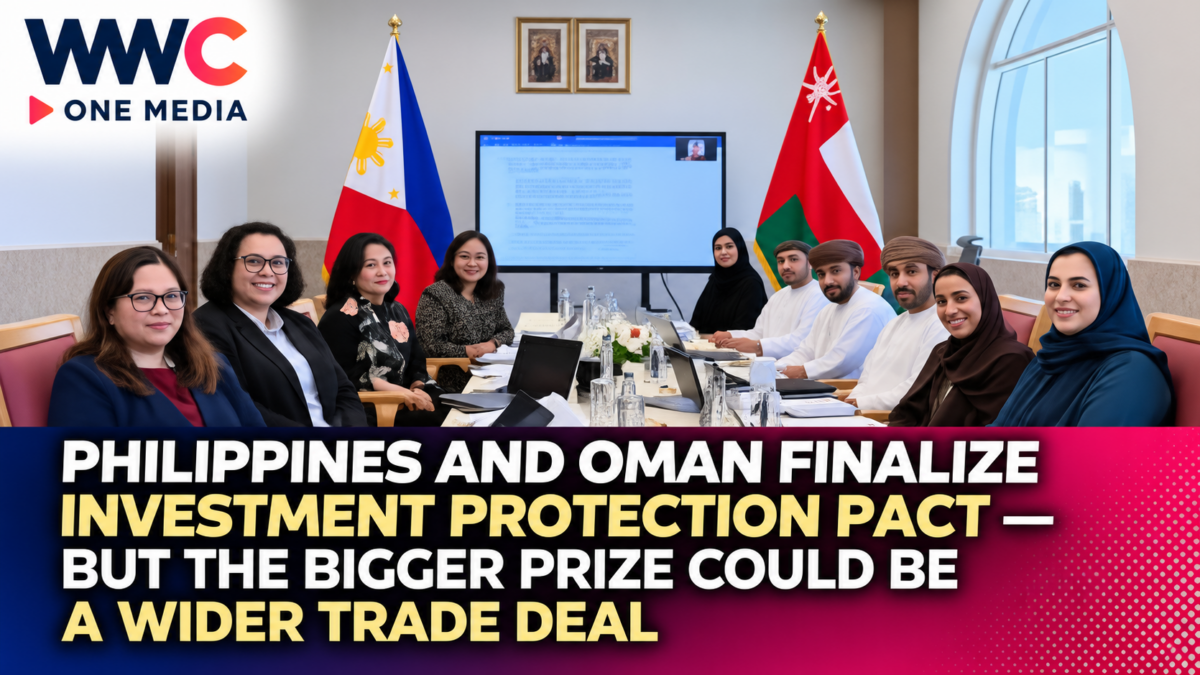
MANILA/MUSCAT — The Philippines and Oman have completed negotiations on a new investment protection agreement aimed at unlocking more Gulf capital for Philippine projects, after Omani investment in the country jumped sharply at the start of 2026 from an extremely low base.
The proposed Philippines-Oman Investment Promotion and Protection Agreement, or IPPA, is expected to be signed before the end of 2026.
Once signed and brought into force through the required domestic procedures, the pact is intended to give investors from both countries clearer protections, including fair treatment, safeguards against discriminatory measures and greater transparency when doing business.
The deal comes as Manila tries to attract Omani capital into sectors including:
agribusiness,
renewable energy,
energy-efficiency technology,
infrastructure and public-private partnerships,
information technology and business-process management,
oil and gas,
halal and specialty food,
and tourism.
But the bigger opportunity may go beyond investment protection.
The Board of Investments says the agreement could eventually support discussions on a preferential trade arrangement, potentially giving Philippine and Omani products better access to each other’s markets.
Omani Investment Is Rising — But From a Very Small Base
The headline number is striking.
Omani investments in the Philippines totaled only about $140,000 from 2021 through 2025.
In January 2026 alone, however, investment from Oman reached roughly $800,000.
That was more than five times the cumulative amount recorded over the previous five years.
Oman also ranked as the fifth-largest source of foreign direct investment into the Philippines during that month, according to figures cited by the BOI.
That sounds dramatic.
But the size of the numbers needs context.
An $800,000 inflow is still small relative to the billions of dollars the Philippines receives annually from larger investment partners.
So the current story is less about the absolute amount already invested and more about whether the new agreement can turn a small investment relationship into a much larger one.
The Pact Is Designed to Reduce Investor Uncertainty
Investment-protection agreements matter because foreign investors often worry about political and regulatory risk.
A company considering a large renewable-energy project, logistics hub or infrastructure investment may be committing capital for 20 or 30 years.
It therefore wants confidence that:
rules will not change arbitrarily,
foreign investors will not be discriminated against,
contracts and investments will receive legal protection,
and government procedures will remain transparent.
The Philippines-Oman IPPA is designed to create a clearer framework around those concerns.
For Manila, the goal is straightforward:
make it easier for Omani businesses and investment funds to feel comfortable committing larger amounts of long-term capital.
The Agreement Is Not Yet in Force
This distinction is critical.
The negotiations are finished.
The pact has not yet taken legal effect.
BOI says signing is planned before the end of 2026.
Depending on the final legal form and domestic requirements, additional government procedures may still be necessary before the protections become operational.
So it would be inaccurate to say the Philippines has already implemented the agreement.
For now, the two governments have agreed on the negotiating text.
That is a major milestone—but not the final step.
Renewable Energy Could Be One of the Biggest Opportunities
Energy is one of the most obvious sectors for deeper cooperation.
Oman is trying to diversify beyond traditional oil and gas under its long-term economic strategy.
That includes growing interest in:
renewable energy,
green hydrogen,
low-emission infrastructure,
and clean industrial development.
The Philippines also needs massive investment in power generation and grid infrastructure as electricity demand grows.
That creates natural overlap.
Omani investors could potentially participate in:
solar,
wind,
energy-storage projects,
power infrastructure,
and other clean-energy developments.
The BOI specifically identified renewable energy and energy-efficiency technologies among the priority sectors for investment cooperation.
Oman Is Building Its Own Green-Energy Economy
Oman itself is aggressively expanding investment into transport, logistics, green fuels and digital infrastructure.
The country says investment in its logistics sector reached around OMR3.3 billion during its latest five-year plan.
Its next development program includes green-port projects, alternative fuels and expanded maritime infrastructure.
That matters to the Philippines because Omani firms and investment institutions increasingly have experience financing exactly the types of projects Manila needs.
Instead of viewing Oman only as an oil-producing Gulf state, Philippine policymakers increasingly see it as a potential partner in:
infrastructure,
green energy,
logistics,
technology,
and food security.
Infrastructure Could Be Another Major Target
The Philippines continues to pursue enormous infrastructure spending through both government funding and public-private partnerships.
That creates opportunities for foreign capital.
Omani investors could potentially participate in:
transport,
ports,
logistics hubs,
industrial facilities,
water projects,
and other infrastructure.
The IPPA specifically identifies public-private partnership projects as an area where both sides see potential.
Long-term infrastructure investment is exactly the type of activity where legal certainty matters most.
A short-term trading company may be able to exit quickly if regulations deteriorate.
An investor that has spent hundreds of millions of dollars on a port or power plant cannot.
That is why investment-protection frameworks are often especially important for infrastructure.
Logistics Could Connect Oman With Southeast Asia
Oman’s geography gives it strategic importance.
Its ports sit outside the Strait of Hormuz and connect major routes linking:
the Middle East,
Africa,
South Asia,
and Europe.
The Philippines, meanwhile, sits at the center of Southeast Asian maritime trade.
Both sides have been discussing greater cooperation in logistics and transport.
During the Oman-Philippines Strategic Majlis forum in Manila in July, officials identified technology, transport, energy, logistics, agriculture and fisheries as major areas for collaboration.
That creates the possibility of a deeper commercial bridge between the Gulf and Southeast Asia.
Philippine businesses could use Oman as a gateway toward Middle Eastern markets.
Omani firms could use the Philippines as an entry point into ASEAN.
PEZA Is Already Talking to Oman About Economic Zones
The discussion is becoming more concrete.
The Philippine Economic Zone Authority and Oman’s Public Authority for Special Economic Zones and Free Zones have explored cooperation involving:
manufacturing,
logistics,
pharmaceuticals,
food processing,
consumer health,
plastics and circular-economy projects,
electronics,
and high-technology industries.
The two agencies have also discussed a joint promotion memorandum that could link their respective economic zones and help connect investors.
That suggests the bilateral relationship is moving beyond diplomatic statements.
Both sides are beginning to identify physical investment platforms where actual companies could locate.
Halal Food Could Become a Particularly Important Sector
Food is another area with strong strategic potential.
The Philippines has a large agricultural base.
Oman and the wider Gulf import significant amounts of food.
The BOI specifically identified processed and specialty food, including halal products, as a priority investment area.
That could create opportunities for Philippine producers in:
processed food,
seafood,
coconut products,
tropical fruits,
meat products,
and other halal-certified goods.
The opportunity extends beyond Oman itself.
A successful Philippine company entering Oman could potentially use the country as a platform to access other Gulf markets.
Agriculture and Fisheries Fit Both Countries’ Priorities
Food security has become increasingly important throughout the Middle East.
Oman has also been investing heavily in fisheries and its broader “blue economy.”
For example, Oman’s Al Wusta region produced around 226,000 tonnes of fish in 2024, representing about a quarter of national production.
The Philippines also has significant fisheries and agricultural resources.
That creates room for cooperation in:
cold storage,
aquaculture,
food processing,
agricultural technology,
and supply-chain infrastructure.
Those businesses could serve both domestic markets and exports.
Tourism Is Another Natural Area of Cooperation
Tourism is also included among the priority investment sectors.
The Philippines offers:
beaches,
islands,
eco-tourism,
and resort development.
Oman has developed its own high-end tourism sector around:
desert destinations,
mountains,
coastlines,
and cultural tourism.
Omani investors could potentially participate in Philippine hotels, resorts and tourism infrastructure.
Philippine hospitality operators could also explore opportunities in Oman.
The bigger challenge will be improving direct air connectivity and making travel between the two countries easier.
There Is Already a Large Human Connection
Economic relations between the countries are not starting from zero.
Oman is home to about 47,000 Filipinos.
As of June 2026, more than 60 Filipino-owned small and medium enterprises were operating in Oman.
That gives the two countries a large people-to-people link that can support deeper investment and trade.
Filipino workers understand the Omani market.
Omani businesses are familiar with Filipino talent.
That can make commercial relationships easier to build.
The Countries Are Also Working on Labor Cooperation
The economic relationship extends beyond investment.
The Philippines has also been pursuing a new bilateral labor agreement with Oman aimed at strengthening protections and cooperation involving Filipino workers.
That matters because labor relations remain one of the most important pillars of the Philippines-Oman relationship.
An investment pact could broaden that relationship from one centered heavily on overseas employment into one that also includes:
capital,
trade,
technology,
and joint ventures.
That would represent a major shift.
A Tax Agreement Could Make Investment Even Easier
The Philippines is also pursuing a double taxation agreement with Oman.
The Department of Finance said in September that it hopes to complete negotiations before the end of the year.
A double-taxation agreement is different from the investment-protection pact.
The IPPA focuses primarily on how investments are treated and protected.
A tax treaty can reduce situations where the same income is taxed twice in both jurisdictions.
For businesses, having both agreements could make cross-border investment considerably more attractive.
Together, they would address two different concerns:
legal protection,
and tax efficiency.
This Is Part of a Bigger Philippine Strategy Toward the Gulf
Manila has been steadily strengthening economic relations with wealthy Gulf economies.
The Philippines already has an investment protection agreement with the United Arab Emirates, and the UAE relationship has expanded into areas such as renewable energy, data centers and advanced technology.
That experience provides a useful model.
Large Gulf economies possess enormous pools of capital through:
sovereign wealth funds,
government-linked companies,
infrastructure investors,
and private family offices.
The Philippines needs capital for:
energy,
transport,
digital infrastructure,
manufacturing,
and agriculture.
That creates a natural match.
Oman Is Smaller Than Saudi Arabia or the UAE — But Strategically Important
Oman does not have the same financial scale as Saudi Arabia or the UAE.
But it still holds considerable strategic value.
The country is a founding member of the Gulf Cooperation Council, alongside Saudi Arabia, the UAE, Qatar, Kuwait and Bahrain.
A stronger relationship with Oman can therefore deepen the Philippines’ broader economic links with the Gulf.
Oman also maintains a relatively diversified diplomatic network and has historically played a mediating role in regional affairs.
That makes it useful not only as an investment source but as a commercial bridge.
Oman Is Also Looking Toward ASEAN
The interest is mutual.
Oman has been expanding its engagement with Southeast Asia.
During ASEAN-related meetings in Manila this year, Omani officials highlighted opportunities in:
logistics,
maritime transport,
energy,
green hydrogen,
food security,
tourism,
digital transformation,
advanced manufacturing,
and emerging technologies.
That list overlaps heavily with the sectors the Philippines wants to develop.
The investment agreement therefore fits into a wider Omani strategy of expanding beyond traditional Gulf and European commercial relationships.
The Philippines Could Become Oman’s ASEAN Gateway
This is where the opportunity becomes strategically interesting.
The Philippines is chairing ASEAN in 2026.
It has one of Southeast Asia’s largest populations and a large English-speaking workforce.
It also has strengths in:
business-process outsourcing,
electronics,
semiconductors,
digital services,
and consumer markets.
If Omani companies want deeper access to ASEAN, the Philippines could position itself as one of several possible entry points.
Conversely, Philippine firms could use Oman to strengthen access to Middle Eastern and African markets.
That two-way gateway concept could ultimately matter more than any single investment project.
But the Starting Point Is Still Small
Optimism should be tempered by reality.
Omani investment in the Philippines is still tiny compared with flows from countries such as:
Japan,
Singapore,
the United States,
South Korea,
and China.
The $800,000 recorded in January is impressive only relative to the extremely low previous base.
The success of the IPPA therefore cannot be judged by whether it produces another million dollars of investment.
The real test will be whether it eventually helps generate:
large renewable-energy projects,
major infrastructure commitments,
manufacturing investments,
or long-term institutional capital.
That will take time.
Investment Agreements Do Not Automatically Create Investment
This is another important caveat.
Governments can sign treaties.
Companies still make the final investment decisions.
Businesses will evaluate:
electricity costs,
tax rates,
regulations,
infrastructure,
political risk,
labor costs,
market size,
and project returns.
An investment agreement can reduce uncertainty.
It cannot make an unprofitable project profitable.
So the IPPA should be viewed as an enabling framework rather than a guarantee of billions in immediate capital.
The Philippines Still Has to Compete for Gulf Money
Omani investors have many choices.
They can invest in:
India,
Saudi Arabia,
the UAE,
Africa,
Europe,
other ASEAN economies,
or their own domestic projects.
The Philippines therefore has to compete.
Its strongest advantages include:
a large consumer market,
a young workforce,
strategic geography,
strong service-sector skills,
and large infrastructure needs.
Its disadvantages can include:
high electricity costs,
bureaucratic delays,
infrastructure gaps,
and regulatory complexity.
The IPPA addresses some of the perceived risk.
But broader reforms will still matter.
A Preferential Trade Deal Could Be the Bigger Prize
That is why the possibility of a future preferential trade arrangement is important.
The BOI says the IPPA could pave the way for deeper economic initiatives, including preferential market access for goods from both countries.
Such a deal could reduce tariffs on selected products and make bilateral trade more attractive.
For Philippine exporters, that could create opportunities in:
food,
electronics,
consumer goods,
industrial products,
and halal-certified merchandise.
For Oman, it could improve access to the large Philippine market and potentially create a bridge into Southeast Asia.
No such preferential trade agreement has been concluded yet.
But the fact that officials are already discussing it shows the relationship is moving beyond investment protection alone.
The Philippines Is Building a Layered Economic Relationship
Taken together, several separate initiatives are emerging:
the investment-protection agreement,
a possible double-tax treaty,
economic-zone cooperation,
investment forums,
labor negotiations,
and discussion of future preferential trade arrangements.
Each one addresses a different barrier.
Investment protection reduces legal uncertainty.
Tax treaties reduce double taxation.
Economic zones provide locations and incentives.
Trade deals improve market access.
Labor agreements strengthen people-to-people ties.
When combined, they can create a much deeper bilateral economic framework.
The Bigger Question Is Whether Oman Moves From Interest to Large Projects
The diplomatic momentum is clearly growing.
The Oman-Cebu Investment Forum began in Cebu in 2025.
A second forum took place in Muscat in February 2026.
A third high-level Strategic Majlis was held in Manila in July.
Now investment-agreement negotiations are complete.
That is a rapid sequence of engagement.
But business relationships ultimately need something more concrete than forums and treaties.
They need projects.
A large renewable-energy investment.
A logistics hub.
A manufacturing facility.
A major PPP.
A tourism development.
Those will be the real milestones.
$800,000 Is the Signal — Not the Destination
The sharp rise in January Omani investment makes a strong headline.
But the number should not be mistaken for the end result.
It is evidence that interest may be increasing.
The new investment-protection framework is meant to accelerate that interest.
The true ambition is much larger.
The Philippines wants to turn Oman from a relatively minor source of foreign capital into a long-term investor across infrastructure, energy, technology, food and tourism.
And Oman appears increasingly interested in using Southeast Asia as part of its own diversification strategy.
That is why the agreement matters.
The Philippines and Oman are no longer talking only about protecting existing investments.
They are trying to create enough confidence for much larger investments—and potentially a wider trade pact—to follow.