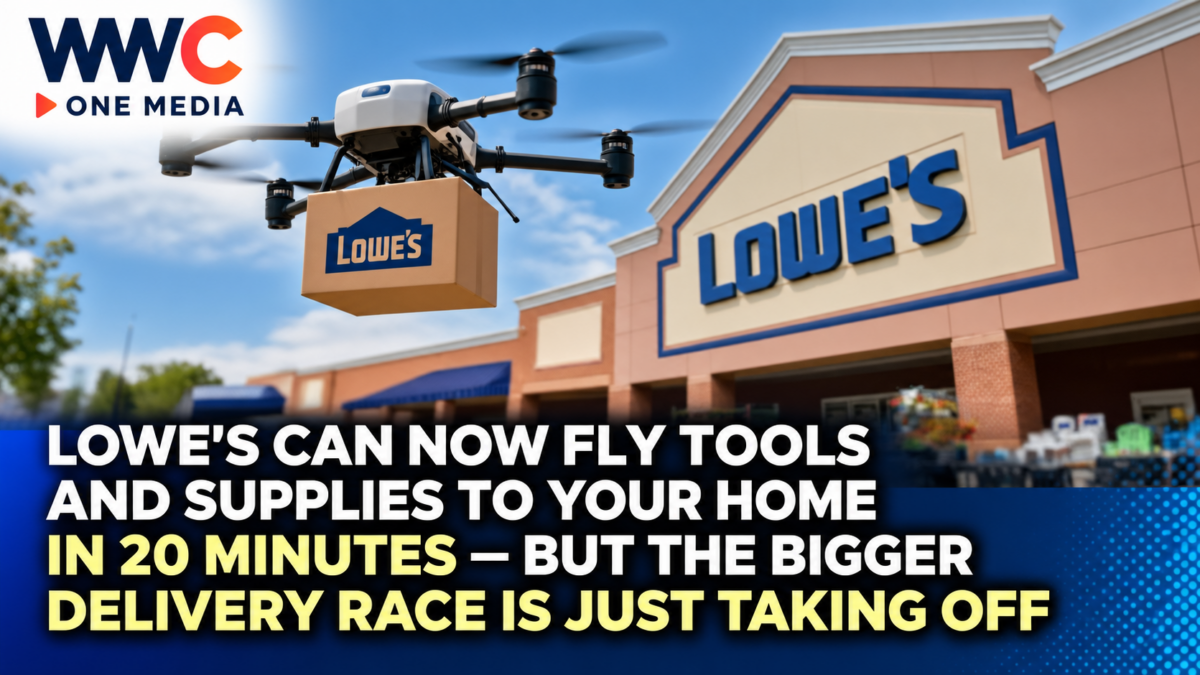
MATTHEWS, North Carolina — Lowe’s has entered the drone-delivery race, teaming up with DoorDash and Alphabet-owned Wing to fly forgotten tools, batteries, tape and other home-improvement essentials directly to customers in as little as 20 minutes.
The pilot, launched September 24 from a Lowe’s store in Matthews, North Carolina, makes Lowe’s the first major home-improvement retailer to offer commercial drone delivery.
Customers within the eligible delivery area can open DoorDash, enter the dedicated “Lowe’s by Drone” storefront, select qualifying items and have the order flown to a designated drop zone near their home.
For now, the service is deliberately limited.
Wing drones carry orders weighing roughly 2.5 pounds per flight, and the initial Lowe’s catalog includes more than 100 lightweight products such as hand tools, painter’s tape, paint supplies, soap, batteries, all-purpose cleaner and other frequently forgotten project essentials.
That may sound small.
Strategically, it is not.
Lowe’s is testing whether one of the biggest frustrations in home improvement—discovering halfway through a project that one cheap but essential item is missing—can be solved without forcing customers to stop working and drive back to the store.
Lowe’s Is Targeting the ‘Forgot One Thing’ Problem
Lowe’s Chief Information and AI Officer Seemantini Godbole said customers regularly report running into the same problem:
they begin a project and suddenly realize they are missing something important.
Maybe it is:
a screwdriver,
painters’ tape,
batteries,
caulk,
cleaning supplies,
or another low-cost item.
Traditionally, that mistake means interrupting the job and driving back to the store.
Lowe’s wants the drone to make that trip unnecessary.
The company says the goal is not simply to make delivery faster.
It is to remove friction from home improvement.
The Drone Can Arrive in About 20 Minutes
Eligible customers can receive orders in as little as 20 minutes.
CNBC’s reporting said the pilot initially operates within roughly a five-mile radius of the Matthews store.
That is substantially faster than most traditional same-day delivery options.
The time advantage matters most for inexpensive items.
Waiting several hours for a $5 or $10 item can feel absurd when the customer needs it immediately to finish a repair.
That is where drones could potentially have the strongest consumer appeal.
DoorDash Handles the Customer Experience
One of the most important elements is that shoppers do not need to learn an entirely new application.
The Lowe’s service operates through DoorDash.
If the customer’s address and order qualify for drone delivery, that option appears inside the app.
DoorDash asks the customer to identify a safe delivery area.
The order is then transferred to Wing’s system for flight.
DoorDash says drone delivery is already available for selected merchants in parts of Charlotte and Dallas-Fort Worth, although eligibility varies by address and operating conditions.
That integration is strategically valuable.
Consumers already understand DoorDash.
The drone becomes another delivery method rather than a separate shopping experience.
Alphabet’s Wing Actually Flies the Order
The aircraft are operated by Wing, the drone-delivery company that originated inside Google’s experimental technology division and is now part of Alphabet.
Wing has spent more than a decade developing autonomous delivery technology.
The company says it has completed more than 1 million commercial deliveries to homes.
Its delivery system is designed primarily around small, lightweight purchases.
The drone flies autonomously to the destination and lowers the package toward the delivery zone without needing to land.
That keeps the aircraft away from people, pets and ground obstacles.
Wing Is Already Moving Beyond Experiments
Drone delivery has often been described as a futuristic concept.
Wing increasingly argues it is becoming an ordinary logistics business.
Its network already works with major commercial partners and is expanding to additional U.S. metropolitan areas.
The company lists existing or planned service in markets including:
Charlotte,
Dallas-Fort Worth,
Atlanta,
Houston,
Los Angeles,
Miami,
Phoenix,
Philadelphia,
San Diego,
and several other cities.
That makes Lowe’s important for a different reason.
Most early drone services have focused on restaurants, medicine or grocery convenience.
Home improvement creates a new use case.
A Missing Tool May Be Perfect for Drone Delivery
The economics of drone delivery become easier to understand when the order is urgent but light.
Consider someone painting a room.
They run out of painter’s tape.
Driving to Lowe’s might take:
10 minutes each way,
plus parking,
plus time inside the store.
A $6 forgotten item could cost 30 or 40 minutes of project time.
A drone can potentially eliminate almost all of that interruption.
That is a stronger value proposition than using a drone simply because it looks futuristic.
But Weight Is Still a Major Limitation
The same technology has obvious limits.
Wing’s current Lowe’s flights carry roughly 2.5 pounds per trip.
That rules out much of Lowe’s inventory.
A drone cannot realistically carry:
lumber,
large power tools,
bags of concrete,
major appliances,
large paint buckets,
toilets,
or most building materials.
So the service is not replacing trucks.
It is targeting a very specific slice of delivery demand.
Small.
Urgent.
High-convenience.
That May Actually Be the Smartest Strategy
Retailers do not necessarily need drones to handle every order.
They need them to handle the orders where drones are economically superior.
A delivery van may carry hundreds of pounds.
But sending a van several miles to deliver one screwdriver or roll of tape can be inefficient.
A lightweight electric drone may be better suited to that transaction.
The future of delivery therefore may not be:
drones replace drivers.
It may be:
software chooses the cheapest and fastest delivery method for each order.
DoorDash Is Already Moving in That Direction
That appears to be DoorDash’s broader strategy.
Only days after Lowe’s announcement, DoorDash unveiled DoorDash Air, its own purpose-built drone-delivery system.
The company plans pilot operations in Northern California with restaurant partners including Chipotle and Popeyes.
DoorDash says roughly 80% of its U.S. food orders are light enough to potentially be served by drone, though range, weather, landing conditions and local regulations determine actual eligibility.
That means DoorDash is simultaneously:
working with Wing,
working with other drone partners,
and developing its own aircraft.
That tells investors something important.
DoorDash does not view drones as a publicity stunt.
It sees autonomous delivery as part of its long-term logistics network.
DoorDash Now Has Its Own FAA Certification
In July, DoorDash received FAA Part 135 air-carrier certification, allowing it to commercially operate its own drone-delivery service.
That is a significant regulatory milestone.
Commercial drone delivery in the United States requires much more than building an aircraft.
Operators need authorization involving:
aircraft safety,
flight operations,
pilot oversight,
maintenance,
and broader aviation regulation.
Receiving certification brings DoorDash closer to controlling the entire delivery chain.
DoorDash Wants One Network for Humans, Robots and Drones
The bigger ambition is multimodal delivery.
Some orders will still go by car.
Some may go by bicycle.
Others could eventually travel by sidewalk robot.
Lightweight urgent orders may go by drone.
Software determines which method makes the most sense.
That could improve efficiency enormously.
A human driver would no longer need to spend 20 minutes transporting a tiny package that a drone could carry automatically in five.
Instead, drivers could focus on orders drones cannot handle.
The First and Last Ten Feet Are Still Difficult
Ironically, flying across town is not necessarily the hardest part.
DoorDash says one of the biggest technical challenges is the first and last ten feet.
How does the restaurant or store safely load the order?
How is packaging secured?
Where does the drone release it?
How does the system ensure children, dogs, trees or power lines are not in the way?
DoorDash designed much of its new drone network around those ground-level problems.
That shows how commercial automation often works.
The impressive technology gets attention.
The mundane logistics decide whether it actually scales.
Lowe’s Is Not Trying to Replace Its Other Fulfillment Options
The retailer already offers:
buy online and pick up in store,
curbside pickup,
traditional same-day delivery,
and other fulfillment methods.
Drone delivery simply becomes another option.
That is likely the realistic future of retail logistics.
Different products require different transportation.
A refrigerator needs a truck.
A bag of concrete needs a vehicle.
A screwdriver might need only a drone.
Lowe’s Is Testing This in Its Home Market
The choice of Matthews is deliberate.
Lowe’s is headquartered in nearby Mooresville, North Carolina.
Charlotte is therefore effectively the retailer’s home market.
Testing nearby gives executives easier access to operations and allows the company to observe customer behavior closely.
The pilot is currently limited to the Matthews location.
Lowe’s says expansion will depend on what it learns.
So it would be premature to say drone delivery is coming to every Lowe’s store.
This remains a test.
Lowe’s Has More Than 1,700 Stores
That said, the potential scale is enormous.
Lowe’s operates a vast U.S. store footprint.
If drone delivery eventually works economically, thousands of neighborhoods could theoretically sit within short flight distances of stores.
Big-box retail locations could become miniature logistics hubs.
Instead of functioning only as places where customers shop, stores increasingly serve as:
warehouses,
pickup centers,
delivery hubs,
and fulfillment centers.
Drones strengthen that model.
Walmart Is Already Moving Aggressively
Lowe’s is not alone.
Walmart has become one of the most aggressive major retailers in commercial drone delivery and has also partnered with Wing.
Wing’s consumer service already operates through platforms including Walmart and DoorDash.
That puts pressure on other retailers.
If customers become accustomed to getting small purchases in 10 or 20 minutes, traditional same-day delivery may begin to feel slow.
Consumer expectations tend to move in only one direction.
Once faster service becomes normal, shoppers rarely want to go backward.
Amazon Has Been Pursuing the Same Goal for Years
Amazon has worked on Prime Air for more than a decade.
But drone delivery has expanded much more slowly than early industry predictions suggested.
The obstacles have included:
regulation,
aircraft design,
noise,
weather,
landing safety,
and local opposition.
That history is an important reminder.
The technical ability to fly a package is not the same thing as building a nationwide commercial network.
Wing, DoorDash, Walmart and Lowe’s still face many of the same challenges.
Noise Could Become One of the Biggest Problems
Residents do not necessarily want dozens or hundreds of drones flying over their neighborhoods every day.
Noise complaints have already affected drone projects.
That is why developers increasingly emphasize quieter aircraft.
DoorDash says its new drone was designed specifically to reduce acoustic impact and uses slower-spinning propellers.
Wing has also spent years refining its aircraft.
The question is not whether one drone is tolerable.
It is what happens when hundreds fly overhead each day.
That is where public acceptance could become a serious constraint.
Privacy Concerns Will Grow Too
Drones carry cameras and sensors necessary for navigation.
Even if those sensors are not being used to surveil customers, people may still feel uncomfortable seeing aircraft repeatedly pass near homes.
Retailers and drone operators will need strong policies around:
data collection,
image retention,
navigation sensors,
and customer privacy.
The technology must not merely be safe.
People must believe it is safe.
Regulators Are Still Fighting Over Expansion
The Federal Aviation Administration has been working toward rules that would make large-scale commercial drone operations easier, particularly flights beyond an operator’s direct line of sight.
But that expansion is already facing legal challenges.
On September 28, a coalition of 15 U.S. states and Harris County, Texas, sued over the FAA’s environmental review tied to proposed commercial-drone rules.
The plaintiffs argue the federal government failed to adequately examine risks including:
noise,
safety,
and environmental effects.
That lawsuit shows the next stage of drone delivery may be fought as much in courts and city halls as in engineering labs.
Beyond-Visual-Line-of-Sight Rules Are Crucial
Large-scale drone delivery becomes far more practical when aircraft can fly beyond the direct visual range of a human operator.
Requiring someone to physically watch every drone severely limits scale.
The FAA has been moving toward a regulatory structure that allows more automated, beyond-line-of-sight operations under defined safety standards.
If those rules become easier and standardized, expansion could accelerate dramatically.
If regulation remains fragmented, nationwide rollout could take much longer.
Weather Is Another Limitation
Delivery drones cannot ignore physics.
Heavy rain.
High winds.
Severe storms.
Ice.
All can reduce operating reliability.
That means drone delivery may never offer the same universal availability as ground transportation.
A customer who becomes dependent on aerial delivery still needs another option when weather prevents flight.
That is another reason retailers will likely maintain mixed delivery networks rather than moving entirely to drones.
Drone Economics Could Eventually Be Powerful
The financial attraction is obvious.
Human delivery is expensive.
Drivers require wages.
Vehicles need fuel.
Cars need maintenance.
Insurance costs money.
Delivery time has limits.
Autonomous electric drones eliminate many of those variable costs.
Reuters has cited estimates that scaled drone-delivery costs could eventually fall toward roughly $2 per delivery by 2034.
If those economics become reality, the technology could change local commerce.
But $2 Delivery Only Works at Scale
The aircraft themselves cost money.
So do:
launch infrastructure,
maintenance,
software,
operations teams,
regulatory compliance,
and insurance.
A drone network serving five orders per day may be economically terrible.
A network serving thousands could be extremely efficient.
That makes order density critical.
Companies such as DoorDash, Walmart and Lowe’s have an advantage because they already possess large customer bases.
They do not have to invent demand from scratch.
DoorDash May Have the Biggest Strategic Advantage
DoorDash does not own most of the products being delivered.
That can actually be a strength.
Its marketplace connects:
restaurants,
retailers,
grocery stores,
pharmacies,
and consumers.
If DoorDash can add drones as another transportation layer, the same aircraft infrastructure can potentially serve multiple merchants.
A drone that delivers a Lowe’s screwdriver in the morning could theoretically deliver food or groceries later.
That shared network could dramatically improve asset utilization.
Alphabet Gets Another Commercial Use for Wing
For Alphabet, Lowe’s adds another merchant category to Wing.
Google’s parent company has invested in Wing for years.
The company’s technology has now moved far beyond experimentation.
Wing says it has passed the one-million-delivery milestone and is expanding across numerous American cities.
Every major retailer or platform added to the network increases the possibility that drone delivery becomes infrastructure rather than novelty.
That is the strategic prize.
Lowe’s Gets Faster Delivery Without Building the Entire Network
Lowe’s benefits from partnership economics.
It does not need to design drones.
It does not need to build an aviation platform.
It does not need to create its own consumer delivery marketplace.
DoorDash provides ordering infrastructure.
Wing provides aircraft and flight operations.
Lowe’s provides inventory and stores.
That division of labor lets the retailer experiment without building everything itself.
That Could Become the Standard Retail Model
Many retailers may follow the same path.
Most companies do not operate their own trucking networks.
They rely on logistics providers.
Drone delivery could evolve similarly.
A handful of companies could build the aircraft and aviation infrastructure.
Large platforms could manage customer ordering.
Retailers simply plug inventory into the system.
If so, Wing and DoorDash could become infrastructure providers for local commerce.
That may ultimately be more valuable than any single Lowe’s delivery.
The Biggest Question Is Whether Customers Care
Technology companies often assume faster is better.
Consumers are more complicated.
Would someone pay extra to receive batteries in 15 minutes rather than one hour?
Would they tolerate drones flying nearby?
Would they choose drone delivery regularly after the novelty disappears?
That is exactly what the Lowe’s pilot can help answer.
A technology can work perfectly and still fail commercially if customers do not value it enough.
Home Improvement May Be an Ideal Test
Lowe’s has one advantage that restaurants do not.
Home-improvement projects frequently create genuine urgency.
A customer halfway through repairing a leaking sink may desperately need one fitting.
A contractor at a jobsite may realize a small tool is missing.
A homeowner hanging shelves may run out of anchors.
These are situations where saving 30 minutes matters.
That could make home improvement one of the most logical categories for drone delivery despite the industry’s many heavy products.
The Pilot Could Also Appeal to Professional Contractors
Lowe’s specifically says the service is intended for both DIY shoppers and Pro customers.
Professional contractors put a direct dollar value on time.
If several workers stop working while someone drives to buy a missing part, the cost can exceed the price of the item many times over.
A 20-minute drone delivery could therefore be economically valuable even if it carries a delivery fee.
That may ultimately be one of the most important customer segments.
The Real Competition Is Not Lowe’s vs. Home Depot
The most interesting aspect of the announcement may be who the partners are.
Lowe’s.
DoorDash.
Alphabet.
Retail.
Delivery software.
Autonomous aviation.
Industries that once had little connection are beginning to overlap.
The future competition may not simply be Lowe’s versus Home Depot.
It could be competing logistics ecosystems:
which retailer can get the right item to a customer fastest,
which platform controls the order,
and which autonomous network handles the final mile.
Drones Are Becoming Part of a Larger Automation Wave
Drone delivery also fits into a much wider transformation.
DoorDash is developing drones and sidewalk robots.
Retailers are deploying warehouse automation.
Self-driving vehicles are expanding.
AI increasingly decides:
routes,
inventory allocation,
delivery estimates,
and demand forecasting.
The long-term goal is a logistics network where humans intervene only when automation is not the best tool.
That could reduce costs significantly.
It could also reshape delivery employment.
Human Couriers Are Not Disappearing Yet
Drone capacity remains too limited for that.
Heavy orders.
Apartments.
Bad weather.
Long distances.
Urban environments.
All still favor human drivers.
DoorDash itself describes the future as multimodal rather than fully autonomous.
That means drivers, robots and drones may coexist for years.
The more immediate change is task specialization.
Drones take the easiest lightweight routes.
Humans handle everything else.
Lowe’s Is Really Testing the Future of the Store
The drone itself is visually dramatic.
But the deeper change may be happening inside retail real estate.
Stores are becoming distributed fulfillment centers.
Inventory sitting on a Lowe’s shelf can now potentially reach a nearby customer without that customer—or even a delivery driver—entering the store.
That turns each retail location into a local logistics node.
The better retailers become at using stores that way, the more competitive they can be against centralized e-commerce warehouses.
Amazon Helped Create the Expectation Lowe’s Is Now Chasing
Amazon trained consumers to expect:
two-day delivery,
then next-day delivery,
then same-day delivery.
Retailers responded by turning physical stores into an advantage.
A Lowe’s warehouse may be far away.
A Lowe’s store may be only three miles away.
Drones make that proximity even more valuable.
The store becomes faster than the fulfillment center.
The 20-Minute Promise Could Change Expectations Again
If customers become accustomed to receiving small retail purchases within 20 minutes, same-day delivery may eventually sound slow.
That would create enormous pressure throughout retail.
Companies might need to compete not only on:
price,
selection,
and product quality,
but on minutes.
That is already happening in food delivery.
Lowe’s is now testing whether it can happen in home improvement too.
But the Pilot Is Still Small
This remains the most important caveat.
The service is currently:
one Lowe’s store,
in one North Carolina market,
with a limited delivery radius,
carrying roughly 2.5 pounds,
and offering just over 100 eligible products.
There is no guarantee Lowe’s will deploy it nationwide.
The company says it will learn from the pilot before determining broader expansion.
That makes sweeping claims about drones replacing traditional retail delivery premature.
Still, the Direction Is Becoming Clear
Walmart is using drones.
DoorDash is building its own drone aircraft.
Alphabet’s Wing has crossed one million commercial deliveries.
Amazon continues working on Prime Air.
And now Lowe’s is flying home-improvement supplies.
The experiments are no longer isolated.
They are converging.
Commercial drone delivery is gradually moving from a technology demonstration toward an actual logistics category.
The question is not whether drones can deliver packages.
That has already been proven.
The harder questions are:
Can they do it cheaply?
Can regulators allow it at scale?
Will neighborhoods tolerate them?
And will customers use the service often enough to justify the infrastructure?
Lowe’s is now helping answer those questions one screwdriver, battery pack and roll of painter’s tape at a time.