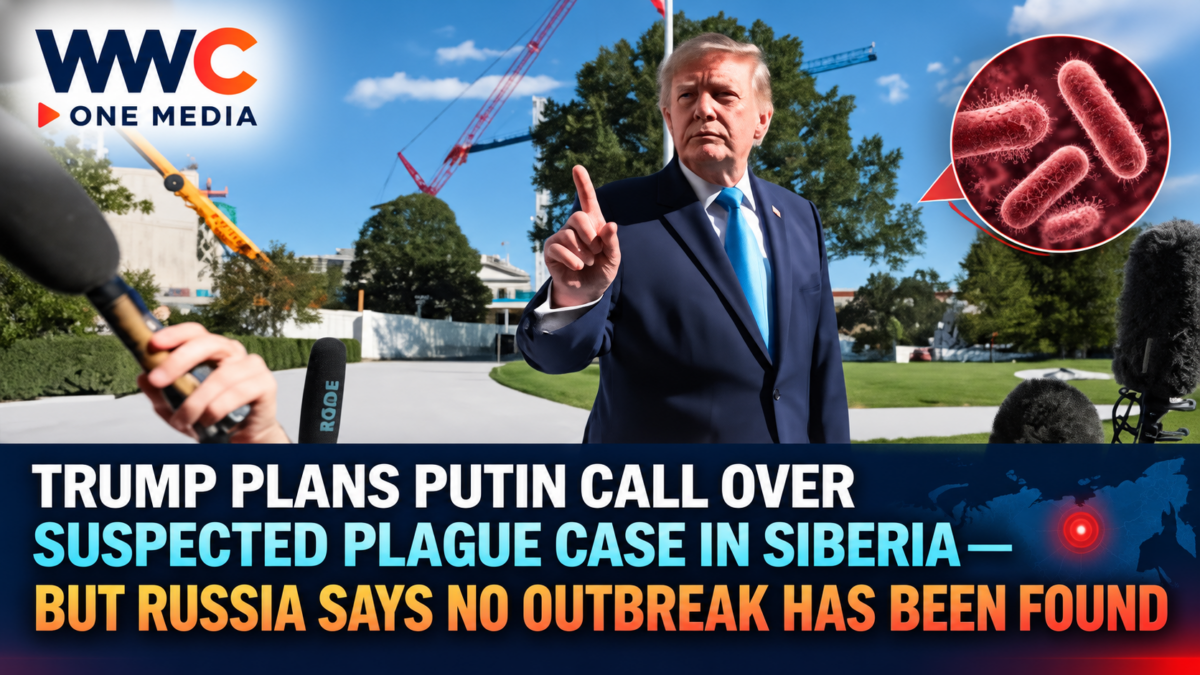
WASHINGTON/MOSCOW — U.S. President Donald Trump says he will speak “very soon” with Russian President Vladimir Putin about a suspected pneumonic plague case linked to a Siberian research institute, escalating international pressure on Moscow to explain the mysterious death of a young laboratory worker.
But despite increasingly alarming headlines, there is still no confirmed pneumonic plague outbreak in Russia.
The case centers on Darya Shipilova, a 28-year-old employee of the Irkutsk Anti-Plague Research Institute of Siberia and the Far East, who died after developing severe pneumonia of an undetermined cause.
Independent Russian media have reported allegations that Shipilova may have been exposed to Yersinia pestis — the bacterium that causes plague — following an accident involving a laboratory test tube.
Russian health authorities dispute that account.
Officials say postmortem testing found no microorganisms connected to her professional work, while testing of people who had been in contact with her has so far produced no evidence of plague.
That leaves Washington, Moscow and global health authorities facing two very different narratives:
A potentially dangerous laboratory exposure involving one of history’s most feared diseases — or an unexplained case of pneumonia that has been amplified by rumors and geopolitical distrust.
And President Trump now says he wants answers directly from Putin.
Trump Says Putin Call Is Coming ‘Very Soon’
Speaking to reporters at the White House on October 6, Trump confirmed that he had scheduled a conversation with the Russian president.
“I have a call scheduled,” Trump said, adding that it would take place “very soon.”
Trump said the United States was already engaged in what he described as “very deep discussions” over the case and suggested more information could be available shortly.
The president had previously offered American assistance, describing plague as a serious disease and saying Washington would be willing to help Moscow if necessary.
The remarks mark an unusual intersection of public health and high-level geopolitics.
Relations between Washington and Moscow remain deeply strained over Ukraine, sanctions and broader security disputes.
Yet infectious disease creates a different kind of risk.
A dangerous pathogen does not respect borders, alliances or sanctions.
That is why the United States is pushing Russia to provide more information even as political relations remain tense.
Marco Rubio Wants More Transparency
U.S. Secretary of State Marco Rubio has taken a more cautious approach than Trump.
Rubio said it would be irresponsible to speculate before more facts are available.
But he also urged Moscow to share additional information internationally.
“We encourage Russia to be transparent and share more information with the world so that all of us could react accordingly and appropriately,” Rubio said during a trip to Iceland.
His message captures Washington’s position:
There is not enough verified evidence to declare a plague outbreak.
But there is enough uncertainty to justify international scrutiny.
Russia Says the Woman Died of Pneumonia of Unknown Origin
Russian authorities continue to push back against claims of a plague outbreak.
Irkutsk regional governor Igor Kobzev said Shipilova died from “pneumonia of unknown aetiology.”
Russia’s federal health watchdog, Rospotrebnadzor, said testing did not detect plague bacteria in the woman or among people who had been in contact with her.
Officials said an extensive investigation identified her contacts and placed them under medical observation.
Testing reportedly detected some cases of COVID-19 and rhinovirus, but no dangerous plague pathogen.
Russian officials have also denied reports that an accident involving plague material occurred inside the laboratory.
The Irkutsk institute said it had found no recorded incident involving dangerous pathogens linked to Shipilova’s work.
That directly contradicts independent Russian media reports claiming she may have broken a tube containing plague bacteria.
Neither version has been independently proven.
About 200 People Were Reportedly Monitored
The precautionary response nevertheless shows how seriously Russian authorities treated the unexplained death.
Local reporting indicated that roughly 200 people who may have had contact with Shipilova were initially quarantined or placed under medical observation.
Parts of the hospital in Shelekhov where she was treated were restricted.
An aluminium plant in the area reportedly introduced mask precautions.
The head of Rospotrebnadzor, Anna Popova, also travelled to the region for emergency discussions.
By October 6, local officials said around 60% of people placed under precautionary restrictions had already been released.
No confirmed secondary plague infections had been reported.
That is an important sign.
If Shipilova had suffered transmissible pneumonic plague, health authorities would be particularly concerned about close contacts because the lung form of the disease can spread through respiratory droplets.
So far, authorities say that pattern has not appeared.
WHO Says Risk Outside Russia Is Very Low
The World Health Organization is also monitoring the case.
According to information relayed by the WHO, Russian officials reported that no plague case had been recorded in Irkutsk and that testing of contacts found no dangerous infectious-disease pathogens.
The WHO has emphasized that transparent and timely information sharing is essential when reports conflict.
Based on currently available information, the agency has assessed the broader public-health danger as low, with the risk outside Russia described as very low.
That means there is currently no evidence supporting fears of an international plague epidemic.
The situation remains one under investigation — not a confirmed global health emergency.
What Is Pneumonic Plague?
Plague is caused by the bacterium Yersinia pestis.
It can appear in several forms.
Bubonic plague generally affects the lymph nodes and is commonly associated with bites from infected fleas.
Septicemic plague spreads through the bloodstream.
Pneumonic plague infects the lungs.
The pneumonic form is particularly concerning because an infected patient can potentially transmit bacteria through respiratory droplets during close contact.
Without prompt treatment it can progress rapidly.
But unlike during the medieval pandemics that made plague infamous, modern medicine has an extremely important advantage:
Plague is treatable with antibiotics when detected early.
That is one reason today’s public-health threat from isolated plague cases is very different from the historic Black Death.
Plague Has Never Completely Disappeared
The disease may sound like something from history books, but Yersinia pestis still exists naturally in animal populations.
Cases continue to occur periodically in several countries.
Siberia itself contains natural plague reservoirs among wild rodents and their fleas.
Reuters notes that plague is endemic in parts of Siberia, although human infections in Russia are rare.
That means the existence of plague bacteria in the region is not, by itself, evidence of a laboratory accident or a major outbreak.
What makes this case unusual is where the deceased woman worked.
The Irkutsk facility specifically studies plague and other dangerous infectious diseases.
That naturally raises the stakes whenever an employee develops unexplained severe pneumonia.
The Alleged Broken Test Tube Is Still Unverified
One of the most explosive claims came from independent Russian outlet People of Baikal.
It reported, citing unnamed sources, that Shipilova may have accidentally broken a test tube containing plague bacteria while working in the laboratory.
That account quickly spread internationally.
But Russian authorities say there is no documented evidence such an accident occurred.
Officials also say tests on Shipilova’s body did not detect pathogens associated with her work.
For responsible publication, that alleged laboratory accident should therefore not be stated as fact.
At this stage there are two competing claims.
The independent-media claim:
Possible laboratory exposure to plague.
The official Russian account:
No evidence of a laboratory accident and no plague detected.
That discrepancy is precisely why the United States and WHO are seeking transparency.
COVID Changed How the World Reacts to Lab Incidents
The international reaction also reflects lessons from the COVID-19 pandemic.
Governments are now far more sensitive to unusual respiratory illnesses connected to biological research facilities.
Even an isolated unexplained death can generate enormous global suspicion if information is slow, inconsistent or incomplete.
That does not mean every unexplained laboratory illness represents a leak.
It does mean governments face much greater pressure to disclose evidence quickly.
The Irkutsk case demonstrates that shift clearly.
A decade ago, the unexplained death of one laboratory employee might have remained primarily a regional health matter.
In 2026, it is prompting discussions between the presidents of the United States and Russia.
Russia Pushes Back at Washington
Moscow has not simply accepted American criticism.
After Trump offered help, Rospotrebnadzor responded by noting disease problems inside the United States, including measles outbreaks and a fatal U.S. plague case reported earlier this year.
The response appeared intended to make clear that Russia does not accept the suggestion that it is incapable of managing infectious disease.
Russian officials insist the situation in Irkutsk is stable and under control.
The diplomatic sparring shows how even a health investigation can become entangled in geopolitical rivalry.
But underneath the rhetoric is a shared interest:
Neither country wants an uncontrolled infectious-disease event.
Washington Is Monitoring, Not Declaring an Emergency
The U.S. Centers for Disease Control and Prevention says it is aware of the reports and monitoring developments.
According to NBC News, the CDC said there was no indication of a broader threat to the United States based on currently available information.
That point deserves emphasis.
There is presently:
No confirmed Russian pneumonic plague outbreak.
No confirmed international spread.
No evidence of a threat to the United States.
No WHO declaration of a public-health emergency.
What exists is a suspicious death, conflicting accounts and demands for clearer information.
Trump’s Call Could Produce the Missing Details
Trump’s planned conversation with Putin may therefore become important less because presidents normally manage disease investigations and more because it could break the information deadlock.
Washington wants Russia to clarify:
What caused Shipilova’s pneumonia?
Was she working with live plague bacteria before becoming ill?
Was there actually a laboratory accident?
How many contacts were monitored or quarantined?
What laboratory tests were performed?
And will Moscow share enough evidence for independent health authorities to assess the risk?
Until those questions are answered, speculation is likely to continue.
The Biggest Danger Right Now May Be Misinformation
There is a strange paradox surrounding this story.
Pneumonic plague is genuinely dangerous.
But exaggerated claims about a disease outbreak can also cause harm.
Social media posts have already described the situation as a confirmed Siberian plague outbreak or alleged massive Russian cover-up.
Available evidence does not currently support those statements.
Russian authorities may ultimately be proven wrong.
Independent media reports may ultimately be confirmed.
But neither outcome has been established yet.
The scientifically responsible position is much narrower:
A worker at a plague research institute died from unexplained pneumonia.
Some independent reports allege possible occupational exposure to plague bacteria.
Russian authorities deny plague was detected.
Contacts have been monitored and no confirmed spread has been identified.
International health authorities are seeking more information.
Anything beyond that currently outruns the evidence.
A Single Death Has Become a Test of Global Health Trust
That may ultimately be the biggest story.
After COVID-19, governments know that uncertainty surrounding unusual respiratory illnesses can rapidly become an international political crisis.
Russia says there is no plague outbreak.
The WHO says the available evidence indicates low risk.
The United States says more transparency is needed.
And Donald Trump is preparing to raise the issue directly with Vladimir Putin.
If Russia’s testing is correct, the episode may end as an isolated unexplained pneumonia death that triggered unusually intense global attention because of where the victim worked.
If further evidence establishes plague exposure, questions about laboratory safety and Russia’s initial disclosures will become far more serious.
For now, the world is not confronting a confirmed new plague outbreak.
But with Washington demanding answers, WHO monitoring the case and Trump preparing to call Putin directly, one unexplained death inside a Siberian anti-plague laboratory has become a test of whether governments learned the most important lesson from the last pandemic: when the pathogen is uncertain, transparency matters almost as much as the diagnosis.