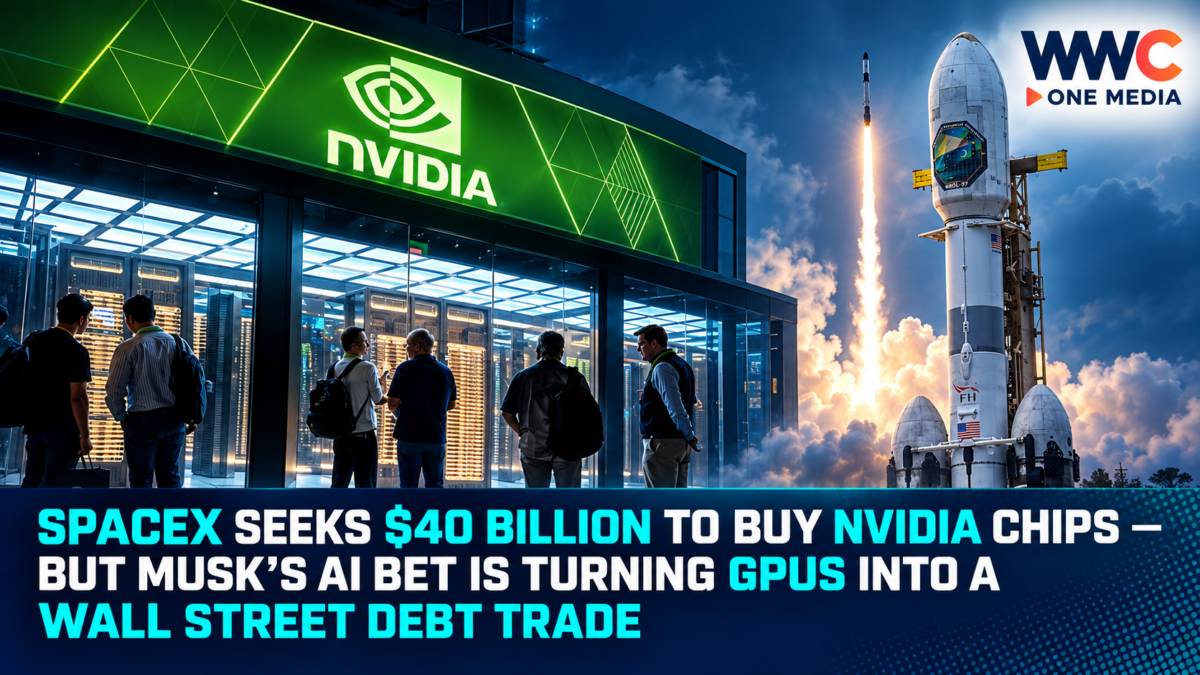
NEW YORK — Elon Musk’s SpaceX is reportedly preparing one of the biggest technology-financing deals ever attempted, seeking roughly $40 billion to buy Nvidia artificial-intelligence chips as the cost of competing at the frontier of AI reaches levels once reserved for governments, telecom networks and energy megaprojects.
Apollo Global Management is expected to lead the financing effort, according to the Financial Times, with SpaceX looking to raise approximately:
$10 billion in bank loans
and
$30 billion through investment-grade debt.
Bond giant Pimco is among the institutions reportedly discussing participation.
The transaction is expected to close in 2027 if completed.
But the significance of the proposed financing extends far beyond SpaceX.
It shows how radically the artificial-intelligence boom is reshaping Wall Street.
Companies once financed AI expansion primarily from their own cash.
Now the cost of GPUs, data centers, electricity and networking equipment has become so enormous that technology groups are increasingly turning to banks, bond investors, private-credit firms and pension capital to finance the arms race.
And at the center of SpaceX’s proposed $40 billion borrowing spree sits one company:
Nvidia.
SpaceX Wants Nvidia Chips for Musk’s AI Empire
The financing would reportedly be used to acquire Nvidia processors for the rapidly expanding computing infrastructure associated with Musk’s AI operations.
SpaceX absorbed xAI before its 2026 public listing, bringing Musk’s artificial-intelligence ambitions more closely together with his rocket and satellite empire.
The xAI operation is best known for Grok and its enormous Colossus data-center complexes, built to train and operate advanced AI models.
Musk has indicated that future Colossus infrastructure will rely heavily — and in some configurations exclusively — on Nvidia hardware.
That makes the reported $40 billion financing not simply another equipment purchase.
It is effectively a bet that the economics of SpaceX’s AI business will eventually justify tens of billions of dollars of borrowed money used to buy rapidly evolving computer hardware.
Nvidia’s Vera Rubin Architecture Is Central to the Plan
The FT reports that Musk favors Nvidia’s upcoming Vera Rubin architecture for the expansion.
Vera Rubin is Nvidia’s next-generation AI computing platform after Blackwell and is designed to support increasingly massive AI training and inference workloads.
The architecture is expected to combine GPUs, CPUs, networking and memory systems into tightly integrated computing racks.
That matters because the largest AI models are no longer trained using isolated processors.
They require enormous clusters containing tens or hundreds of thousands of chips operating together.
The costs quickly become extraordinary.
A single advanced AI processor can cost tens of thousands of dollars.
Once networking, memory, cooling, buildings and power infrastructure are added, a hyperscale AI facility can require tens of billions of dollars in capital.
SpaceX’s reported financing shows just how large that bill is becoming.
$40 Billion Would Be Bigger Than Many Corporate Acquisitions
To put the proposed amount in perspective, $40 billion is larger than the market value of many publicly traded companies.
And unlike an acquisition, SpaceX would largely be borrowing the money to purchase computing infrastructure that will depreciate technologically over time.
That creates a very different financial risk.
An office building might remain economically useful for decades.
A semiconductor can become outdated within a few product cycles.
That means lenders must ask a difficult question:
How much will today’s $30,000 or $50,000 AI chip be worth when a substantially faster processor arrives three years later?
Wall Street is still trying to answer that.
Banks Are Nervous About Lending Against GPUs
Reuters recently reported that financial institutions remain cautious about treating Nvidia processors like traditional long-lived infrastructure assets.
Nvidia argues that its AI chips can remain economically useful for many years.
Some lenders are less convinced.
Banks and credit investors have generally assumed much shorter depreciation schedules — sometimes just three to four years — because AI hardware improves so rapidly.
That disagreement matters when GPUs are being used, directly or indirectly, to support enormous financing structures.
Lenders increasingly want other protections, including:
long-term customer contracts,
corporate guarantees,
reliable cash flow,
or additional collateral.
SpaceX may have an advantage here.
Unlike a small AI startup, it has a large operating business with Starlink, rocket launches and other revenue streams.
It also now carries investment-grade credit ratings.
SpaceX’s IPO Changed Its Borrowing Power
SpaceX went public in June 2026 in an $86 billion IPO, one of the largest initial public offerings ever.
The listing transformed the company’s access to capital.
Soon after the IPO, the three major credit-rating agencies granted SpaceX investment-grade status.
Moody’s assigned it Baa1.
Fitch rated it BBB+.
S&P Global Ratings gave it BBB.
All three assigned stable outlooks.
That matters enormously for the proposed $30 billion bond portion.
Many pension funds, insurers and institutional bond portfolios are restricted from buying speculative-grade debt.
Investment-grade status opens SpaceX to an entirely larger universe of investors.
In practical terms, its credit rating may be almost as important to this transaction as Nvidia’s chips.
Apollo Is Becoming One of AI’s Biggest Financiers
Apollo’s involvement is also significant.
The alternative-asset giant is rapidly becoming one of the central financiers of the AI infrastructure boom.
In June, Apollo led a $35 billion financing package alongside Blackstone and major banks to support a Broadcom-based AI infrastructure platform.
That initial deal was designed to provide more than 1 gigawatt of computing capacity for Anthropic, while the broader platform aims to enable more than 20 gigawatts of AI compute through 2028.
Now Apollo is reportedly turning to SpaceX.
The pattern is increasingly clear.
AI infrastructure is becoming so capital-intensive that even the world’s richest technology companies need financial intermediaries capable of raising tens of billions of dollars at a time.
The AI Boom Is Becoming a Credit Boom
This may become one of the defining financial stories of the next several years.
At first, AI was mainly an equity-market phenomenon.
Investors bought:
Nvidia,
AMD,
Broadcom,
Microsoft,
Meta,
and other companies expected to benefit from artificial intelligence.
Now AI is increasingly entering the debt markets.
Banks are underwriting loans.
Private-credit funds are financing data centers.
Insurance companies and pension funds are buying bonds.
Asset managers are creating special financing vehicles.
Chip suppliers are providing guarantees.
Cloud companies are signing long-term contracts that help support borrowing.
Morgan Stanley estimates that AI infrastructure may require around $1.5 trillion in external financing by 2028, according to Reuters.
That means the AI investment boom is becoming deeply intertwined with the global financial system.
Nvidia Wants to Turn Chips Into a Financeable Asset Class
Nvidia itself has been pushing this transformation.
The chipmaker has been working with financial institutions on a huge initiative intended to mobilize as much as $500 billion for AI infrastructure.
The idea is straightforward:
If investors can become comfortable financing Nvidia-powered computing infrastructure in the same way they finance aircraft, energy projects or telecommunications equipment, far more capital can flow into data centers.
But Wall Street remains cautious.
Aircraft have long operating histories and established resale markets.
AI GPUs do not.
A five-year-old jet may still have substantial value.
A five-year-old accelerator may be dramatically less competitive against the newest generation.
That is why Nvidia’s attempt to turn compute into a mainstream financial asset could become just as important as its semiconductor technology itself.
SpaceX Gives Lenders Something Smaller AI Companies Cannot
The SpaceX deal could prove easier to finance than many standalone AI projects because lenders are not relying solely on Grok.
SpaceX has several major businesses.
Starlink generates subscription revenue from customers across the world.
Its rocket operations provide launch services to governments and commercial customers.
NASA and the U.S. military are major clients.
And SpaceX has accumulated substantial strategic importance to the American aerospace sector.
That gives creditors a broader corporate foundation than they would have if they were lending purely to a loss-making AI startup.
Still, SpaceX is spending aggressively.
The company faces huge capital requirements across:
AI,
Starship,
Starlink satellites,
launch infrastructure,
and potentially orbital data centers.**
Those overlapping investments create their own financial risks.
xAI Has Already Shown How Difficult AI Economics Can Be
Musk’s artificial-intelligence business has grown rapidly, but its economics remain challenging.
Reuters Breakingviews noted earlier this year that xAI had been renting unused Colossus computing capacity to companies including Anthropic.
The arrangement helped monetize infrastructure that might otherwise sit idle.
But it also raised questions over whether Musk’s own AI workloads were generating enough demand to fully utilize the massive facilities he had built.
That issue becomes more important when the infrastructure is financed with debt.
Idle GPUs purchased with equity are expensive.
Idle GPUs purchased with borrowed money still require interest payments.
The financial pressure is much greater.
The Entire Industry Is Spending at Historic Levels
SpaceX is hardly alone.
Meta, Microsoft, Amazon, Google, OpenAI, Anthropic and other AI companies are committing unprecedented sums to computing infrastructure.
The largest projects are increasingly measured in gigawatts, not individual data centers.
That is why power producers, nuclear utilities and electrical-equipment companies have become part of the AI trade.
The bottleneck is no longer simply obtaining processors.
The industry needs:
chips,
electricity,
cooling,
land,
networking,
optical communications,
and vast amounts of financing.
Every layer costs billions.
Broadcom Is Challenging Nvidia With the Same Financing Playbook
Nvidia also faces another problem:
Competition.
Broadcom is pushing custom AI accelerators, commonly called XPUs, as alternatives to Nvidia GPUs for major AI labs and hyperscalers.
Its partnership with Apollo and Blackstone shows that Broadcom understands financing is becoming a competitive weapon.
The June $35 billion platform is designed to finance custom Broadcom computing systems for companies including Anthropic and potentially other frontier AI laboratories.
That means the chip battle increasingly has two components.
The first is:
Who has the best processor?
The second is:
Who can help customers finance enough processors to build the biggest computing clusters?
A $40 billion SpaceX-Nvidia transaction would be an enormous victory for Nvidia on both fronts.
The Deal Would Deepen Musk’s Dependence on Nvidia
Musk has publicly discussed building his own chips and expanding vertical integration.
His companies are also pursuing the ambitious Terafab semiconductor project.
But the proposed financing shows how difficult it is to escape Nvidia in the near term.
Building a competitive AI accelerator requires years of design work.
Manufacturing it requires access to advanced semiconductor foundries.
Networking tens of thousands of chips requires sophisticated interconnect technology.
Software ecosystems are another major barrier.
Nvidia’s CUDA platform remains deeply entrenched across AI research and development.
So even as Musk pushes toward greater chip independence, his fastest route to enormous computing capacity may remain:
buying more Nvidia hardware.
This Is Great News for Nvidia — With One Catch
A potential $40 billion SpaceX order would reinforce Nvidia’s extraordinary dominance.
But it also highlights a subtle risk.
Nvidia increasingly depends on customers being able to raise staggering amounts of money to buy its products.
If debt markets remain open, that creates a powerful flywheel:
investors finance data centers,
customers buy GPUs,
Nvidia generates more revenue,
and rising AI demand encourages even more financing.
But if bond investors eventually become concerned about AI returns, that cycle could slow.
The issue is not whether companies want Nvidia chips.
Demand remains enormous.
The issue is whether every customer can continue financing purchases at increasingly huge scale.
Investors Are Already Questioning AI’s Capital Intensity
AI companies are spending much more money than previous generations of software businesses.
Traditional software was attractive partly because it required limited physical capital.
Build the code once, sell it repeatedly.
AI is different.
Every larger model requires:
more chips,
more electricity,
more networking,
more cooling,
and larger data centers.
That makes frontier AI increasingly resemble heavy industry.
The financial model may ultimately look less like traditional software and more like:
telecommunications,
energy,
or semiconductor manufacturing.
Those industries can generate enormous profits.
But they also require continuous capital spending and large balance sheets.
SpaceX’s reported $40 billion financing is one of the clearest examples yet of that transformation.
The Biggest Risk May Be Technological Obsolescence
There is another question lenders will eventually have to confront.
What happens if the technology changes faster than expected?
Suppose SpaceX borrows money to buy tens of billions of dollars of Vera Rubin hardware.
Then two or three years later, Nvidia introduces a dramatically more efficient architecture.
Or custom chips from Google, Amazon, Broadcom or Musk’s own teams become competitive.
The old processors may still work.
But their economic value could decline sharply.
That is why Wall Street is reluctant to value AI chips like traditional infrastructure.
Debt repayment schedules can last many years.
Technology cycles may last only a fraction of that.
SpaceX’s Financial Transparency Could Also Matter
Public-market investors received more access to SpaceX’s finances after its June IPO.
But credit investors will likely demand even deeper disclosure before committing tens of billions of dollars.
The more debt a company carries, the more investors care about:
cash flow,
capital expenditure,
debt maturities,
interest coverage,
customer concentration,
and the profitability of individual business units.
Musk historically preferred operating many of his companies outside the public markets.
SpaceX’s listing changed that.
A $40 billion financing would push the company even further into traditional Wall Street discipline.
Why the Deal Could Become a Template
If Apollo succeeds in placing $30 billion of SpaceX bonds alongside $10 billion in loans, the structure could become a model for other AI companies.
Large AI labs may increasingly finance hardware separately from their core corporate operations.
Banks and asset managers could package data-center projects into investable debt.
Long-term contracts with companies such as Google, Meta or Microsoft could help secure financing.
Chipmakers might provide residual-value guarantees.
Private-equity groups could supply junior capital.
In other words, a new financial ecosystem is being built around artificial-intelligence hardware.
The companies selling the chips may benefit.
The companies arranging the debt may benefit.
And investors hungry for yield may gain access to an entirely new asset class.
But $40 Billion of Debt Changes the Stakes
Borrowing magnifies everything.
If Musk’s AI strategy works, debt can accelerate growth without forcing SpaceX to issue huge amounts of additional equity.
If it fails, the company still owes the money.
Interest payments do not disappear because a new AI architecture arrives.
That makes the reported transaction a much bigger wager than another bullish Nvidia purchase.
SpaceX is essentially betting that future demand for artificial intelligence — from Grok, outside customers and potentially entirely new products — will generate enough economic value to justify financing tens of billions of dollars of hardware today.
For Nvidia, the proposed order would demonstrate just how deep its competitive moat remains.
For Apollo, it could establish the asset manager as one of the dominant financiers of the AI era.
For Wall Street, it would provide another chance to turn GPUs into an institutional credit product.
And for Elon Musk, it represents something even larger.
He has spent years using ambitious engineering projects to attract enormous pools of capital.
First rockets.
Then satellites.
Then electric cars.
Now artificial intelligence.
But if SpaceX really borrows $40 billion largely to buy Nvidia chips, Musk’s next great technological gamble will also become one of his biggest financial bets — because the AI race is no longer being funded only by Silicon Valley profits.
It is increasingly being financed by Wall Street debt.