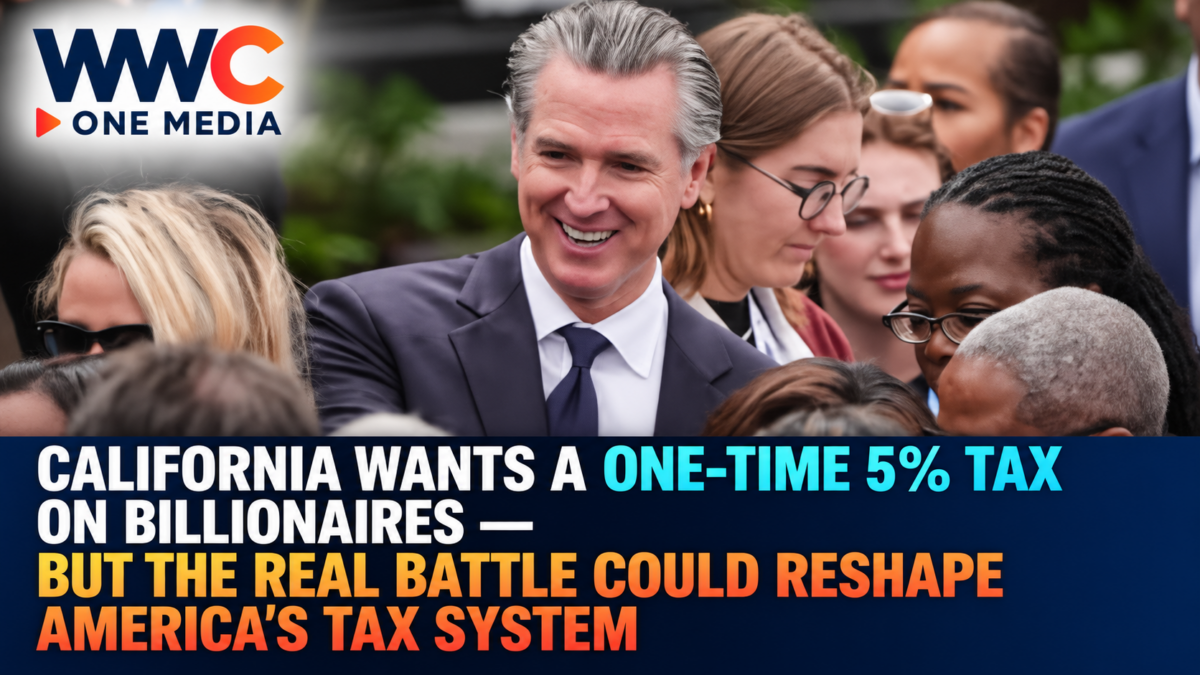
SACRAMENTO — California voters are about to decide whether some of the richest people on Earth should pay a one-time tax on their fortunes — and the political battle has already become much bigger than a fight over state revenue.
On November 3, Californians will vote on Proposition 40, a ballot measure that would impose a one-time tax of up to 5% on the net worth of California billionaires who were residents of the state on January 1, 2026.
Supporters say the measure could raise tens of billions of dollars for healthcare and other public programs while forcing the ultra-wealthy to shoulder more of the cost of a safety net strained by federal spending cuts.
Opponents warn it could drive billionaires, businesses and investment out of California while establishing a dangerous precedent for taxing wealth rather than income.
But beneath those arguments lies an even bigger political struggle.
If Proposition 40 passes, California could become the first major U.S. state to demonstrate that a direct tax on billionaire wealth can survive both a ballot-box fight and an all-out campaign funded by some of America’s richest people.
And that could give the national wealth-tax movement something it has never had before:
a working model.
What Proposition 40 Actually Does
Despite the rhetoric surrounding the campaign, Proposition 40 is not an annual wealth tax.
It is a one-time levy.
Under the official proposal, California residents whose assets exceed $1 billion would face a tax equal to as much as 5% of their net worth.
Covered assets include:
business ownership,
stocks and other securities,
intellectual property,
art,
and collectibles.
Real estate and certain pension and retirement assets are generally excluded.
The tax would be due in 2027.
Taxpayers could spread payments over five years, although doing so would increase the eventual amount paid.
The California Legislative Analyst’s Office estimates that the measure would generate tens of billions of dollars spread over several years.
Supporters have promoted figures approaching $100 billion, but official state analysts use a more cautious estimate because billionaire wealth can fluctuate sharply and because wealthy residents may change their behavior in response to the tax.
Where the Money Would Go
The initiative is heavily focused on healthcare.
Approximately 90% of the revenue would go toward public healthcare programs.
The remaining 10% would be directed toward areas including food assistance, education and administration of the tax.
The measure also prohibits the state from simply replacing existing funding with billionaire-tax revenue, meaning the money is intended to supplement rather than substitute for current spending.
Supporters argue the money is urgently needed because California faces pressure on Medi-Cal and other social programs following federal spending reductions.
That is why the measure has become closely associated with healthcare unions, particularly SEIU-United Healthcare Workers West, which helped place it on the ballot.
California Has More Billionaires Than Any Other State
The proposal matters partly because of where it is happening.
California has roughly 250 billionaires with combined wealth exceeding $2 trillion, according to Reuters.
Few places in the world contain such a large concentration of ultra-rich individuals.
Silicon Valley alone has produced fortunes on a scale rarely seen in modern history.
The founders, investors and executives behind companies including Google, Meta, Nvidia and many of the world’s biggest technology businesses live or have lived in California.
That makes the state an ideal testing ground for proponents of wealth taxation.
If California cannot persuade voters to tax billionaires, supporters may struggle to make the argument elsewhere.
But if California does it successfully, other Democratic-leaning states could take notice.
Sergey Brin Is Spending Enormous Sums to Stop It
The opposition is also extraordinary.
Google co-founder Sergey Brin has contributed more than $100 million to groups fighting the billionaire tax and promoting competing ballot initiatives.
Brin-backed political group Building a Better California had attracted more than $150 million by August, with funding also coming from venture capitalist John Doerr, Ripple co-founder Chris Larsen and former Google CEO Eric Schmidt.
The fundraising has accelerated as voting approaches.
The San Francisco Chronicle reported that wealthy tech and finance figures poured roughly $45 million into the effort in a single recent week, bringing Building a Better California’s fundraising to about $259 million.
That has transformed Proposition 40 into one of the clearest examples of the political power of extreme wealth.
Supporters say billionaires are spending hundreds of millions of dollars to avoid paying billions.
Opponents say they are protecting California from an economically damaging tax experiment.
Both sides understand that the fight will not necessarily end at the state line.
Proposition 42 Could Kill the Tax Even If Prop 40 Wins
The ballot has another unusual twist.
Voters will also decide Proposition 42, which would amend California’s constitution to prohibit new state taxes on ownership of financial and other personal assets.
That measure applies to taxes enacted or taking effect after January 1, 2026.
Its language specifically says that if another ballot measure conflicts with it and Proposition 42 receives more affirmative votes, the conflicting measure can be voided.
That creates a bizarre possibility.
California voters could approve Proposition 40.
They could also approve Proposition 42.
And depending on which receives more votes and how courts interpret the conflict, the billionaire tax could still be blocked.
The state’s own Legislative Analyst acknowledges that competing measures on the same ballot could create legal disputes.
In other words, voters are not simply choosing whether to tax billionaires.
They are also deciding whether California should constitutionally restrict future wealth taxation.
Gavin Newsom Opposes Proposition 40
The measure has also split California Democrats.
Governor Gavin Newsom opposes Proposition 40, even though many progressives and national Democratic figures support it.
Newsom has argued that a wealth tax makes more sense at the federal level because billionaires can simply leave an individual state.
That is the central economic argument against California acting alone.
A billionaire can move.
Their company may remain in California.
Their wealth may still come from California-based businesses.
But state residency can change.
If enough ultra-wealthy people relocate, critics say California could lose not only the wealth-tax revenue but also recurring income-tax payments.
The Legislative Analyst’s Office estimates the measure could cause an ongoing reduction of less than $1 billion per year in income-tax revenue from billionaires, depending on behavioral changes.
The Migration Question Is the Biggest Economic Risk
California already relies unusually heavily on wealthy taxpayers.
Capital gains and high-income residents generate a large portion of state revenue.
That makes the budget highly sensitive to stock-market swings — and to decisions by wealthy individuals about where they live.
Opponents say Proposition 40 could accelerate billionaire departures to states such as:
Texas,
Florida,
Nevada,
and Washington.
The Tax Foundation and other tax-policy critics have long argued that state-level wealth taxes are difficult to administer and can encourage migration.
Supporters dispute how large that effect would be.
They argue California’s technology ecosystem, universities, workforce, investment networks, climate and access to capital are difficult to reproduce elsewhere.
Reuters noted that California remains enormously attractive to high-value businesses despite its tax burden, helping explain why it continues to have more billionaires than any other state.
Bernie Sanders Says This Is a Fight Against Oligarchy
Senator Bernie Sanders has become one of Proposition 40’s most prominent national supporters.
He argues that the measure is not simply about funding healthcare.
It is about whether democratic governments retain the power to tax extreme concentrations of wealth.
Sanders says California’s approximately 260 billionaires collectively own more than $2.4 trillion, while ordinary households face rising healthcare and living costs.
His argument closely mirrors the FT’s broader thesis:
Proposition 40 could become a national test of whether voters see billionaire wealth primarily as private property to be protected — or as an economic concentration large enough to justify a new form of taxation.
That is why supporters frequently use the word “oligarchy.”
The political fight is about money.
But it is also about power.
Even Some Supporters Admit the Measure Is Imperfect
Proposition 40 is not receiving unconditional support from everyone on the left.
Billionaire environmentalist and Democratic donor Tom Steyer, for example, has called aspects of the proposal “problematic” while still supporting it as an emergency response to healthcare funding pressures.
Steyer says he would prefer a national wealth tax but argues California cannot wait indefinitely for Congress.
That hesitation reflects legitimate policy questions.
Wealth taxes are difficult to administer because many billionaires own assets that do not have simple daily market prices.
Publicly traded stock is easy to value.
A privately held company is harder.
So are:
artworks,
intellectual property,
private investments,
and complex partnership interests.
The state would potentially have to fight years of litigation over what those assets are worth.
Valuing Billionaire Fortunes Could Become a Legal Nightmare
Imagine someone owns 35% of a private technology company.
There may be no publicly traded share price.
The company might have raised money several years earlier at one valuation.
Current investors may believe it is worth something completely different.
The billionaire might argue the stake cannot be sold easily and deserves a discount.
California tax officials might disagree.
Multiply that across hundreds of wealthy individuals holding thousands of complicated assets and the administrative challenge becomes enormous.
The proposal therefore creates a tax system far more complex than simply applying a higher rate to income.
That complexity is one reason many economists who support greater taxation of wealth still disagree over the best mechanism.
But Supporters Have Some Powerful Economists
Proposition 40 has attracted support from prominent academics.
Six Nobel Prize-winning economists, including Joseph Stiglitz and Peter Diamond, endorsed the measure in September.
They argue that growing wealth concentration threatens both economic fairness and democratic institutions.
UC Berkeley economists Emmanuel Saez and Gabriel Zucman, two of the most influential academic advocates of wealth taxation, have also supported the proposal.
Their broader argument is that conventional income taxes miss enormous increases in billionaire wealth.
A founder can see shares appreciate by tens of billions of dollars without selling them.
Because unrealized gains are generally not taxed as ordinary income, enormous fortunes can compound for years.
A wealth tax attempts to capture part of that increase directly.
Proposition 40 Could Become California’s Reverse Prop 13
The political symbolism extends back nearly half a century.
In 1978, California voters passed Proposition 13, sharply restricting property taxes.
That measure helped ignite a national anti-tax movement and became one of the defining conservative political victories of its era.
The FT argues Proposition 40 could represent something approaching the mirror image:
a state ballot initiative capable of triggering a national movement toward taxing wealth rather than reducing taxes.
Whether that comparison proves justified depends entirely on what voters do.
But California has repeatedly shown that policies tested there can influence the rest of America.
Environmental standards, consumer regulations, labor rules and technology policies developed in California often spread nationally because of the state’s enormous economic size.
Tax policy could be next.
The Billionaires Are Also Fighting for the Rules After 2026
This is why Proposition 42 may ultimately matter as much as Proposition 40.
Prop 40 is a one-time tax.
Prop 42 is about the future.
If Proposition 42 becomes part of the California Constitution, the state would lose much of its ability to impose new taxes on financial assets and personal wealth in the years ahead.
That means billionaire-backed groups are not merely trying to defeat one tax.
They are trying to shut the door on similar taxes before another proposal appears.
This turns the ballot fight into a battle over the rules of taxation for decades.
Polling Shows a Very Close Fight
The electorate remains divided.
Reuters reported that a September poll showed approximately 52% support for Proposition 40.
That gives supporters a narrow advantage but hardly a comfortable one.
California ballot measures often lose support as Election Day approaches, particularly when voters encounter heavy advertising urging them to vote no.
And opponents have an enormous advertising war chest.
That makes the final weeks particularly important.
Voters are likely to be bombarded with competing messages.
Supporters will argue:
protect healthcare and make billionaires pay.
Opponents will argue:
protect jobs, businesses and California’s economy.
The more complicated provisions involving Propositions 41 and 42 may be much harder to explain.
The Fight Is Really About Whether Billionaires Can Be Taxed at the State Level
There is a fundamental structural problem with taxing the ultra-rich.
A federal government can impose nationwide rules.
A state cannot.
California can tax someone who lives in California.
But it cannot easily stop that person moving to Austin, Miami or Las Vegas.
That is why Newsom and other critics say the federal government is the appropriate place for a wealth tax.
Supporters respond that waiting for Congress could mean waiting forever.
National wealth-tax proposals have repeatedly stalled.
So their strategy is essentially:
start somewhere powerful enough to prove it can work.
California is that somewhere.
What Happens If Prop 40 Wins?
A victory would not produce an immediate flood of money.
Implementation would take time.
Asset valuations would have to be determined.
Taxpayers could choose installment payments.
Litigation would almost certainly follow.
And conflicts with Propositions 41 or 42 could end up in court.
But politically, the impact would be immediate.
Progressive lawmakers across the country would point to California as evidence that taxing billionaire wealth is electorally viable.
National Democrats could face pressure to embrace similar policies.
Billionaires and business groups would likely organize aggressively to prevent the idea spreading.
And the 2028 presidential campaign could inherit wealth taxation as a much bigger national issue.
What Happens If It Loses?
A defeat would be equally significant.
Opponents would argue that even California — one of America’s most liberal states — rejected a direct tax on billionaires.
That could weaken momentum behind national wealth taxes.
It would also demonstrate the effectiveness of extraordinarily well-funded opposition campaigns.
But even a loss may not end the debate.
The fact that a wealth-tax proposal reached the ballot, attracted Nobel economists, national politicians and hundreds of millions of dollars in opposition spending already shows how dramatically the political conversation has changed.
Twenty years ago, taxing wealth directly sat largely outside mainstream American politics.
Now California voters are being asked to decide it themselves.
California Is Voting on More Than a Tax
The official ballot language sounds technical.
A one-time 5% levy.
Tens of billions in revenue.
90% for healthcare.
But the November 3 vote carries a much larger symbolic meaning.
It asks whether extraordinary private wealth should remain largely untouched until assets are sold — or whether governments can tax the fortunes themselves when inequality reaches historic levels.
It asks whether billionaires will leave if governments demand more from them.
It asks whether voters trust California to spend the money effectively.
And perhaps most importantly, it tests how much political power hundreds of millions of dollars in billionaire-funded campaigning can buy.
California has produced more billionaire fortunes than any other American state.
Now its voters are being asked whether those fortunes themselves should become taxable.
If Proposition 40 fails, it may become another cautionary tale about the limits of state-level wealth taxation.
If it wins, the biggest consequence may not be the tens of billions California collects — but the possibility that America’s decades-old tax debate has just moved onto entirely new ground.