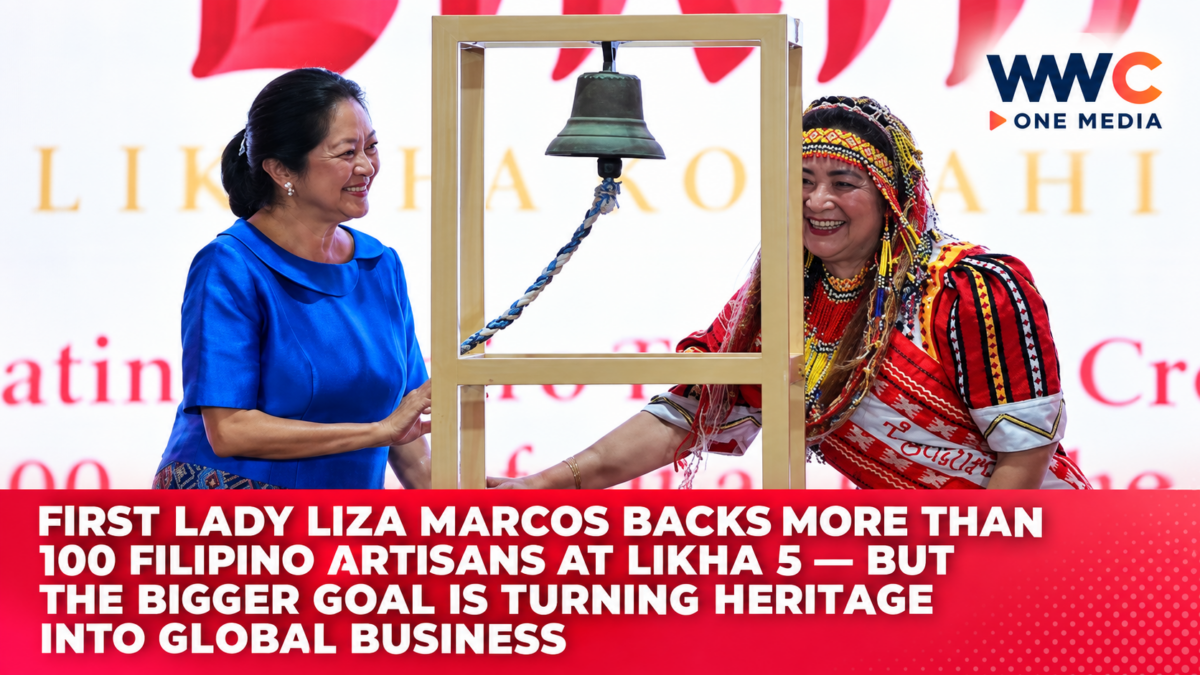
PASAY CITY — More than 100 Filipino artisans, emerging makers and heritage brands have taken over the newly revived Likhang Filipino Exhibition Halls as LIKHA 5 puts traditional craftsmanship at the center of a much bigger ambition: transforming Filipino cultural heritage into sustainable livelihoods, stronger creative businesses and products capable of competing in global markets.
First Lady Liza Araneta-Marcos led the opening of “LIKHA 5: Likha Ko, Lahi Ko” at the Likhang Filipino Exhibition Halls along Roxas Boulevard in Pasay City, continuing an initiative launched in 2023 to give artisans from across the Philippines greater visibility and commercial opportunities.
The fifth edition features 106 booths divided among emerging artisans, previous LIKHA participants and established local brands.
Thirty booths are dedicated to new artisans.
Another 48 booths in the Artisan Village represent 58 LIKHA graduates.
Twenty-eight additional booths showcase established brands and legacy makers.
The exhibition is more than a retail fair.
Visitors can watch live demonstrations, attend workshops and interact directly with master artisans to understand the skills behind textiles, baskets, accessories, traditional clothing, home décor and other handcrafted products.
And that educational component is central to the First Lady’s message.
Her argument is that traditional Filipino art should not survive merely as something displayed in museums.
It needs to remain economically viable enough for younger generations to keep practicing it.
LIKHA Is About Keeping Traditional Crafts Alive
Araneta-Marcos said the earlier editions of LIKHA helped reveal the depth of Philippine native arts and crafts, while the fifth edition is focused on ensuring those traditions continue as living parts of the country’s heritage.
That distinction matters.
Cultural preservation is often discussed as if it simply means protecting old objects.
Craftsmanship requires something more difficult:
people must continue learning the skills.
Materials must remain available.
Communities must have customers.
And artisans must be able to earn enough money for younger people to believe the craft has a future.
Without those economic incentives, traditions can disappear even when they are publicly celebrated.
More Than 100 Makers Are Participating
Official LIKHA information confirms that the 2026 edition brings together more than 100 Filipino artisans.
The event introduces 30 new artisans alongside returning LIKHA graduates and established brands.
That structure is important because the program is not limited to famous names.
It deliberately creates space for emerging makers who may not yet have:
large distribution networks,
professional marketing,
export experience,
or access to major commercial buyers.
For a small artisan business in a remote province, simply getting products in front of thousands of consumers, designers and institutional buyers can significantly expand opportunity.
LIKHA Gives Remote Artisans a Bigger Market
One of the original goals of LIKHA was to provide artisans from geographically challenged communities with greater exposure.
That can be particularly important in the Philippines.
Some of the country’s most distinctive crafts are produced outside major commercial centers.
Transportation is expensive.
Digital marketing capabilities vary widely.
And many traditional producers operate as family businesses or community enterprises rather than large companies.
A national platform can therefore close part of the gap between extraordinary craftsmanship and limited market access.
GMA reported that participating artisans themselves described LIKHA as beneficial to their livelihoods because it gives their products access to larger markets while helping preserve Filipino culture and tradition.
There Is Already Evidence That LIKHA Can Change a Small Business
One of the clearest examples is Banwa Pens, the Iloilo-based handmade pen business founded by artisan Arnel John “Nonoy” Vallejo.
The Philippine Information Agency reported that Vallejo began the business as a small passion project while still working a regular job.
After participating in LIKHA, the brand gained broader exposure.
Banwa Pens later received one of the most visible commissions possible: producing the official ballpoint pens used by ASEAN leaders during the 48th ASEAN Summit.
That is exactly the kind of commercial progression LIKHA is designed to encourage.
A local craft moves from:
small-scale production,
to national exposure,
to institutional recognition,
and potentially into international markets.
For artisans, that path may be more valuable than a one-time subsidy.
The Creative Economy Is Already Worth ₱2.12 Trillion
This cultural story also has serious economic scale.
According to the Philippine Statistics Authority, the country’s creative economy reached ₱2.12 trillion in 2025, up 6.9% from ₱1.98 trillion in 2024.
Creative industries accounted for 7.6% of Philippine GDP.
That means creativity is not a niche part of the economy.
It already contributes more than one peso out of every thirteen pesos of economic output.
The sector includes:
digital creative services,
advertising,
publishing,
film and audiovisual media,
music,
visual arts,
design,
trade shows,
and traditional cultural expression.
LIKHA sits directly inside that larger economic ecosystem.
Traditional Culture Employs Millions
Traditional cultural-expression activities are especially important from an employment perspective.
PSA estimates show that the creative industries employed 8.71 million people in 2025, equivalent to 17.8% of total employment.
Traditional cultural expression accounted for the largest portion of creative employment at 33%, equivalent to roughly 2.87 million people.
That is why artisan policy is not only about culture.
It is also about jobs.
Weaving.
Woodcraft.
Basketry.
Metalwork.
Textiles.
Jewelry.
Traditional accessories.
Handmade homeware.
These are economic activities supporting real households and communities.
But Creative Employment Actually Fell Slightly
The PSA data also contains a warning.
Creative-industry employment slipped 0.4% in 2025, falling from 8.74 million to 8.71 million workers even as the sector’s economic output expanded.
That suggests growth in the creative economy does not automatically mean every artisan or craft community benefits equally.
Some of the fastest-growing creative sectors are digital.
Traditional crafts face very different pressures.
Mass-produced imports can compete on price.
Young people may migrate to cities.
Raw materials can become harder to source.
And handmade production is inherently difficult to scale.
Events such as LIKHA therefore address a real structural challenge:
how to keep traditional craftsmanship economically relevant inside a modern economy.
LIKHA 5 Has a New Permanent Home
This year’s event is especially notable because LIKHA is now being held inside the newly reopened Likhang Filipino Exhibition Halls at the International Trade Center Complex in Pasay.
President Ferdinand Marcos Jr. officially launched the renovated facility on January 15, 2026, alongside the First Lady and former First Lady Imelda Marcos.
The facility occupies the site of the former PhilTrade Center, which dates back to 1979.
The government describes its reopening as a revival of a venue historically used to promote Philippine export products.
The Halls Are Intended to Operate Year-Round
That may be even more important than LIKHA itself.
The Likhang Filipino Exhibition Halls are designed as a permanent showroom, marketplace and incubation facility rather than merely a venue for occasional fairs.
The complex showcases:
furniture and lighting,
fashion and textiles,
traditional arts and crafts,
home décor,
gifts,
food,
health,
and wellness products.
More than 2,000 products from nearly 200 enterprises were included in the permanent galleries when the facility reopened.
That gives Filipino designers and artisans something many small creative businesses desperately need:
continuous visibility.
Trade Fairs Have One Big Limitation
Traditional trade shows last a few days.
Buyers arrive.
Products are displayed.
Deals may happen.
Then the booths disappear.
A year-round facility changes the model.
Foreign buyers visiting Manila can see Filipino products throughout the year.
Government delegations can visit.
Tourists can discover local design.
Exporters can maintain product visibility between major events such as Manila FAME and IFEX Philippines.
CITEM Executive Director Leah Pulido Ocampo has described the halls as a way of maintaining momentum from the agency’s major trade shows throughout the year.
That could help convert cultural promotion into actual commercial relationships.
Exporting Is the Bigger Business Opportunity
The Philippines already exports hundreds of billions of pesos worth of creative products and services.
PSA data show creative-goods exports reached ₱320.06 billion in 2025, while creative-services exports totaled ₱426.99 billion.
That gives the creative economy a significant export dimension.
But the country also imported ₱711.48 billion in creative goods during the same year.
That creates an opportunity.
If more Philippine designers and makers can produce commercially scalable products, they may capture a greater share of both domestic consumption and global export demand.
LIKHA can help create the brand story.
CITEM and trade promotion programs then have to help turn that story into orders.
Filipino Craftsmanship Has an Advantage Mass Production Cannot Copy Easily
Handmade Philippine products cannot always beat factory-made imports on price.
They can compete on something else:
identity.
Materials.
Craft tradition.
Regional design.
Storytelling.
Authenticity.
A handwoven textile from a specific community cannot easily be reduced to a generic commodity.
That can become a significant advantage in premium markets where consumers increasingly want products with provenance and cultural meaning.
The challenge is making sure artisans receive enough of the economic value created by those stories.
The Risk Is Turning Heritage Into Decoration
This is where cultural commercialization becomes complicated.
Using indigenous or traditional design can generate revenue.
But it can also create problems when:
communities are not credited,
designs are copied,
traditional motifs are commercialized without consent,
or middlemen capture most of the profits.
Successful creative-economy policy therefore has to protect more than craftsmanship.
It must also protect intellectual and cultural ownership.
Otherwise, artisans may see their traditions become commercially popular without benefiting proportionately.
Workshops Matter Because Craft Knowledge Is Often Personal
Many traditional skills are not learned from textbooks.
They are passed directly from one practitioner to another.
A master weaver teaches technique.
A woodworker demonstrates how a particular tool is used.
A basket maker shows how materials are prepared.
The knowledge is physical.
It is learned through repetition.
That makes LIKHA’s workshops and live demonstrations more important than they may initially appear.
They are not simply entertainment for visitors.
They make the process visible and help transmit appreciation—and potentially skills—to another generation.
The Event Also Helps Consumers Understand Why Handmade Products Cost More
One persistent problem facing artisans is pricing.
Consumers sometimes compare a handcrafted product with a cheap industrial alternative without understanding the labor behind it.
Watching a maker weave, carve or assemble an item changes that calculation.
A basket that took two days to create no longer looks expensive merely because a machine-made version is available for less.
The buyer begins to understand what is being purchased:
labor,
knowledge,
time,
materials,
and heritage.
That can support higher-value markets where artisans are paid more fairly.
Heritage Needs Buyers, Not Just Applause
This is perhaps the most important economic reality.
An artisan cannot live on recognition alone.
Public officials can praise craftsmanship.
Events can celebrate national identity.
But traditions will survive long-term only if someone is willing to pay the people practicing them.
That means preservation policy has to include:
market access,
pricing support,
business education,
design development,
digital commerce,
export promotion,
and intellectual-property protection.
LIKHA addresses visibility.
The next step is helping participants convert visibility into stable businesses.
The Newbies Section Could Be Especially Important
LIKHA 5’s 30-booth Newbies section deserves particular attention.
Established brands already know how to operate in major retail environments.
Emerging artisans often do not.
For newcomers, a national exhibition can provide exposure to:
buyers,
media,
designers,
other makers,
government agencies,
and potential collaborators.
The experience can also teach practical lessons about packaging, pricing and customer reaction.
That makes LIKHA partly an incubation program.
The Artisan Village Shows the Program Is Trying to Build Continuity
Another 48 booths represent 58 returning LIKHA graduates.
That matters because many government exhibitions suffer from a familiar problem:
participants appear once and disappear.
A graduate section implies an effort to maintain relationships with earlier artisans and show how businesses evolve after joining the program.
The ideal outcome is not for an artisan to participate in LIKHA forever.
It is for the artisan eventually to become commercially strong enough to reach customers independently.
Established Brands Create Another Link in the Ecosystem
The 28 booths allocated to established brands and legacy artisans create opportunities for smaller makers to interact with businesses that have already built stronger distribution and branding.
That can lead to:
mentoring,
collaborations,
design partnerships,
supplier relationships,
and shared retail opportunities.
Creative industries often grow through networks rather than isolated businesses.
A weaver can work with a fashion designer.
A woodworker can collaborate with a furniture brand.
A traditional pattern can inspire contemporary home décor.
LIKHA creates a physical space where those relationships can begin.
ASEAN Exposure Could Expand the Opportunity
The timing also matters because the Philippines is hosting major ASEAN activities in 2026.
The Likhang Filipino Exhibition Halls were partly designed to serve buyers, tourists and official delegations visiting the country during the Philippine ASEAN chairship.
That gives Filipino makers access to an audience beyond ordinary domestic shoppers.
Regional diplomats and business leaders can encounter local design while attending international events.
The Banwa Pens story already demonstrates how cultural products can become part of diplomacy.
That kind of visibility can be commercially powerful.
Philippine Craft Can Become Soft Power
Countries routinely use culture to strengthen their global image.
Japan has design.
South Korea has entertainment and beauty.
Italy has fashion and luxury craftsmanship.
Thailand has food and wellness.
The Philippines has an enormous portfolio of regional crafts, textiles, materials and indigenous design traditions.
If presented consistently, those products can become part of the country’s international identity.
That creates what policymakers often describe as soft power.
A foreign visitor may first encounter the Philippines through a textile, piece of furniture or handmade object.
The product becomes a cultural ambassador.
But Global Success Requires Consistency
Beautiful craftsmanship alone is not enough for export markets.
International buyers also require:
consistent quality,
reliable production,
delivery schedules,
professional packaging,
proper documentation,
and the ability to meet larger orders.
This can be difficult for individual artisans.
Scaling handmade production without destroying what makes it special is one of the hardest challenges in craft businesses.
That is where organizations such as CITEM can become important.
The artisan provides the craft.
The wider ecosystem has to provide business infrastructure.
E-Commerce Could Expand the Market Dramatically
Many crafts no longer need traditional retail distribution to reach customers.
Social media and e-commerce allow small producers to sell directly to buyers across the Philippines and abroad.
That creates opportunities that previous generations of artisans never had.
But it requires skills in:
photography,
digital marketing,
online customer service,
payments,
shipping,
and inventory management.
Programs such as LIKHA could become even more valuable if exposure at the physical exhibition is connected directly to digital storefronts.
A visitor may see an artisan once.
An online store lets that relationship continue.
Tourism Can Also Become Part of the Business Model
Crafts and tourism naturally reinforce each other.
Travelers want objects that connect them to the places they visit.
Artisan communities can also become destinations themselves.
Visitors can:
watch weaving,
learn pottery,
see carving,
join workshops,
and purchase directly from producers.
That creates multiple income streams.
The product becomes only one part of the experience.
For rural communities, creative tourism can help generate income without requiring every artisan to relocate to Manila.
The Biggest Threat May Be the Loss of the Next Generation
Traditional crafts survive only if younger people learn them.
That is becoming harder.
A young Filipino deciding between an artisan livelihood and a more predictable salaried job may understandably choose the latter.
If craft work is poorly paid, the knowledge eventually disappears.
That is why the First Lady’s focus on continuity is relevant.
The most effective preservation policy may ultimately be economic.
Make craftsmanship profitable enough that young people want to continue it.
LIKHA 5 Is Free to the Public
LIKHA 5 runs from October 2 to October 4, 2026, from 9 a.m. to 7 p.m., with free admission.
The venue is designed to be accessible to seniors and persons with disabilities, with parking and food options available onsite.
Those details support another goal:
making Filipino craft accessible not only to collectors and industry professionals but to ordinary families.
Cultural preservation becomes stronger when people actually engage with the culture.
The Bigger Test Comes After the Exhibition Closes
LIKHA 5 can bring attention to Filipino craftsmanship for three days.
The harder task begins afterward.
How many participating artisans receive large orders?
How many enter new retail markets?
How many begin exporting?
How many increase their incomes?
How many hire additional workers?
And how many younger Filipinos decide that traditional craftsmanship can still provide a viable livelihood?
Those are the metrics that ultimately determine whether cultural promotion becomes economic development.
This Is Bigger Than One First Lady’s Advocacy
The political figure at the center of the event is Liza Araneta-Marcos.
But the economic opportunity is much broader.
The Philippines already has a ₱2.12-trillion creative economy.
Millions of people work in creative industries.
Traditional cultural expression alone supports a massive number of workers.
The country already exports hundreds of billions of pesos in creative goods and services.
The raw ingredients therefore exist.
What many artisans still lack is scale.
LIKHA’s Real Mission Is to Turn Craft Into Sustainable Enterprise
That may be the best way to understand LIKHA 5.
It is a heritage exhibition.
But it is also a business-development platform.
A preservation project.
An export-promotion exercise.
A tourism showcase.
And a creative-industry incubator.
The First Lady’s message focuses on ensuring Filipino craftsmanship survives for generations.
The business challenge is determining how.
For many artisans, the answer may ultimately be straightforward:
heritage survives when the people carrying it forward can build a livelihood from it.
That means the real success of LIKHA 5 will not be measured by how many people admire the products in Pasay this weekend.
It will be measured by how many Filipino makers eventually turn those products into businesses strong enough to survive long after the exhibition ends.