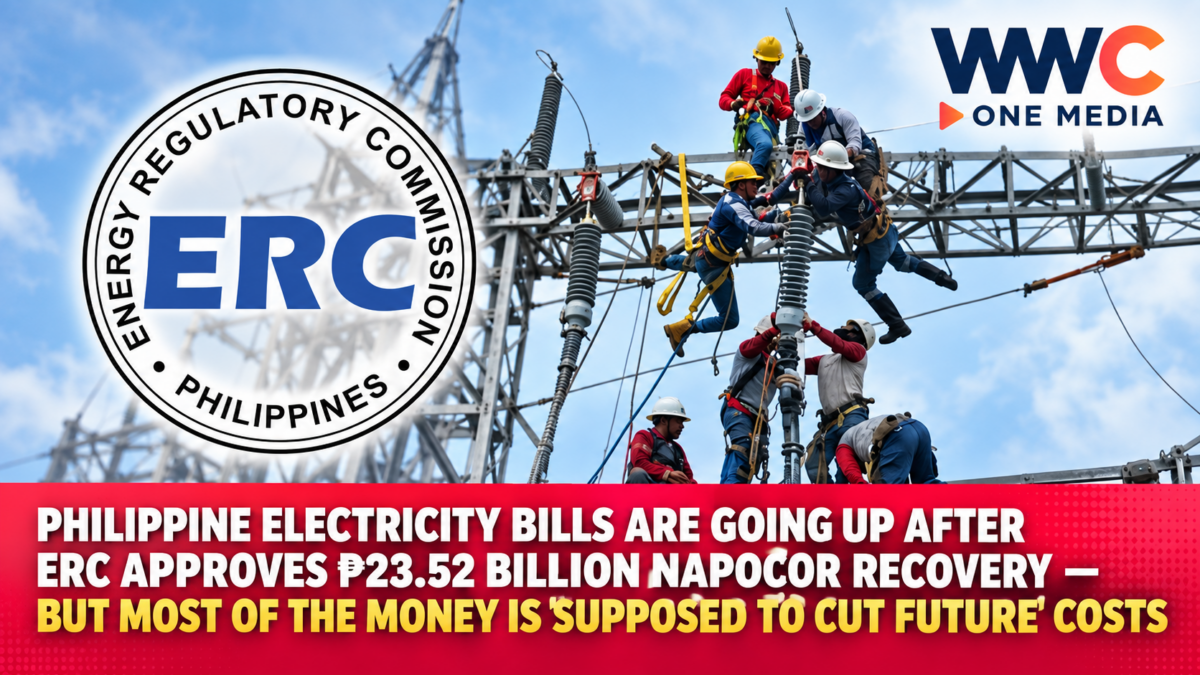
MANILA — Filipino electricity consumers will begin paying a higher nationwide power charge starting in October after regulators allowed the National Power Corporation, or Napocor, to recover ₱23.52 billion in previously disallowed costs tied to supplying electricity in remote and off-grid communities.
The Energy Regulatory Commission approved the recovery through an omnibus order resolving 26 long-pending Napocor rate cases filed between 2013 and 2024 and covering costs incurred from 2012 through 2022.
The immediate impact will appear in the Universal Charge for Missionary Electrification, better known as UC-ME.
The ERC approved an additional:
₱0.0634 per kilowatt-hour
on top of the existing:
₱0.2763 per kWh
bringing the total UC-ME to:
₱0.3397 per kWh beginning with the October 2026 billing period.
That means the increase applies not only to consumers living on remote islands.
Under Philippine law, the Universal Charge is collected from electricity end-users nationwide to help finance missionary electrification and other power-sector obligations.
So even customers in Metro Manila, Cebu, Davao and other areas connected to the main grids can feel the increase.
How Much More Could Households Pay?
The additional ₱0.0634 per kWh may sound small.
But the increase depends on how much electricity a household consumes.
For example:
A household using 100 kWh would pay about ₱6.34 more per month.
At 200 kWh, the increase would be around ₱12.68.
At 300 kWh, it would be roughly ₱19.02.
At 500 kWh, it would be about ₱31.70.
A large consumer using 1,000 kWh would pay approximately ₱63.40 more from this specific adjustment alone.
Those figures do not include other changes in generation, transmission, taxes or distribution charges that may also affect the final monthly electricity bill.
Why Consumers Nationwide Pay for Remote Islands
The reason goes back to the structure of the Philippine power sector.
Many remote islands and isolated communities are not connected to the Luzon, Visayas or Mindanao grids.
Electricity there is often produced using relatively small diesel or bunker-fuel power plants.
That can be extremely expensive.
But consumers living in those areas do not pay the full cost of generating that electricity.
Instead, they pay a subsidized rate.
The difference between the subsidized rate and the actual cost of producing power is financed partly through the Universal Charge for Missionary Electrification.
In effect, electricity consumers nationwide help subsidize power for communities where ordinary commercial electricity service would otherwise be too expensive or financially unviable.
The Universal Charge Is Required by Law
The UC-ME is not simply a discretionary fee created by Napocor.
It comes from the Electric Power Industry Reform Act of 2001, or EPIRA.
Section 34 of the law created a Universal Charge to fund several obligations, including missionary electrification.
The law states that the charge is non-bypassable and collected monthly from end-users by distribution utilities and other authorized power suppliers.
That means ordinary electricity consumers ultimately finance part of the cost of keeping power available in remote areas.
Why ₱23.52 Billion Is Being Recovered Now
The unusual part of the ERC decision is how old many of the cases are.
Some applications stretch back more than a decade.
The omnibus order finally resolved Napocor petitions involving:
Basic UC-ME applications for 2017 through 2022,
UC-ME true-up cases covering 2012 through 2022,
and adjustments under the Generation Rate Adjustment Mechanism and the Incremental Currency Exchange Rate Adjustment.
ERC Chairperson Francis Saturnino Juan said some of the cases had been pending since 2013 and that leaving them unresolved created uncertainty for both Napocor and power providers serving remote communities.
The commission therefore reconsidered earlier decisions that had disallowed portions of Napocor’s claimed costs.
The ERC Restored ₱23.52 Billion
In total, regulators restored about ₱23.52 billion in Napocor costs.
Those funds are intended partly to settle long-outstanding subsidy claims owed to entities supplying power in missionary areas.
These include:
Napocor itself,
New Power Providers,
Qualified Third Parties,
and Microgrid Service Providers.
Those providers serve communities where electricity generation can be much more expensive than on the main grid.
Without sufficient subsidy payments, they can face financial pressure that may ultimately threaten service reliability.
Napocor Says More Than One Million Households Depend on These Systems
Napocor President and CEO Jericho Jonas Nograles said the restored recoveries will help maintain uninterrupted electricity service for more than one million households covered by Napocor and other missionary electrification providers.
That provides the social argument behind the increase.
Consumers in major urban areas pay slightly more so households in geographically isolated places can continue receiving electricity at rates they can afford.
The challenge is making sure that subsidy does not become permanently dependent on expensive diesel.
That is where the second half of the ERC decision becomes important.
₱16.54 Billion Must Go to Capital Spending
Of the ₱23.52 billion restored, ₱16.54 billion must be used exclusively for capital expenditures, according to Napocor.
That money is intended for projects that could eventually reduce the cost of supplying electricity in off-grid communities.
Napocor says planned investments include:
retiring old and fully depreciated generating plants,
hybridizing existing power facilities,
and deploying battery-energy-storage systems.
This is one of the most important parts of the ruling.
Consumers are being asked to pay more now.
Regulators want a significant portion of that money used in ways that could reduce subsidy requirements later.
The Goal Is to Move Away From Diesel
Diesel remains one of the biggest reasons missionary electrification is expensive.
Small island grids cannot benefit from the scale of large coal, gas, hydro or renewable plants connected to the national grid.
Instead, many communities rely on diesel generators.
Fuel must often be transported by ship.
Global oil prices can fluctuate dramatically.
And older generators can be inefficient.
That combination pushes the true cost of electricity far above rates paid by consumers in those communities.
Replacing part of that diesel generation with:
solar,
wind,
battery storage,
or hybrid systems
could materially reduce fuel expenses over time.
The Energy Department Is Already Moving in That Direction
The Department of Energy announced in August that it plans a dedicated Green Energy Auction for off-grid islands.
The program is specifically intended to replace costly diesel generation with renewable energy and battery-storage systems.
DOE said the objective is not only to improve reliability but also to lower the UC-ME burden paid by consumers nationwide.
That makes the ERC decision part of a larger transition.
The government is effectively trying to use higher near-term collections to fund a system that becomes cheaper later.
Whether that actually happens will depend heavily on project execution.
One Recent Grid Connection Shows How Much Can Be Saved
There is already a strong example.
In June, the municipalities of Lebak, Kalamansig and portions of Palimbang in Sultan Kudarat were connected to the main Mindanao grid.
That allowed Napocor to begin decommissioning its Kalamansig Diesel Power Plant.
Napocor estimates the transition will save roughly:
₱750 million per year in fuel
plus another:
₱46 million annually in rented generators.
And those numbers do not yet include other savings from:
maintenance,
lubricants,
spare parts,
and manpower.
That illustrates why connecting communities to the main grid—or replacing diesel with renewables—can eventually reduce the nationwide subsidy burden.
Missionary Electrification Is Supposed to Be Temporary Where Possible
The concept behind missionary electrification is not necessarily that Napocor should operate diesel power plants forever.
The regulatory definition describes it as providing basic electricity service in areas that are currently economically unviable, with the goal of eventually bringing those areas toward commercial viability.
Kalamansig is a good example.
Napocor served the community while it remained isolated.
Once grid infrastructure became available, the diesel facility could be retired and equipment redeployed to areas that still need it.
That is the ideal model:
subsidize communities while necessary,
then reduce the subsidy when cheaper electricity becomes available.
But Fuel Prices Are Making the Current System More Expensive
The ERC said rising fuel prices are increasing the cost of producing electricity in off-grid areas.
That means the subsidy requirement can rise even if consumption remains relatively stable.
Diesel-generation economics are particularly sensitive to oil prices.
When international fuel prices spike:
Napocor’s generation costs rise,
private providers need larger subsidies,
and the UC-ME fund comes under greater pressure.
That exposes electricity consumers nationwide to global energy volatility.
Renewables could weaken that connection.
The ERC Also Restored Napocor’s Return on Rate Base
Another important—and potentially controversial—part of the order is the restoration of Napocor’s 12% return on rate base for the 2012-to-2022 period, according to the corporation.
Return on rate base, or RORB, is intended to provide regulated utilities or power providers with a return on qualifying investments used to provide service.
Critics can reasonably ask why consumers should fund a return for a government corporation.
Napocor’s answer is that these funds are necessary to finance capital investments and modernize missionary power systems.
The ERC has imposed a condition:
the restored return must be directed toward reducing long-term UC-ME costs.
ERC Says Every Peso Must Help Lower Future Subsidies
ERC Chair Juan said the restored return must ultimately work toward reducing the cost of electricity in missionary areas and lowering the UC-ME burden over time.
That creates a clear benchmark for accountability.
If consumers pay the additional charge for years but off-grid generation remains heavily dependent on old diesel systems, the policy will be much harder to defend.
If the money finances renewable plants, storage systems and grid connections that permanently cut costs, the near-term increase becomes easier to justify.
This Is Not the Same as Napocor’s Stranded Debt Charge
Electricity bills already contain several government-mandated universal charges.
Consumers sometimes see these charges grouped together and assume they are all paying for old Napocor debt.
That is not accurate.
The UC-ME specifically supports missionary electrification.
EPIRA also allows other universal charges for purposes such as:
NPC stranded debt,
stranded contract costs,
environmental funds,
and certain other authorized obligations.
The ₱0.0634/kWh adjustment discussed here is specifically an increase in the missionary electrification component.
Consumers Should See the Charge Separately on Their Bills
ERC rules require the Universal Charge for Missionary Electrification to be separately identified on electricity bills.
That means customers should be able to see the UC-ME rate independently from:
generation,
transmission,
distribution,
system loss,
taxes,
and other charges.
The ERC also adopted a new electricity-bill format in September designed to provide clearer breakdowns of government-mandated pass-through charges.
That should make it easier for consumers to understand which portion of their monthly payment is changing.
Your Total Electricity Bill Could Still Move by Much More
The ₱0.0634/kWh UC-ME increase is only one component.
The total bill can change much more depending on:
generation costs,
fuel prices,
WESM prices,
power-supply contracts,
transmission charges,
foreign-exchange movements,
taxes,
and other adjustments.
So a household seeing its monthly bill jump significantly should not assume the entire increase came from Napocor.
For a household consuming 200 kWh, the direct incremental effect of this specific order is about ₱12.68.
Anything substantially larger would be coming from other bill components as well.
The Increase Comes at a Sensitive Time for Households
Any electricity increase is politically sensitive in the Philippines.
Power rates are already among the biggest recurring expenses for many families and businesses.
Air-conditioning demand can push consumption much higher during hot months.
Businesses also pass electricity costs into:
food,
retail prices,
manufacturing,
cold storage,
and services.
That means even relatively small per-kWh adjustments can spread through the broader economy.
For commercial and industrial users consuming thousands or millions of kilowatt-hours, the impact can become much larger than for an individual household.
Businesses Will Pay More Too
Because the Universal Charge applies broadly to end-users, commercial establishments and industrial customers are also exposed.
A business consuming 10,000 kWh per month would pay about ₱634 more monthly from the incremental UC-ME alone.
At 100,000 kWh, the added charge would reach roughly ₱6,340 per month.
For energy-intensive companies, those costs become another operating expense.
Again, the individual increase is not enormous compared with total electricity spending.
But businesses pay attention to every additional power cost because the Philippines already struggles with relatively expensive electricity.
The Recovery Is Expected to Run for Years
Bilyonaryo reported that the higher charge is intended to support the ₱23.52-billion recovery over roughly three years.
That means consumers should not view the October increase as a one-month adjustment.
It is designed as a multi-year recovery mechanism.
The exact amount collected can still depend on actual electricity consumption and regulatory implementation.
But households should expect the higher UC-ME component to remain relevant beyond the October billing cycle.
There Are Still More UC-ME Cases in the Pipeline
The latest omnibus order does not necessarily end all missionary-electrification adjustments.
ERC records show Napocor has filed additional petitions involving UC-ME requirements for 2026 and 2027, as well as requests to recover revenue shortfalls from later years.
That means missionary-electrification costs remain an active regulatory issue.
Future adjustments could still be considered depending on:
fuel costs,
generation expenses,
subsidy requirements,
and the pace of renewable-energy deployment.
The Bigger Problem Is Structural
The ₱23.52-billion order may look like a billing issue.
The deeper problem is how the Philippines powers thousands of islands.
Providing electricity to isolated communities is inherently expensive.
Some islands have too few customers to justify large generation facilities.
Others are too distant from transmission lines.
Diesel becomes the easiest solution.
But it is often the most expensive one over time.
That is why the long-term answer is unlikely to be simply adjusting UC-ME rates repeatedly.
It is changing how those communities are powered.
Renewables Could Reduce the Need for Subsidies
The Philippines has strong renewable resources.
Many remote islands have abundant:
sunlight,
wind,
and in some areas hydro or biomass potential.
Pairing renewables with batteries can reduce diesel consumption substantially.
Diesel generators may still remain as backup.
But every liter of fuel not burned can reduce subsidy requirements.
That is exactly why the DOE’s dedicated off-grid renewable auction could be important.
If private developers can supply renewable electricity to islands at lower long-term prices, the UC-ME could eventually decline.
Battery Storage Is Especially Important for Islands
Solar power generates during the day.
Island communities need electricity at night too.
Battery energy-storage systems can save excess daytime renewable electricity and release it later.
That reduces the amount of diesel generation required after sunset.
Napocor specifically identified battery storage and hybridization among the projects that could be financed using the restored capital expenditure funds.
That could transform the economics of isolated grids.
But Renewable Projects Also Need Oversight
The promise of cheaper electricity does not guarantee the projects will be efficient.
Government agencies still need to ensure:
competitive procurement,
reasonable project costs,
reliable technology,
proper maintenance,
and transparent implementation.
If capital spending is poorly managed, consumers could end up paying higher charges without receiving the promised long-term savings.
That makes regulatory monitoring critical.
The ERC’s instruction that the restored return be used to reduce future UC-ME should therefore be closely tracked.
The Real Test Is Whether the Charge Eventually Goes Down
Consumers are being asked to accept a clear cost today:
an additional ₱0.0634 per kWh.
The promised payoff comes later:
cheaper,
cleaner,
more efficient
off-grid electricity.
That gives the government a measurable test.
If Napocor retires expensive diesel units,
connects more islands to the grid,
deploys renewable generation,
and adds battery storage,
the subsidy requirement should eventually shrink.
If UC-ME continues rising indefinitely, then the transition will not have delivered its intended economic benefit.
The ₱23.52 Billion Is Really About Two Different Problems
Part of the money solves an old problem.
It settles costs and subsidy obligations accumulated through long-running cases dating back more than a decade.
Another part is supposed to solve a future problem.
It finances investments intended to make missionary electrification less expensive.
Those two purposes should not be confused.
One pays the past.
The other is supposed to reduce what consumers pay later.
For Consumers, the Impact Begins Now
Beginning with October 2026 bills, electricity users nationwide should see the higher UC-ME rate.
At 200 kWh:
about ₱12.68 extra.
At 500 kWh:
about ₱31.70 extra.
For most households, it will not be the largest component of the electricity bill.
But it represents another increase at a time when consumers remain highly sensitive to energy costs.
And because the charge is nationwide, millions of customers will collectively fund the recovery.
The Bigger Question Is What Consumers Get in Return
Napocor argues that the additional resources will protect electricity service for more than one million households in off-grid communities while helping finance a cleaner energy transition.
ERC says the restored returns must ultimately reduce long-term missionary electrification costs.
DOE is planning renewable auctions specifically to replace expensive island diesel generation.
Those goals are aligned.
Now comes the difficult part:
execution.
Because Filipino consumers are not simply being asked to pay ₱23.52 billion in additional recovery.
They are effectively being asked to finance a promise:
pay slightly more today so remote communities can keep their lights on—and so those communities can eventually be powered more cheaply tomorrow.
Whether that promise is fulfilled will determine if this electricity-bill increase becomes a temporary bridge to cheaper power or another long-term charge consumers simply learn to live with.