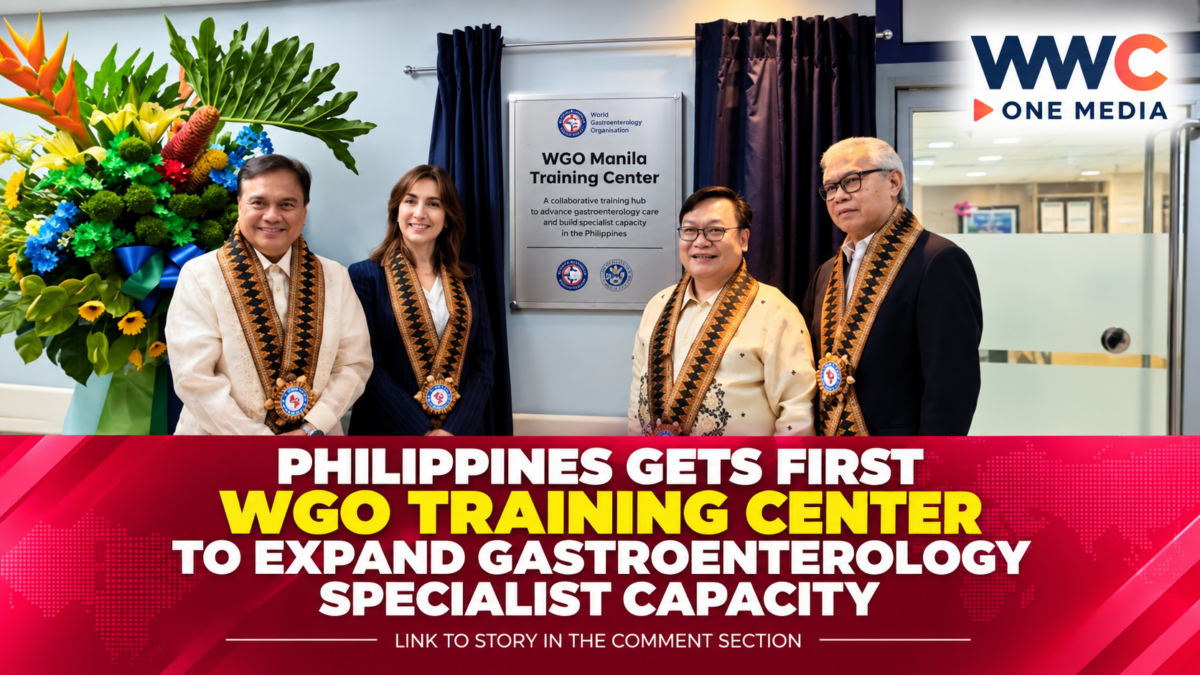
MANILA, Philippines — The Philippines is set to expand its pool of specialists in gastroenterology, digestive endoscopy and liver care after the World Gastroenterology Organisation (WGO) designated the Institute of Digestive and Liver Diseases (IDLD) at St. Luke’s Medical Center–Global City as an official WGO Training Center.
The WGO Manila Training Center, inaugurated on Oct. 6, is the first WGO training center in the Philippines, the third in Southeast Asia and the organisation’s 25th worldwide. It is designed to provide structured training for Filipino and international gastroenterology trainees while strengthening specialist capacity across the Philippines and the wider Asia-Pacific region.
The new center will focus particularly on advanced endoscopy and hepatology, giving doctors access to clinical observerships, simulation-based training and hands-on ex-vivo workshops that are designed to complement conventional clinical training.
Training doctors in advanced procedures
The Manila center will provide training in a range of advanced diagnostic and therapeutic procedures, including endoscopic mucosal resection (EMR), endoscopic submucosal dissection (ESD), endoscopic retrograde cholangiopancreatography (ERCP) and endoscopic ultrasound (EUS).
Training will also cover clinical hepatology, including support for liver transplantation, as well as gastrointestinal motility, inflammatory bowel disease, capsule endoscopy and bariatric and metabolic endoscopy.
The program will combine several forms of learning rather than relying solely on observation.
Trainees will be able to observe high-volume clinical practice, participate in structured simulation exercises, attend educational sessions and undertake ex-vivo workshops designed to develop procedural skills in a controlled environment.
The center will also provide faculty feedback and opportunities for deliberate practice, allowing trainees to build technical skills before applying them in clinical settings.
Two training tracks to build procedural skills
The Manila Training Center will operate two main training tracks.
The first will focus on simulation-based mastery and lower gastrointestinal endoscopy, culminating in a Basic Endoscopy Skills Training Lower Gastrointestinal Workshop.
The second will focus on image-enhanced endoscopy and advanced therapeutic techniques, including optical diagnosis, lesion recognition and treatment procedures.
Both tracks will include clinical and endoscopic observerships, institute conferences, educational sessions and hands-on ex-vivo training.
International trainees will also be able to take part in structured observerships lasting between two weeks and one month, subject to program availability and institutional requirements.
The center’s organizers said the combination of observation, simulation, classroom learning, hands-on training and faculty feedback is intended to give trainees a more comprehensive pathway to developing specialist skills.
A regional hub for gastroenterology training
The initiative is intended to benefit more than doctors based in Metro Manila.
The WGO said its training-center programme is designed to strengthen gastroenterology and liver-care capacity in places where access to high-quality specialist education remains limited. The organisation aims to increase both the number of digestive-health professionals and their level of expertise, while adapting training to regionally relevant diseases and healthcare needs.
WGO President Carolina Olano said unequal access to quality medical education remains a challenge internationally.
The organisation’s model is therefore built around creating training hubs where specialists can receive advanced instruction and then take that knowledge back to their own hospitals and communities.
That creates what Olano described as a “multiplier effect” — the impact of a training center extending beyond the doctors who directly attend its programs.
The Manila center is expected to contribute to that regional network by training doctors from the Philippines and other parts of Asia-Pacific.
St. Luke’s already has advanced GI capabilities
The designation builds on the existing capabilities of St. Luke’s IDLD.
According to WGO, the institute was established in 2010 and has developed a strong focus on clinical care, research, education and specialist training in gastroenterology, digestive endoscopy and hepatology.
Its endoscopy unit has been recognised under the World Endoscopy Organization’s CORE programme since 2020.
In March 2026, the institute also received Level 3 classification under the Philippine Society of Digestive Endoscopy’s EndURe Network, recognising its infrastructure, advanced capabilities, quality systems and patient-safety practices.
The institute currently has 32 consultants, including 24 full-time and eight part-time specialists, along with four fellows-in-training, according to WGO’s profile of the center.
It has also developed international collaborations, including a partnership with Kobe University School of Medicine in Japan that began in 2015 and contributed to the development of St. Luke’s Center for Advanced Gastrointestinal Endoscopy.
Focus on building Filipino expertise
For St. Luke’s, the WGO designation is intended to go beyond adding another international credential to the hospital.
St. Luke’s President and Chief Executive Officer Dennis P. Serrano said the hospital wants to develop local expertise and share its knowledge and training capabilities beyond its own institution.
The broader objective is to help ensure that advanced digestive-health care can be delivered by specialists trained within the Philippines rather than requiring patients and doctors to rely as heavily on overseas expertise.
The institute’s head, Ian Homer Y. Cua, described the WGO designation as an important step for gastroenterology training in the Philippines and the Asia-Pacific region.
The center will also serve as a platform for collaborative research, faculty exchanges, mentorship and partnerships with other institutions.
Training could strengthen access to complex GI care
The need for more specialist capacity is particularly important as gastroenterology becomes increasingly specialised.
Modern digestive-health care covers a wide range of conditions, from gastrointestinal cancers and inflammatory bowel disease to liver disorders and complex diseases requiring advanced endoscopic procedures.
Procedures such as ESD, EMR, ERCP and EUS require specialised training and equipment. Expanding access to doctors with those skills could help hospitals manage more complex cases locally.
The WGO center’s objectives specifically include building capacity in the diagnosis and management of viral hepatitis, inflammatory and motility disorders and gastrointestinal malignancies.
The center will also support research and evidence-based practice, giving trainees opportunities to work with subspecialised faculty and multidisciplinary teams.
Connecting Philippine doctors to a global network
Another potential benefit is access to the wider WGO network.
The organisation operates training centers in multiple regions and uses them to facilitate knowledge-sharing, faculty exchanges and specialist education. Its broader goal is to create a connected learning network rather than isolated training institutions.
For Filipino trainees, that could create opportunities to learn from specialists working in other countries and gain exposure to procedures or subspecialties that may not be readily available through local training programmes.
The Manila center will likewise contribute Philippine expertise to the international network.
That two-way exchange could be particularly useful for rapidly evolving areas of gastrointestinal medicine, where techniques, technologies and clinical guidelines continue to change.
A new hub for Southeast Asia
The inauguration of the WGO Manila Training Center gives the Philippines a new role in regional specialist education.
As the third WGO training center in Southeast Asia, it joins a network intended to address gaps in access to advanced gastroenterology education and improve the quality of digestive-health services.
The immediate focus will be on training doctors and developing procedural expertise.
But the longer-term goal is broader: to create specialists who can return to their own hospitals, train colleagues, participate in research and expand access to advanced gastrointestinal and liver care.
If that model succeeds, the center’s impact will extend well beyond the St. Luke’s campus — potentially strengthening the Philippines’ specialist workforce and making the country a more important training hub for gastroenterology across Southeast Asia.