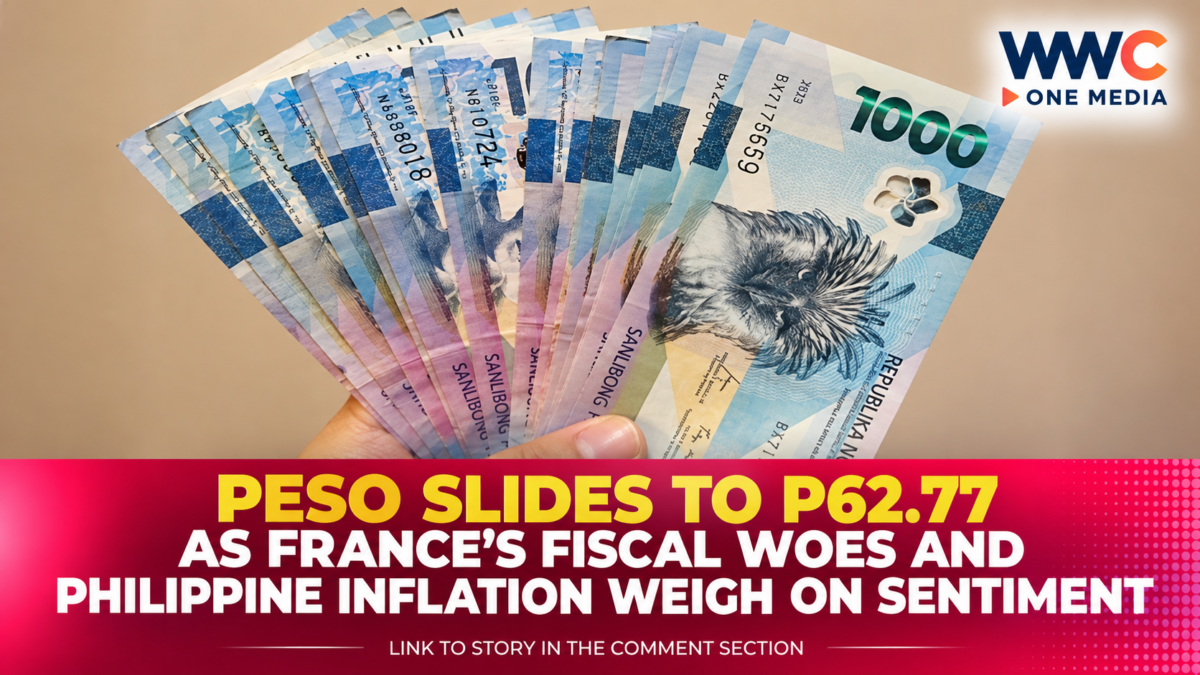
MANILA, Philippines — The Philippine peso weakened further against the US dollar on Tuesday, pressured by renewed demand for safe-haven assets as concerns over France’s finances rattled European markets and a sharp acceleration in Philippine inflation raised fresh worries over the domestic economic outlook.
The peso closed at P62.771 per US dollar on Oct. 6, down 15 centavos from Monday’s P62.621 finish, according to Bankers Association of the Philippines data. The currency opened at P62.55 and reached the same level as its intraday high before weakening to as much as P62.84 during the session.
That low brought the peso close to its P62.86 record-low closing level, recorded on Sept. 14.
Dollar trading volume also declined, with about US$1.496 billion changing hands on Tuesday, down from US$1.689 billion on Monday.
Safe-haven demand lifts the dollar
Market sentiment was affected by growing concerns over France’s fiscal position and political uncertainty in the euro zone.
A currency trader cited in the report said the dollar-peso pair moved higher as investors continued to favour safe-haven assets amid fiscal and political concerns in Europe.
The euro has come under significant pressure in recent sessions as investors reassessed the financial risks facing France.
The common currency fell to a 17-month low of US$1.1161 on Oct. 5, weighed down by concerns about France’s debt levels and political gridlock ahead of its 2027 elections.
France’s borrowing costs have also risen sharply as investors demand greater compensation for holding its government debt, adding to concerns about the sustainability of its public finances.
The weakness in the euro has, in turn, supported the US dollar as investors seek currencies and assets perceived as safer during periods of market uncertainty.
Philippine inflation jumps to 7.2%
The peso’s decline also came as the Philippines reported a much sharper-than-expected acceleration in inflation.
Annual headline inflation rose to 7.2% in September, up from 6.1% in August, according to the Philippine Statistics Authority.
The September figure exceeded the 6.6% median forecast in a Reuters poll of economists, although it remained within the Bangko Sentral ng Pilipinas’ forecast range of 6.4% to 7.4%.
The acceleration was driven by higher prices for rice, electricity, other fuels and transport, while core inflation — which excludes volatile food and energy prices — reached 4.7%.
The sharp increase marks a significant departure from the gradual easing seen in previous months. Inflation had declined to 6.1% in August from 6.2% in July, with lower food inflation helping to moderate price pressures.
Inflation complicates the interest-rate outlook
The latest inflation figures could make monetary policy decisions more difficult for the Bangko Sentral ng Pilipinas.
Higher inflation can reduce the central bank’s room to cut interest rates, particularly if price pressures prove persistent rather than temporary.
The September inflation figure was still within the BSP’s forecast range, but its stronger-than-expected acceleration could encourage markets to reassess expectations for monetary easing.
For financial markets, the combination of higher domestic inflation and a stronger US dollar creates additional pressure on the peso.
A weaker peso can also increase the local-currency cost of imported goods, including fuel and other commodities, potentially adding another source of inflationary pressure.
Peso remains close to record low
Tuesday’s trading session highlighted how vulnerable the peso remains to shifts in global risk sentiment.
Although the currency initially strengthened to P62.55 per dollar, it subsequently weakened sharply as demand for dollars increased.
Its intraday low of P62.84 was only two centavos away from its record-low close of P62.86.
The peso has experienced several periods of weakness in recent months as investors have weighed global interest-rate expectations, oil prices, domestic inflation and broader economic risks.
The latest move therefore puts renewed attention on whether the currency can stabilise without additional pressure from external shocks.
Global markets remain focused on the US Federal Reserve
Investors are also watching the US Federal Reserve closely for signals about the direction of interest rates.
Markets have recently reduced expectations of an October rate increase following weaker-than-expected US employment data.
Reuters reported that traders were pricing in only about a 20.5% probability of a Fed hike in October, down sharply from roughly 51% a week earlier. However, expectations for a rate increase later in the year remained considerably higher, with an estimated 84.5% probability of a December hike.
The uncertainty surrounding US monetary policy remains important for emerging-market currencies such as the peso.
Higher US interest rates generally strengthen the appeal of dollar-denominated assets, while expectations of lower rates can reduce some of the pressure on emerging-market currencies.
For now, however, investors are balancing those expectations against renewed inflation concerns and heightened global fiscal risks.
France adds another layer of uncertainty
France’s fiscal problems have become an increasingly important factor for European markets.
The country is facing pressure to reduce its budget deficit while political divisions have complicated efforts to push through spending restraint.
French 10-year borrowing costs have risen sharply, while the spread between French and German government debt has widened, reflecting increased investor concern over France’s fiscal position.
The euro’s decline has provided another channel through which European uncertainty can influence global currency markets.
For investors in emerging markets, episodes of heightened uncertainty often lead to a shift towards the US dollar and other perceived safe-haven assets.
That dynamic was evident in Tuesday’s peso trading.
What comes next for the peso
The peso now faces several competing forces.
On one side, expectations of a less aggressive Federal Reserve could eventually reduce some pressure on emerging-market currencies. On the other, elevated Philippine inflation, global fiscal concerns and continued demand for the US dollar could keep the peso under pressure.
The domestic inflation outlook will be particularly important for the BSP as policymakers assess whether recent price increases are temporary or signal a more persistent acceleration.
The currency’s proximity to its previous record-low close also means traders will be watching closely for signs of further depreciation.
For now, the peso remains caught between global demand for the US dollar and renewed concerns over domestic inflation — leaving the Philippine currency vulnerable to further swings as investors digest developments in both the local and international economies.