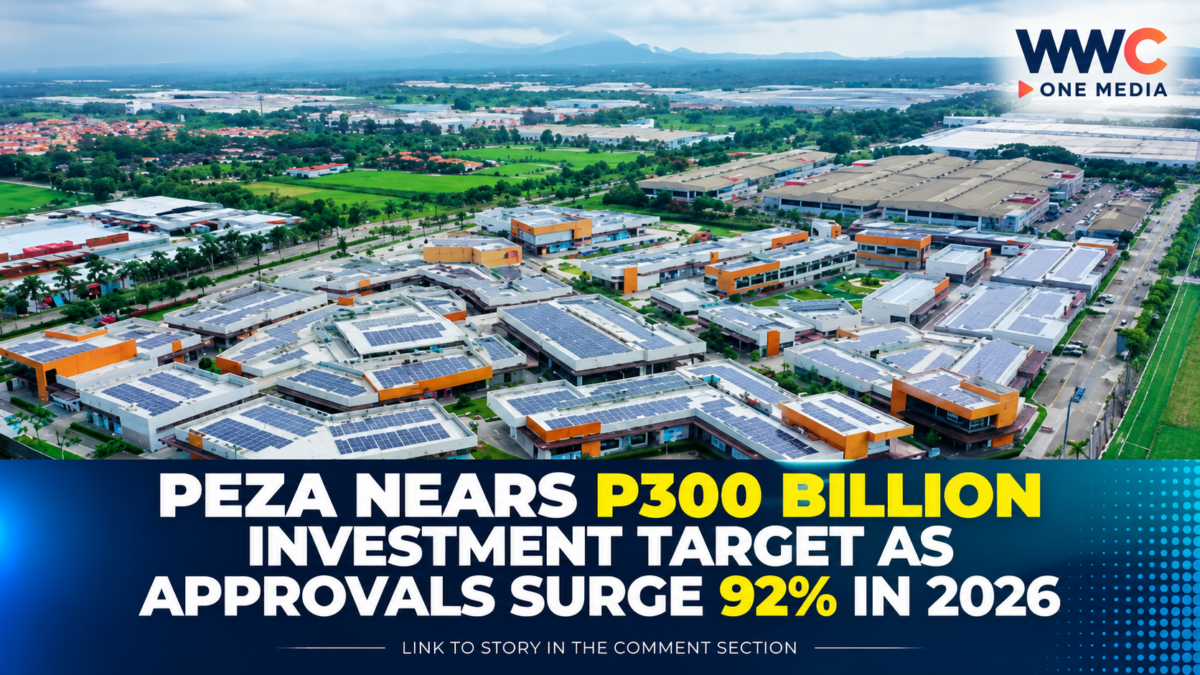
MANILA, Philippines — The Philippine Economic Zone Authority (PEZA) is just P2.86 billion short of its P300-billion investment target for 2026, after approving P297.14 billion worth of projects in the first nine months of the year.
The figure marks a sharp increase from the same period in 2025 and puts the agency within striking distance of its full-year goal, with three months still remaining.
PEZA said its Board approved 223 new and expansion projects worth P297.14 billion from January to September, representing a 92.07% increase from the P154.70 billion approved during the same period last year. The projects are projected to generate US$8.94 billion in exports and 33,331 direct Filipino jobs.
September approvals provide major boost
September was particularly strong for PEZA, with the Board approving P80.675 billion in investments from 27 new and expansion projects.
That was 65.08% higher than the P48.869 billion approved in September 2025. The projects are expected to generate around US$2.342 billion in exports and create 6,292 direct jobs.
The September projects covered a broad range of activities, including export manufacturing, facilities, information technology-business process management, ecozone development, logistics, domestic-market enterprises and utilities.
Five major projects accounted for P77.617 billion of the September approvals. They involve shipbuilding and repair, photovoltaic or solar manufacturing, real estate activities, bioethanol production and electronics manufacturing.
These projects are planned for Tarlac, Cavite, Batangas and Negros Occidental, extending investment activity beyond the country’s traditional economic centres.
Taiwan, Netherlands, South Korea lead foreign sources
PEZA’s latest figures also point to a diverse group of foreign investors.
Taiwan, the Netherlands, South Korea, Singapore and Indonesia were the leading foreign sources of approved investments from January to September, according to the agency.
PEZA said the broader investor base reflects growing interest in the Philippines as companies look to diversify their supply chains and establish production and export operations in the country.
The agency is also seeking to capitalise on the Philippines’ expanding network of trade and economic partnerships, including progress in negotiations for a Philippines-European Union free trade agreement.
PEZA said improved market access could help attract more companies seeking a base from which to serve regional and international markets.
Manufacturing and high-value industries remain key
The investment approvals span several industries, but PEZA is increasingly positioning its economic zones for higher-value activities.
The agency said it is targeting investments in advanced manufacturing, semiconductors and electronics, aerospace, pharmaceuticals and medical devices, artificial intelligence and digital technologies, logistics and renewable energy.
This push comes as companies around the world reassess their supply chains and seek additional production locations.
PEZA’s economic zones provide investors with established industrial and business infrastructure, while incentives and streamlined government processes are intended to make the Philippines more competitive as an investment destination.
The agency currently oversees 441 operating economic zones nationwide, including more than 200 within the Luzon Economic Corridor, according to PEZA.
Investment approvals are not the same as actual spending
The P297.14 billion figure represents approved investment commitments, rather than money that has already been fully spent or deployed.
PEZA’s approval numbers indicate that companies have received clearance for new or expansion projects. The economic impact will depend on how quickly these approved projects are implemented, begin operations and translate into actual exports and employment.
This distinction is important when assessing what the latest figures mean for the Philippine economy.
PEZA itself has said its priority is to help turn investment commitments into operational projects, jobs, exports and stronger links with Filipino suppliers.
PEZA eyes new record after passing 2025 performance
PEZA’s latest performance has already surpassed its P261-billion investment approval figure for 2025, according to the agency’s records.
It set the P300-billion target for 2026 after recording P260.89 billion in approved investments in 2025.
With P297.14 billion already approved by September, PEZA needs only P2.86 billion more to reach this year’s target.
Director General Tereso O. Panga said the agency intends to continue investment promotion and investor-facilitation efforts through the final quarter.
PEZA is also aiming to go beyond P300 billion and potentially challenge its historical record of about P311 billion in approved investments, which the agency said was achieved during the Aquino administration.
Stronger exports and jobs remain the bigger test
The investment numbers are significant, but their longer-term value will ultimately depend on how they translate into economic activity.
The projects approved through September are projected to generate nearly US$9 billion in exports and more than 33,000 direct jobs, offering potential benefits beyond the initial investment commitments.
PEZA’s August data had already shown that ecozone enterprises generated US$32.89 billion in actual exports during the first half of 2026, up 2.35% from the same period in 2025. Direct employment in the zones reached about 1.82 million, a 1.56% increase year on year.
The September approvals therefore add to an existing base of export-oriented businesses and workers operating inside Philippine economic zones.
P300 billion now within reach
PEZA’s latest numbers put the agency considerably closer to a target that appeared more challenging earlier in the year.
After eight months, approved investments stood at P216.46 billion, or 72.16% of the P300-billion goal. The strong September approvals added more than P80 billion in a single month, leaving only P2.86 billion to close the gap.
With three months left in 2026, PEZA is now positioned to meet its annual target if investment approvals continue, while further large projects could push the final total beyond P300 billion.
For the Philippines, the bigger question will be whether this pipeline of approved investments develops into factories, technology operations, export facilities and other businesses that generate sustained employment and strengthen domestic supply chains.
For PEZA, however, the immediate milestone is clear: the P300-billion investment target is now within striking distance.