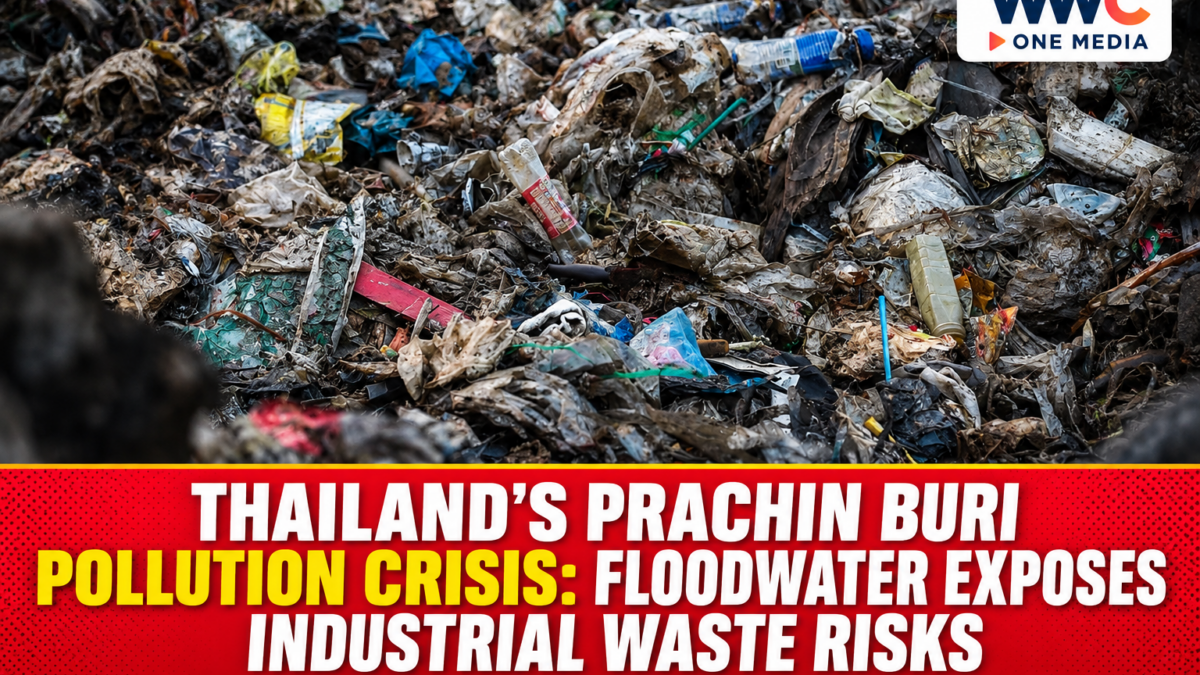
Flooding in Thailand’s Prachin Buri province has triggered an investigation into suspected industrial-waste contamination after unusual water discolouration and oil-like residue appeared around a waste-treatment area in October 2026.
Thailand’s Department of Industrial Works subsequently reported elevated oil-and-grease and hydrocarbon readings in samples collected around a landfill operation, while authorities ordered the operator to suspend activities temporarily and undertake corrective measures.
The episode has raised a wider question about how industrial waste facilities are monitored when heavy rain and flooding overwhelm local drainage and containment systems. It also gives Thailand’s regulators a practical test: whether enforcement orders, environmental monitoring and site rehabilitation can prevent similar incidents from recurring.
Floodwater exposed a problem beyond ordinary debris
The affected area is in Hua Wa subdistrict, Si Maha Phot district, in Prachin Buri. During flooding in early October, an oil-like sheen appeared on water around an industrial-waste landfill and waste-treatment area.
The Department of Industrial Works said preliminary inspections identified signs that industrial-waste leachate and contaminants may have escaped from the landfill and waste-treatment areas operated by Green Environment Technology Co., Ltd.
The department’s account is important because it describes an initial assessment, not a final judicial finding of liability. The company should not be treated as criminally responsible unless the relevant authorities establish that through the applicable legal process.
The Department of Disease Control also reported that unusual floodwater and a rainbow-coloured surface residue had been observed along a waterway extending for more than three kilometres, with agricultural land and nearby communities potentially exposed.
The incident demonstrates why flood response cannot be limited to removing household rubbish and clearing roads. Where industrial waste is stored, floodwater can also become a pathway through which contaminants move beyond a facility.
Laboratory results identified oil-related pollution
The Department of Industrial Works collected water samples from three locations: contaminated water near waste containers awaiting treatment, an industrial-waste leachate pond and contaminated water outside the facility.
Its laboratory results, dated Oct. 12, found that oil and grease exceeded the applicable factory-effluent standard. Hydrocarbons were also detected at elevated levels, with the department identifying similarities between the samples collected at the leachate pond and outside the facility.
The agency said the findings were consistent with the characteristics of used lubricating oil or alternative fuel that does not dissolve in water. It described these substances as possible contributors to the visible surface sheen.
The results also require careful interpretation. The department said most measured water pollutants were within applicable limits and that the heavy metals detected were generally below or within the relevant standards. However, it reported biological oxygen demand above 4.0 milligrams per litre, placing the tested surface water in a category it described as unsuitable for consumption.
That combination matters. A finding that certain heavy metals were not present at levels associated with severe acute harm does not mean the water is automatically safe for household or agricultural use.
The department advised residents to avoid using the affected water, drinking it or having prolonged direct contact with it.
Authorities ordered a temporary shutdown and corrective work
The Department of Industrial Works and Prachin Buri’s provincial industrial office used powers under Thailand’s Factory Act to impose restrictions on the facility.
The provincial office ordered the closure of all industrial-waste landfill pits under Section 37, including measures intended to prevent further spread through rainwater runoff. It also required additional contamination surveys inside and outside the site and an environmental rehabilitation plan.
Separately, the Department of Industrial Works issued a temporary suspension order covering the company’s factory operations under Section 39.
The operator was directed to improve its wastewater-treatment system, move raw materials and waste into buildings, and arrange for an engineer to inspect and certify the structural stability of the site’s embankments and buildings. The department set December 2026 as the deadline for those specified improvements.
It also ordered the immediate suspension of electronic-system acceptance of industrial waste and unused materials, preventing additional waste from being received while the corrective measures were being addressed.
These are administrative enforcement measures. They should not be described as a final criminal conviction or as proof that every aspect of the incident has been conclusively resolved.
Fish deaths are a separate investigation
The contamination concerns have also unfolded alongside reports of fish deaths in parts of the Prachin Buri River system. However, Thailand’s government has cautioned against treating the two events as one confirmed incident.
A government statement on Oct. 14 said the fish deaths and the oil-like sheen were recorded in different locations. Initial measurements around affected fish cages showed dissolved oxygen below 2 milligrams per litre, a level that can cause severe oxygen stress in fish.
Officials said flooding may have carried organic matter and stagnant water into the river, reducing dissolved oxygen. But the government said it could not confirm that this was the only cause of the deaths.
The Pollution Control Department separately reported elevated petroleum hydrocarbons in samples taken near the industrial-waste landfill. It planned further investigation and sediment sampling to help identify pollution sources.
The distinction is essential. The presence of oil-related contamination near a landfill does not establish that it caused fish deaths at another location. Linking the events requires evidence from sampling, environmental tracing and the relevant investigations.
Thailand’s wider water-quality challenges have also been covered in WWC’s report on arsenic concerns and clean-water planning in northern communities. The locations and pollutants differ, but both cases show why water testing must identify the substance, location and exposure pathway before authorities can assess the risks.
Waste oversight is becoming a national issue
Prachin Buri’s incident is part of a broader regulatory challenge involving industrial-waste processing, recycling and disposal.
On Nov. 11, the Department of Industrial Works reported that five ministries were coordinating a national response to illegal electronic-waste imports and industrial-waste disposal. The programme covers inspections and enforcement, controls on imports and exports, and possible legal reforms.
The department’s announcement described a nationwide effort to strengthen inspections and follow up on corrective orders. That approach matters because closing one facility or containing one visible spill does not necessarily resolve weaknesses in the wider waste-management chain.
Thailand has also faced separate pollution concerns involving industrial and commercial facilities. WWC previously examined an oil leak at a Bangkok data centre, where the response involved contaminated wastewater, sediment removal and environmental monitoring.
For Philippine readers, the broader lesson is relevant to industrial areas and flood-prone communities across Southeast Asia. Waste facilities need adequate containment, drainage, treatment systems and emergency procedures before extreme weather arrives — not only after contamination is detected.
What happens next
The immediate test in Prachin Buri is whether the operator completes the improvements required by the December deadline and whether regulators verify that the site meets the necessary conditions before operations can resume.
Further water and sediment testing will also be important. Surface-water samples provide information about conditions at particular locations and times, while sediment analysis can help investigators assess whether contaminants have accumulated in riverbeds or other receiving areas.
The government’s wider inspection programme will need to demonstrate that enforcement extends beyond announcements and initial inspections. That means checking whether facilities comply with orders, whether waste is stored and treated properly, and whether violations lead to appropriate action.
The October incident has shown how flooding can expose weaknesses in industrial-waste controls. The longer-term measure of success will be whether Thailand can prevent contaminated material from leaving facilities and protect communities and agricultural areas when the next period of heavy rain arrives.
Frequently asked questions
Where did the industrial-waste pollution concern occur in Thailand?
The incident involved Hua Wa subdistrict in Si Maha Phot district, Prachin Buri province, where unusual floodwater residue was reported near an industrial-waste landfill and treatment area.
What did Thailand’s laboratory tests find?
The Department of Industrial Works reported oil and grease above the applicable factory-effluent standard, elevated hydrocarbons and biological oxygen demand above 4.0 milligrams per litre in the samples it discussed.
Was the landfill operator ordered to stop operating?
Yes. The Department of Industrial Works reported a temporary factory suspension order, while the provincial industrial office ordered the closure of the facility’s industrial-waste landfill pits and additional corrective measures.
Did the industrial-waste pollution cause fish deaths?
That has not been established. The Thai Government said the fish deaths and the oil-like sheen occurred at different locations and that the causes of the fish deaths remained under investigation.
What happens to the affected facility next?
The operator was directed to complete specified improvements, including wastewater-treatment upgrades and engineering inspections, by December 2026. Regulators will need to assess compliance and the site’s environmental condition.