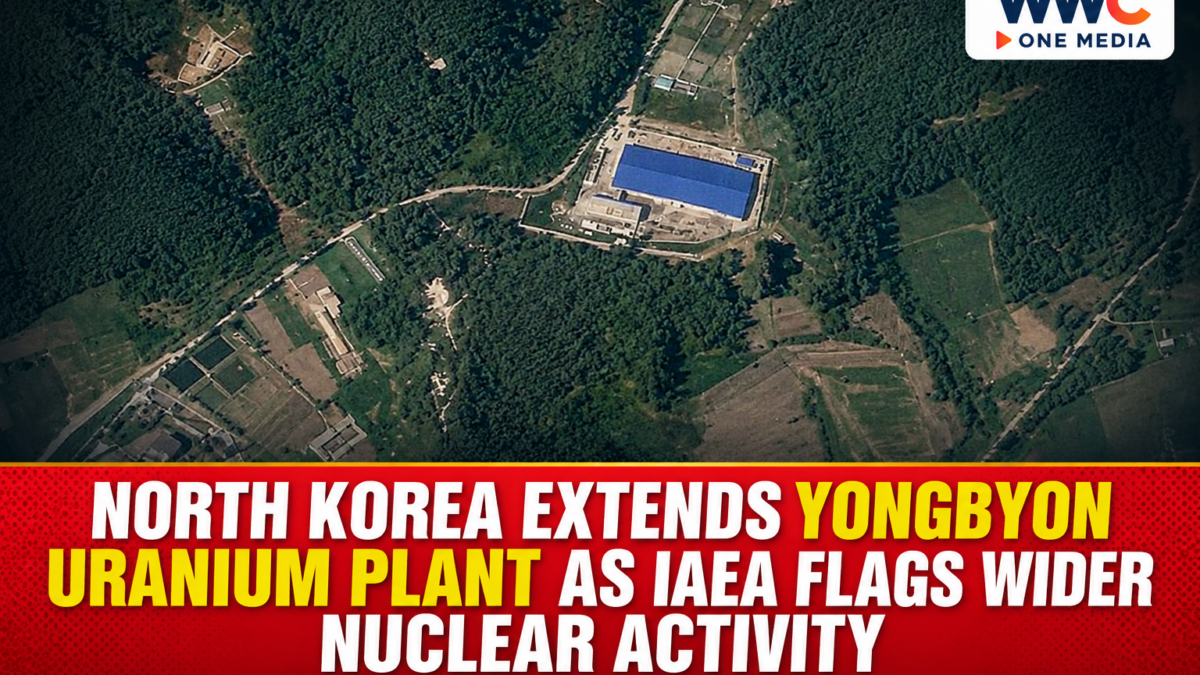
North Korea has built another extension to its uranium-enrichment infrastructure at the Yongbyon nuclear complex, with the exterior of the latest addition completed by late October 2026, the International Atomic Energy Agency (IAEA) said in a statement on Nov. 18.
The development comes alongside indications that two separate reactors at the site remain active, adding to concerns about the continued development of North Korea’s nuclear programme.
The latest assessment is important because it points to further construction at a facility already associated with uranium enrichment. However, the IAEA has not publicly established whether the new extension contains operating centrifuges, how much additional enrichment capacity it could provide, or whether it has begun producing nuclear material.
A further extension at an existing enrichment facility
IAEA Director General Rafael Grossi told the agency’s Board of Governors that construction on a further extension to the original Yongbyon enrichment facility began in mid-September 2026.
The new section was externally complete by late October, he said. Grossi did not provide measurements, an estimated centrifuge count, construction costs or a timetable for the installation of equipment.
His statement distinguishes this development from the additional enrichment facility at Yongbyon that the agency had previously reported. The latest construction concerns an extension to the original facility, rather than simply another reference to the newer building.
The distinction matters when assessing the scale of the development. A completed exterior establishes visible construction progress, but it does not by itself prove that the interior is fitted out or that enrichment operations have started in the new space. EBS PublicNow
What the IAEA can — and cannot — verify
The agency’s assessment must be understood in light of its limited access to North Korea.
An IAEA safeguards report published in August 2025 stated that the agency had been unable to implement safeguards measures in the country since April 2009. Without access to nuclear facilities and other relevant locations, it could not confirm their operational status, configuration or the nature and purpose of activities taking place inside them.
The report said the agency continued monitoring through analysis of commercially available satellite imagery and open-source information. iaea.org
That limitation is central to interpreting the latest announcement. The IAEA can identify construction patterns and changes visible from outside a facility, but it cannot use those observations as a substitute for on-site inspection of the new extension.
Readers should therefore distinguish between what has been observed and what remains unknown. The exterior completion is part of the agency’s assessment; the extension’s internal equipment, operating condition and production contribution have not been specified in Grossi’s public statement.
The wider challenge of maintaining international oversight has also featured in South Korea’s cooperation with the IAEA on North Korea’s nuclear programme.
Two reactors add to the monitoring picture
Grossi’s statement also covered activity at two separate reactor facilities at Yongbyon.
The agency has observed indications that the site’s 5-megawatt electric reactor likely continues operating in its seventh irradiation cycle. It also reported that the light-water reactor, following a period of shutdown, has been operating since the end of April 2026.
These are separate developments from the uranium-enrichment extension. Uranium enrichment and reactor operations involve different processes and should not be treated as interchangeable evidence of a single production activity.
The 5MW(e) reactor is relevant to the production of spent nuclear fuel, which can be reprocessed to obtain plutonium. The light-water reactor is a separate facility, and the IAEA’s statement does not provide a new estimate of its output or explain its operating purpose in detail.
The agency’s wording is also qualified: it reported indications that the 5MW(e) reactor was likely operating, rather than presenting the finding as the result of a physical inspection. EBS PublicNow
Yongbyon is part of a wider nuclear infrastructure
The latest extension is not the first construction development identified at the site.
In its 2025 safeguards report, the IAEA described the original Yongbyon enrichment facility and the construction history of its earlier extensions. It also assessed a separate two-storey building at the complex that had been under construction since December 2024 and was externally complete by May 2025.
The agency compared commercially available satellite imagery with photographs released by North Korean state media to assess the building’s features. It said the images were consistent with a facility similar in dimensions and infrastructure to the Kangson uranium-enrichment facility. iaea.org
That earlier building and the extension announced in November 2026 should not be confused. They are separate construction developments described at different times.
The wider context also includes North Korea’s public insistence that it will continue strengthening its nuclear forces. WWC has previously examined the gap between Pyongyang’s position and international demands in its report on North Korea’s rejection of the IAEA’s nuclear criticism.
The international security implications
Grossi described the continuing expansion of North Korea’s uranium-enrichment programme as a serious concern. He also said the continuation and further development of the country’s nuclear programme violate relevant United Nations Security Council resolutions.
The IAEA’s statement reflects the agency’s role in monitoring nuclear developments and maintaining readiness to resume verification work. It does not mean inspectors have returned to North Korea or that the agency has directly examined the new extension.
For governments concerned about proliferation, the difficulty is not simply identifying new buildings. It is establishing what equipment is inside, whether it is operating, what material is being produced and how much of that material exists.
Those questions are difficult to answer without access to the facilities and relevant records. Satellite imagery can help track visible construction and activity, but it cannot provide a complete inventory of nuclear material.
North Korea’s nuclear status and its refusal to abandon its weapons programme have also complicated diplomatic efforts. The latest IAEA assessment adds another physical development to that long-running dispute, but it does not establish a new weapons count or quantify how much the country’s potential nuclear-material production has changed.
What happens next
The immediate question is whether the new extension will move beyond external construction into an operational phase. The IAEA’s public statement does not provide a confirmed date for equipment installation or the start of enrichment activity in the additional space.
Further assessments may help clarify visible changes at Yongbyon and the status of the two reactors. Direct verification, however, would require the agency to regain access to relevant facilities.
Grossi said the IAEA continues to maintain enhanced readiness to play its verification role in North Korea. That readiness is not the same as an active inspection mission.
For now, the latest statement establishes a further expansion of the site’s physical infrastructure, while leaving important questions about the extension’s equipment and operation unanswered.
Frequently asked questions
What is North Korea building at Yongbyon?
The IAEA said a further extension to the original uranium-enrichment facility at Yongbyon had been under construction since mid-September 2026 and was externally complete by late October.
Is the new extension already enriching uranium?
The IAEA’s Nov. 18 statement does not confirm that centrifuges have been installed or that enrichment has begun inside the new extension.
Why can the IAEA not inspect the facility directly?
The agency’s 2025 safeguards report says it has been unable to implement safeguards measures in North Korea since April 2009. It monitors developments using commercially available satellite imagery and open-source information.
Are the Yongbyon reactors still operating?
The IAEA reported indications that the 5MW(e) reactor likely continues in its seventh irradiation cycle. It also said the light-water reactor had been operating since the end of April 2026 after a period of shutdown.
Does the new extension mean North Korea has more nuclear weapons?
The statement does not provide a new warhead estimate or quantify additional nuclear-material production. An extension to a facility does not, by itself, establish how much weapons material has been produced or how many weapons North Korea possesses.