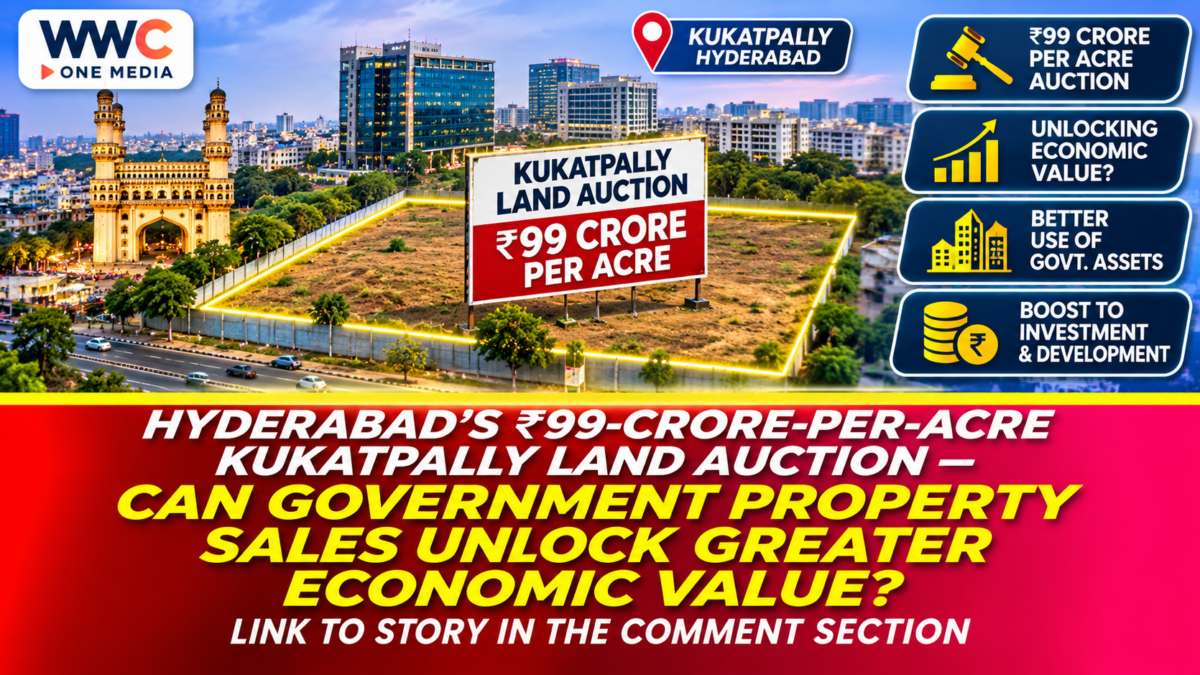
HYDERABAD, INDIA — The Hyderabad Metropolitan Development Authority (HMDA) placed a major land parcel in Moosapet, Kukatpally, on its November 2026 electronic auction schedule, setting a minimum bidding price of ₹99 crore per acre as Telangana continues pursuing opportunities to monetise public property.
The auction was scheduled for Nov. 27, 2026, under an official notification dated Oct. 24, highlighting the substantial financial value attached to government land in Hyderabad.
However, establishing a minimum auction price is only one stage of a property transaction. Whether the proposed sale generates public revenue depends on investor participation, acceptance of bids and completion of the applicable legal requirements.
Kukatpally land auction puts premium Hyderabad property in focus
The property offered through the HMDA auction is identified as Plot No. 1 in Moosapet village, Kukatpally mandal, within Telangana’s Medchal-Malkajgiri district.
The official auction schedule identifies the property using Survey Nos. 121/P to 141, 146, 147 and 155 to 157.
The sale was listed under electronic auction event number 40104 and classified as a large land parcel.
The minimum bidding price of ₹99 crore per acre, equivalent to ₹990 million, establishes the starting financial threshold rather than a guaranteed transaction value.
The distinction is important because the financial expectations associated with government property sales do not necessarily correspond to the amount investors are ultimately willing to pay.
Hyderabad schedules another high-value property auction in Kokapet
The Moosapet property was not the only major land parcel included in HMDA’s Nov. 27 auction schedule.
Another property, identified as Plot No. 17 within the Neopolis layout in Kokapet, carried a minimum bidding price of ₹120 crore per acre.
| Property location | Minimum bidding price |
|---|---|
| Moosapet, Kukatpally | ₹99 crore per acre |
| Neopolis, Kokapet | ₹120 crore per acre |
The Kokapet property’s minimum price was ₹21 crore per acre higher than the Moosapet property’s threshold.
However, differences in asking prices should not automatically be interpreted as differences in profitability or investment quality.
Property development potential depends on applicable land-use permissions, infrastructure requirements, financing costs, market demand and other commercial considerations.
Why India is exploring public land monetisation
The Hyderabad auction illustrates one mechanism through which government-controlled property can potentially generate financial resources.
Public asset monetisation involves obtaining economic value from existing government assets through legally authorised arrangements.
These arrangements may include property sales, leases and other commercial structures.
The approach has also featured in wider Indian government initiatives, including the ₹1,300-crore BSNL and MTNL property monetisation proposals previously examined by WWC ONE MEDIA.
The telecommunications asset programme and the Hyderabad land auction are separate initiatives. Nevertheless, both illustrate the distinction between identifying the potential commercial value of public assets and actually receiving revenue from completed transactions.
For public authorities, the financial benefits of monetisation must be considered alongside existing land-use requirements and longer-term development objectives.
Why legal certainty matters in government property auctions
Government property transactions can involve legal questions that extend beyond the commercial attractiveness of the land.
Potential buyers need clarity concerning ownership, permitted development, existing legal restrictions and the obligations attached to a proposed sale.
An auction notification establishes that a property has been offered under specified terms. It does not necessarily resolve every existing or potential legal dispute involving that property.
WWC ONE MEDIA has previously examined these distinctions in its coverage of a separate Telangana High Court property dispute involving judicial directions and police intervention.
That litigation is unrelated to the Moosapet auction.
Its relevance lies in demonstrating why court orders, ownership rights and administrative decisions must be evaluated separately when assessing property transactions.
Minimum auction prices do not guarantee successful sales
A reserve price, also known as an upset price, represents the minimum bidding threshold established for an auction.
The amount does not establish that a buyer has agreed to purchase the property at that price.
For a property offered at ₹99 crore per acre, a prospective purchaser must consider not only the acquisition cost but also the potential expenses associated with developing and operating the asset.
These may include construction, financing, regulatory approvals, taxation and supporting infrastructure.
An investor’s assessment of commercial viability may consequently differ from the valuation underlying the government’s minimum auction price.
The absence of an independently verified auction result means the Moosapet property’s scheduled minimum price cannot be presented as confirmed government revenue.
Similarly, the publication of an auction schedule does not establish that ownership has been transferred to a private purchaser.
Public interest and commercial development remain important considerations
Government land transactions raise broader questions about how valuable urban property should be utilised.
Selling public land may provide an opportunity to generate financial resources. Retaining it for public infrastructure or other community purposes may offer different long-term benefits.
Evaluating these alternatives requires consideration of the property’s legal status, applicable planning framework and the needs of the surrounding area.
Land ownership and land-use arrangements can also have distinct economic consequences, as examined in WWC ONE MEDIA’s coverage of the Starowitz property dispute involving land transfers and conditional renewable-energy payment rights.
Although that case concerns a different jurisdiction and private property arrangements, it illustrates why ownership, permitted uses and financial entitlements should not be treated as interchangeable.
For public authorities, the challenge is ensuring that asset transactions comply with legal requirements while delivering measurable benefits.
What happens next for the Kukatpally land auction?
The next significant developments would include confirmation of the auction outcome, any accepted bid, the identity of a successful purchaser and the completion of applicable transaction requirements.
An authenticated court order would also provide clarity regarding the legal challenges surrounding the proposed disposal.
Until these records become available, the verified commercial position remains that HMDA scheduled the Moosapet property for auction at a minimum price of ₹99 crore per acre.
The potential financial value is substantial. However, whether the property sale ultimately generates public revenue depends on the outcome of the auction and the completion of the legal transaction.
Frequently asked questions
What is the Kukatpally land auction?
It is an HMDA electronic auction involving Plot No. 1 in Moosapet village, Kukatpally mandal, Telangana, India, scheduled for Nov. 27, 2026.
What was the minimum price for the Moosapet land?
HMDA established a minimum bidding price of ₹99 crore per acre.
What was the Kukatpally auction event number?
The Moosapet property was registered under electronic auction event number 40104.
Has the Kukatpally property been sold?
A completed sale has not been independently established through an official auction result or transaction record.
Does an auction notification establish final government revenue?
No. An auction notification establishes the proposed sale terms. Actual revenue depends on successful bidding, acceptance and completion of the transaction.