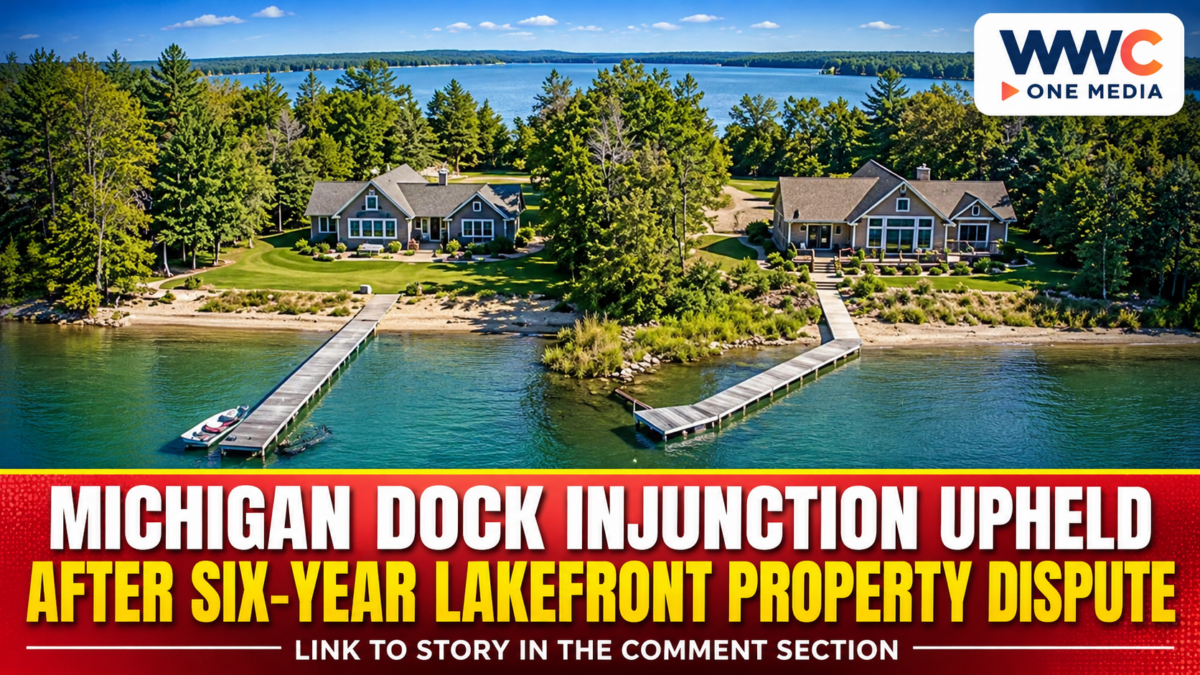
A Michigan appeals court has upheld a permanent injunction barring a couple from installing or using docks and boat hoists on a neighbouring property’s deeded lake bottomlands. The November 16, 2026, decision also leaves in place a US$1 nominal-damages award in a dispute involving two properties beside Walnut Lake in West Bloomfield.
The ruling in Mendelson v. Schmit closes the latest stage of litigation that began in 2020, when Robertus Schmit asked neighbours Marc and Lisa Mendelson to move a dock that partly occupied bottomlands included in his property. The appellate court found no reversible error in the restrictions imposed by the trial court, while making clear that the injunction does not prohibit every instance of a boat floating across the property line.
The case offers a practical lesson in lakefront ownership: access to the water, ownership of the lakebed and the right to place structures on privately deeded bottomlands are not necessarily the same legal question.
How the Walnut Lake property dispute began
The court’s account traces the dispute to two neighbouring purchases. Marc and Lisa Mendelson bought property near Walnut Lake in 2008. Schmit acquired the property immediately north of theirs in 2013, and his deeded property included part of the lake’s bottomlands.
The Mendelsons kept a dock in the lake throughout the year and used it seasonally. Part of that dock was positioned over Schmit’s bottomlands. After learning about the encroachment in 2020, Schmit asked them to move it. They refused and brought a lawsuit seeking, among other relief, recognition of a prescriptive easement or other property rights connected to the dock.
Schmit responded with counterclaims that included ejectment, nuisance and trespass. The trial court initially granted the Mendelsons a prescriptive easement and dismissed Schmit’s counterclaims. That outcome did not survive the first appeal.
Why the earlier easement ruling was reversed
In a November 30, 2023, decision, the Michigan Court of Appeals concluded that the Mendelsons had not established the 15-year period of continuous, unopposed trespass required for a prescriptive easement over the relevant bottomlands.
The court said neither the dock nor the mooring of the couple’s boat over Schmit’s property established the required period. It therefore reversed the trial court’s ruling on the easement and concluded that Schmit was entitled to summary disposition on his ejectment and trespass claims. The case returned to the trial court to determine whether additional relief, including an injunction or damages, was appropriate.
A separate attempt by the Mendelsons to establish a prescriptive easement for an irrigation tube was also rejected in a later appeal. The court found that the claim could have been raised in the earlier proceedings and was barred by the doctrine of res judicata.
The procedural history matters because the November 2026 ruling was not a fresh determination of every ownership question. It addressed the relief imposed after the earlier appellate decisions.
What the permanent dock injunction actually prohibits
After an evidentiary hearing on remand, the trial court awarded Schmit US$1 in nominal damages and issued a permanent injunction. It barred the Mendelsons from installing or using docks or hoists on Schmit’s deeded bottomlands.
The order included an exception for incidental and unintentional trespass by a floating watercraft used or owned by the Mendelsons. In other words, the restriction targeted the placement and use of structures on the neighbouring lakebed; it was not written as a blanket ban on a boat ever passing over the property line.
The trial court explained that Schmit had not provided testimony or other admissible evidence showing monetary loss caused by the trespass. The US$1 award was therefore nominal rather than compensation for a quantified financial injury.
Schmit had sought a larger nominal award during the remand proceedings, but the trial court awarded US$1. The Mendelsons did not challenge that damages award in the appeal decided in November 2026.
Why the appeals court rejected the riparian-rights argument
The Mendelsons argued that the injunction did not adequately account for their claimed riparian rights — legal rights associated with property adjoining water. They said the order could restrict their ability to use the lake and install or maintain a dock.
The appeals court was not persuaded. It noted that the couple had not properly asked the trial court to determine whether they were riparian owners or to define the scope of any such rights. The issue was therefore not preserved for appellate review.
The panel also pointed to the deed description in the record. Unlike Schmit’s deed, the description of the Mendelsons’ property did not include any part of the lake or its bottomlands, and did not state that their property extended to the water’s edge. The court said aerial photographs submitted by the couple did not clearly establish that boundary.
Importantly, the opinion did not make a broad ruling defining the riparian rights of every owner around Walnut Lake. It held that the arguments presented in this case did not establish reversible error in the injunction.
The court also rejected arguments involving changing water levels, erosion and the year-round use of the lake, noting that those matters had not been meaningfully raised before the trial court in time for appellate consideration.
What the ruling means for property owners
The decision illustrates why a lakefront property dispute cannot be reduced to a simple question of whether a homeowner can use the water beside a property.
A deed may describe ownership of land beneath the water separately from rights to use the lake’s surface. A dock, hoist or other fixed structure can also create a different legal issue from a boat that happens to float across a boundary. The court’s treatment of those distinctions is specific to the record and procedural history in this case; it should not be treated as a universal rule for every waterfront property.
The same need to distinguish ownership, possession and legal remedies appears in other property disputes. WWC has examined those questions in its coverage of a Texas homebuyer’s continuing contract dispute and a California property-sale litigation involving a disputed mansion agreement. A separate report on land-boundary and ownership challenges facing communities also shows why the underlying documents and the precise relief sought can matter as much as the parties’ competing claims.
For buyers, the practical point is straightforward: waterfront descriptions, surveys, easements and recorded property boundaries deserve careful review before a dock or other structure is installed.
What happens next
The Michigan Court of Appeals affirmed the trial court’s order. The November 16 opinion does not announce a new damages calculation or a broader determination of lake access rights. It leaves the permanent injunction and the US$1 nominal award intact.
The opinion is marked unpublished. It resolves the appeal between these parties, but should not be described as a published Michigan appellate precedent establishing a general rule for all lakefront owners.
Frequently asked questions
Who were the parties in the Walnut Lake dock case?
Marc and Lisa Mendelson were the plaintiffs and appellants. Robertus Schmit was the defendant and appellee.
What did the Michigan appeals court decide?
On November 16, 2026, the Michigan Court of Appeals affirmed the trial court’s permanent injunction and nominal-damages order.
Why was the dock prohibited?
The dock was partly situated over bottomlands included in Schmit’s deeded property. The injunction bars the Mendelsons from installing or using docks or hoists on those bottomlands.
Did the couple receive a complete ban on using Walnut Lake?
No. The injunction contains an exception for incidental and unintentional trespass by a floating watercraft used or owned by the couple. The appeals court did not make a general ruling on all riparian rights around the lake.
Why was the damages award only US$1?
The trial court found no admissible evidence that Schmit had suffered monetary damages from the trespass. It therefore awarded nominal damages of US$1.