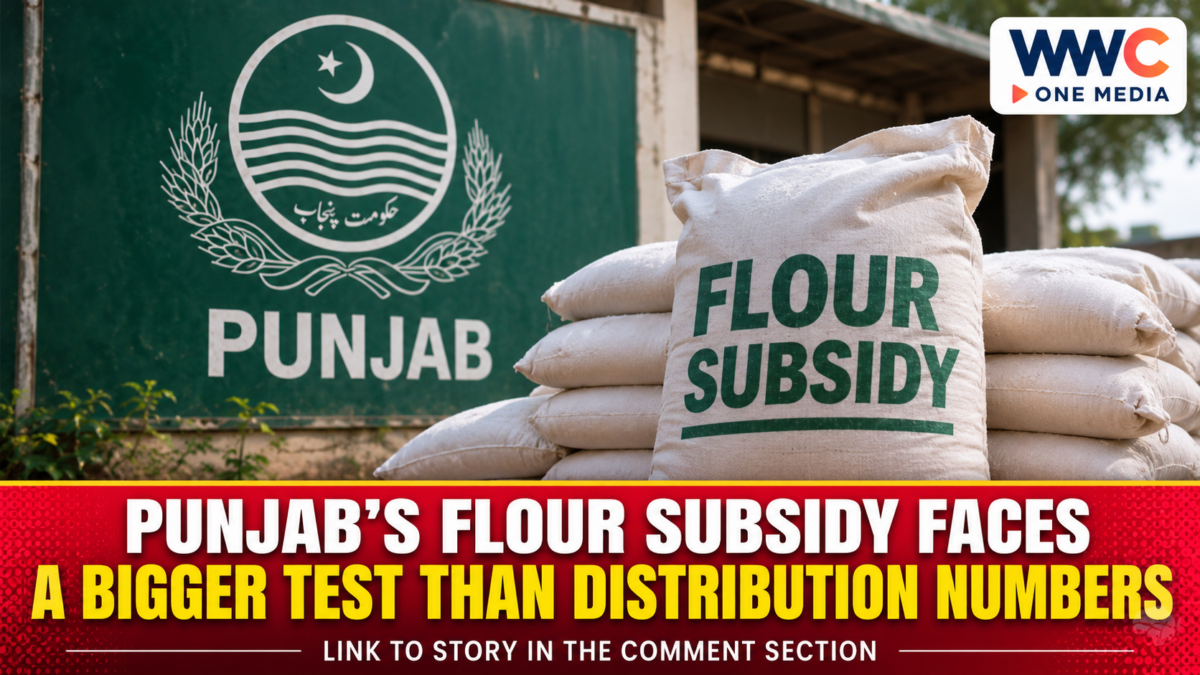
Punjab’s government says it supplied 656,475 bags of subsidised flour across the province on November 27, 2026, while taking regulatory action against 25 flour mills. The figures were announced by Punjab Minister for Food Safety and Consumer Protection Salma Butt in a statement issued on November 28.
The reported distribution comes as Punjab implements a revised wheat-release and flour-distribution framework that fixes the price of government wheat and subsidised flour while imposing tighter reporting and monitoring requirements on participating mills.
The figures point to the scale of the province’s intervention in a politically sensitive food market. But the more important test is whether government wheat can move through mills and retail outlets efficiently, whether consumers can consistently buy flour at the prescribed price, and whether enforcement measures produce measurable improvements in availability and compliance.
Punjab flour subsidy puts distribution capacity in focus
The minister said subsidised flour was available through 9,281 shops across Punjab, with a 10-kilogram bag priced at Rs1,275.
She also reported that 9,271 metric tonnes of government wheat were released to 271 flour mills on November 27. Lahore Division accounted for more than 248,000 subsidised flour bags distributed through 2,620 shops.
These figures describe a large distribution network, but the number of bags supplied does not, by itself, establish how many households received flour, whether all outlets maintained adequate stocks or whether consumers in every district could purchase the product at the official rate.
That distinction matters in any subsidy programme. Government releases are only one part of the supply chain. Wheat must be delivered, processed, converted into flour, transported and made available through participating shops. A disruption at any stage can weaken the effect of the subsidy even when official distribution totals appear substantial.
Punjab’s reported approach also separates government-supported flour from products made using privately procured wheat. That distinction is important because the two supply channels operate under different pricing arrangements.
Two flour markets operate under different price arrangements
Alongside the subsidised supply, the minister reported that more than 750,000 bags of 15-kilogram flour made from privately procured wheat were supplied to private markets.
The reported average price of a 15-kilogram private-market bag was Rs2,390. The same size was reported at Rs2,200 in Bahawalpur, Rahim Yar Khan, Khushab and Bhakkar. Punjab’s average wheat price was reported at Rs5,513 per 40 kilograms.
The figures should not be treated as a direct like-for-like comparison with the Rs1,275 subsidised 10-kilogram bag. The bag sizes differ, and the products come through separate supply channels.
For consumers, the important issue is whether the subsidised product is consistently available and whether its prescribed price is observed at participating outlets. A low official price has limited practical value if consumers cannot find the product or must turn to more expensive alternatives.
The distinction between public and private wheat also reflects a wider challenge for food markets: governments may intervene in one part of the supply chain while private traders and millers continue operating in another.
WWC has previously examined how international grain disruptions can influence wheat costs and supply decisions in its report on Black Sea grain trade and rising wheat prices. Punjab’s current policy is a domestic example of how authorities attempt to manage food affordability while maintaining a separate commercial market.
New wheat rules increase reporting and oversight requirements
Punjab’s revised Wheat Release and Flour Distribution Order 2026 reportedly establishes a more controlled process for distributing government wheat.
The framework described in the published account sets the government wheat release price at Rs4,500 per 40 kilograms and the retail price of a 10-kilogram flour bag made from government wheat at Rs1,275.
Government wheat is designated for approved operational flour mills and licensed atta chakkis. Participating operators are required to enter agreements with their respective District Food Controllers, with releases linked to advance payments and verification.
The framework also requires daily verification of proceeds from the sale of flour produced using government wheat.
Another important component is digital reporting. Mills are required to upload operational information to the Food Department Inventory Management System, or FDIMS. The reported rules also prescribe a 70:18:12 extraction ratio, allocating 70% to flour, 18% to fine flour and 12% to bran.
In practical terms, the reporting system is intended to make it easier for authorities to track the movement and processing of government wheat. It can help identify discrepancies between the quantity released to a mill and the products that should result from processing.
However, digital reporting is only effective when records are complete, accurate and regularly checked. A monitoring platform cannot automatically guarantee that flour reaches consumers at the correct price.
The wider regional food-security picture also matters. WWC’s coverage of India’s wheat harvest risks heading into 2027 examines how weather-related production risks can affect agricultural supply and price expectations.
Mill enforcement raises questions about compliance
The minister reported that 25 flour mills were proceeded against on November 27 and that 48 show-cause notices were issued over violations.
The reported division-level breakdown included action against 11 mills in Faisalabad Division and nine in Sargodha. Another 19 show-cause notices were reportedly issued to flour mills in Dera Ghazi Khan Division.
The licences of one mill each in Rahim Yar Khan and Sahiwal were also reported suspended.
A show-cause notice is not the same as a final finding of liability. It gives the affected party an opportunity to respond to an allegation or regulatory concern. The eventual outcome depends on the applicable process and the evidence considered by the relevant authority.
The minister also said a fine of Rs2 million would be imposed on every mill found violating the prescribed regulations. The legal basis, scope and implementation of that penalty should be checked against the applicable order and individual enforcement decisions before treating it as an amount already collected or imposed in every case.
The distinction is important for public accountability. Enforcement statistics can demonstrate regulatory activity, but the number of notices or cases alone does not show whether violations were resolved, whether penalties were upheld or whether supply conditions improved afterward.
WWC’s earlier reporting on Australia’s wheat harvest and quality concerns also highlights the importance of monitoring quality and supply conditions throughout the grain chain.
Why the subsidy needs more than headline distribution figures
A government-set flour price can provide a clear reference point for consumers and retailers. But its effectiveness depends on the government’s ability to maintain sufficient stocks, distribute wheat according to demand and prevent the subsidised product from being diverted or sold outside the prescribed system.
Punjab’s reported distribution figures provide an indication of the scale of its intervention. They do not yet establish the programme’s full cost, the amount of subsidy per bag, the number of households reached or the total quantity of flour actually purchased by consumers.
Those details would help determine whether the programme is delivering its intended benefits and whether its operating model is financially sustainable.
The distinction between availability and affordability is equally important. A product can be present in the market but still remain inaccessible to households with limited purchasing power. WWC has explored a related issue in its report on global food prices and Philippine household affordability.
For Punjab, the policy’s success will ultimately depend on what happens beyond the distribution announcement: reliable retail availability, transparent mill records, consistent price enforcement and clear reporting of regulatory outcomes.
What happens next
The next important indicators are the department’s daily wheat-release and flour-distribution records, the results of inspections, and the status of the mills that received notices or had licences suspended.
The government will also need to demonstrate that its digital reporting requirements can connect wheat allocations with actual milling and retail distribution.
Public disclosure of district-level supply data, inspection outcomes and final enforcement decisions would give consumers and businesses a clearer basis for evaluating the programme.
The November 27 figures provide a snapshot of the government’s reported activity. Whether the subsidy translates into sustained access to affordable flour will depend on the consistency and transparency of the system over time.
Frequently asked questions
1. How many subsidised flour bags did Punjab report supplying on November 27, 2026?
Punjab Minister Salma Butt reported that 656,475 bags of subsidised flour were supplied across the province on November 27.
2. What is the price of subsidised flour in Punjab?
The reported government-fixed price is Rs1,275 for a 10-kilogram bag produced using government wheat.
3. How much government wheat was released to flour mills?
The minister reported that 9,271 metric tonnes of government wheat were released to 271 flour mills on November 27.
4. How many flour mills faced regulatory action?
The minister reported that 25 flour mills were proceeded against and 48 show-cause notices were issued. The licences of one mill each in Rahim Yar Khan and Sahiwal were also reported suspended.
5. What is Punjab’s new wheat monitoring system?
The reported distribution framework requires participating mills to upload daily operational information to the Food Department Inventory Management System, known as FDIMS. The system is intended to support monitoring of government wheat stocks and flour production.