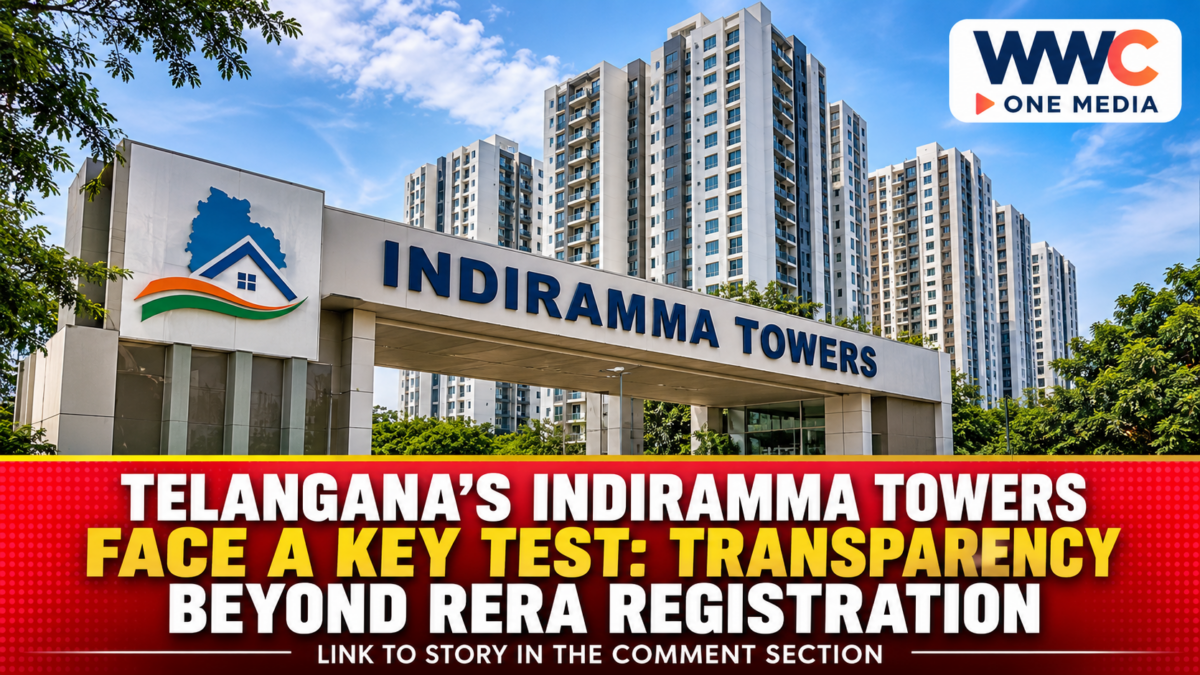
Telangana’s Indiramma Towers housing programme is moving forward with a published subsidy and beneficiary-payment structure, but the scheme’s long-term credibility will depend on more than the number of flats announced or construction milestones reached. Clear project disclosures, verifiable approvals and accessible complaint channels will be important as the government advances its affordable-housing programme.
The state’s housing framework offers eligible families a defined route towards homeownership. Meanwhile, the Real Estate (Regulation and Development) Act provides a regulatory structure for project registration, disclosures and complaints involving covered developments. The practical question is how consistently those protections will be applied and communicated to beneficiaries as individual towers progress.
What the published housing notification says
A Telangana Housing Board demand notification dated November 7, 2026, sets out terms for Indiramma Indlu affordable ownership flats in selected urban centres. It specifies a registerable area of 512 square feet, free land and a government subsidy of ₹5 lakh.
The notification lists a tentative beneficiary contribution of ₹3.5 lakh for each flat, excluding the subsidy. It also sets out a payment schedule tied to construction milestones: ₹1 lakh at provisional allotment, another ₹1 lakh after completion of the reinforced-concrete structure, ₹1 lakh at the finishing stage and the remaining balance at completion and handover.
Applicants are required to pay a ₹100 non-refundable application fee. The notification also specifies a ₹10,000 refundable earnest-money deposit or token advance, subject to the stated conditions.
These are important financial details because the headline subsidy does not represent the entire beneficiary obligation. Families need to understand the payment schedule, eligibility conditions and possible additional costs before making financial commitments.
The notification gives December 5, 2026, as the application deadline for the demand survey it covers. It also states that registration of demand does not automatically confer a right to allotment. The process includes verification and a lottery-based selection mechanism.
Scope matters: the November 7 notification covers specified urban-centre projects. Its terms should not automatically be treated as the final project-specific conditions for every tower, including the Kowkoor development.
The role of TG-RERA in housing transparency
The Real Estate (Regulation and Development) Act, 2016, was designed to strengthen accountability in the property sector. Under the law, covered projects generally need registration before promoters advertise, market, book or sell units, subject to statutory exemptions.
The registration framework requires project-related information, including approvals, sanctioned plans, development details and other prescribed disclosures. The law also provides for updates on project progress and gives eligible complainants a route to seek regulatory intervention.
Telangana’s Real Estate Regulatory Authority, or TG-RERA, provides public access to registered-project information and a complaint mechanism. Its published guidance says an aggrieved person may file a complaint concerning a registered project over alleged violations of the Act or its rules.
For housing beneficiaries, this framework can make a difference. Registration and disclosures can help people check project information, while the complaint process provides a formal route when obligations are allegedly not met.
However, RERA registration should not be confused with a guarantee that construction will finish on time or that every concern will be resolved automatically. The authority’s role operates within the law and the specific facts of each registered project.
Why construction monitoring needs clear documentation
Large housing developments require more than a foundation ceremony. They involve structural work, utilities, access roads, safety requirements, approvals and coordination among public agencies and contractors.
Beneficiaries have a direct interest in knowing whether construction is progressing according to approved plans and declared schedules. Publicly accessible project information can help them understand the status of a development without relying solely on announcements.
The government can strengthen confidence by making project registration details, approved plans, completion schedules and progress disclosures easy to locate. It can also explain which office is responsible for receiving complaints about construction quality, delays, allotment and beneficiary payments.
The distinction between regulatory oversight and day-to-day construction supervision is important. RERA has statutory functions, while construction implementation and administrative responsibilities may involve the housing authorities and other government bodies. The precise division of responsibilities should be documented rather than assumed.
Beneficiaries need practical access to grievance channels
A formal complaint mechanism is useful only when beneficiaries know how to use it. Clear instructions should explain where to submit a complaint, what documents to attach, how to track its status and which authority handles each category of concern.
The TG-RERA framework provides a complaint route for matters within its jurisdiction involving registered projects. Beneficiaries should retain allotment documents, payment receipts, written communications and other project records that may be relevant if a dispute arises.
For issues outside RERA’s jurisdiction, the responsible housing office or other designated government agency should be identified. A clear referral process can help prevent complaints from being passed between offices without resolution.
The government could also improve accessibility through regular public progress updates and straightforward explanations of beneficiary rights and obligations.
What happens next
The next important step is project-level transparency. Beneficiaries and the public need access to the relevant registration details, approved plans, project schedules and official channels for raising concerns.
The November 7 Housing Board notification provides a documented outline of financial and application conditions for the urban-centre demand survey. But project-specific documents remain essential when assessing individual developments.
Any separate announcement assigning TG-RERA a direct construction-monitoring role, requiring complaint boxes at every tower or allowing monthly beneficiary inspections should be supported by an official order or written government statement before those measures are treated as established policy.
For families considering the programme, the immediate priority is to verify the applicable project conditions, understand the payment schedule and keep records of every application and transaction.
Frequently asked questions
How much is the government subsidy under the published notification?
The November 7, 2026, Telangana Housing Board notification specifies a ₹5 lakh government subsidy for the flats covered by that demand survey.
Does the subsidy mean the flat is entirely free?
No. The notification also specifies a beneficiary contribution and a payment schedule. Applicants should check the applicable project documents for the exact amount and conditions.
Does applying guarantee an Indiramma Towers flat?
No. The notification says demand registration does not automatically create a right to allotment. Verification and the prescribed selection process apply.
What does TG-RERA do?
TG-RERA administers the real-estate regulatory framework in Telangana, including project registration, prescribed disclosures and complaints concerning registered projects.
Where can beneficiaries raise a RERA-related complaint?
The TG-RERA website provides information about filing complaints. Beneficiaries should first check whether the project and issue fall within the authority’s jurisdiction.
Are monthly construction inspections by beneficiaries confirmed for every tower?
That specific arrangement should not be treated as confirmed without the relevant official written directive. Beneficiaries should look for project-specific instructions from the Housing Board or the responsible government department.