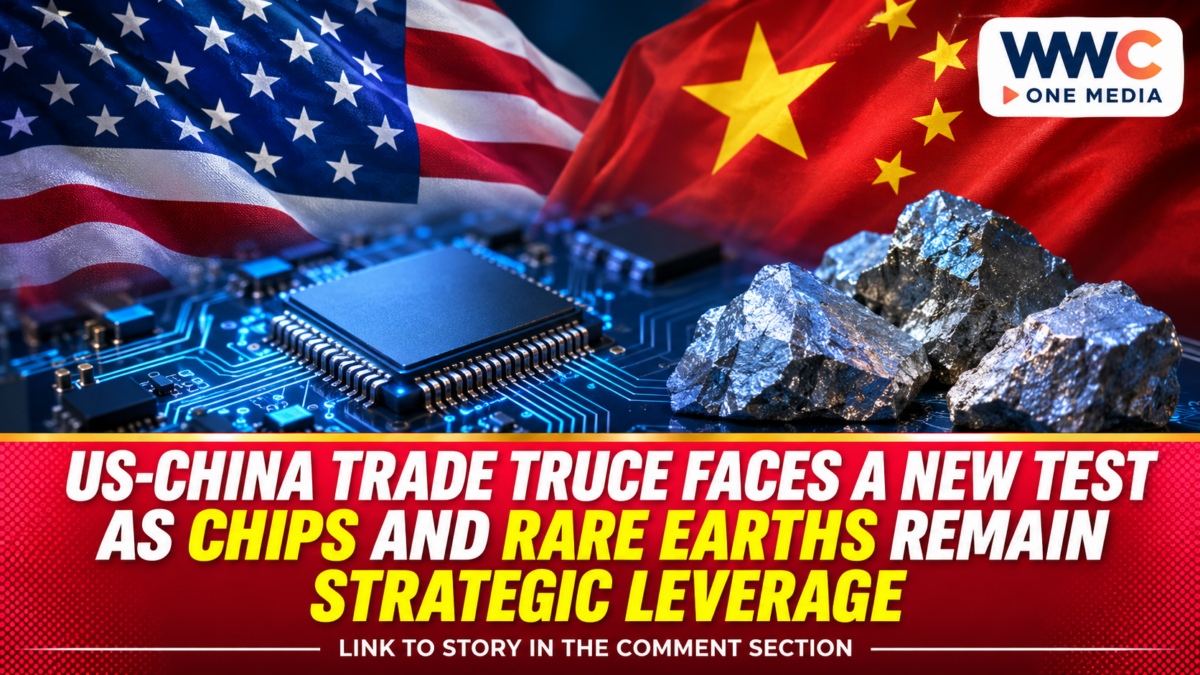
The United States and China have continued adjusting parts of their trade and export-control policies in November 2026, but neither side has removed the strategic restrictions that make their economic relationship vulnerable to sudden disruption. Recent decisions by Beijing and Washington show that temporary trade relief is continuing alongside new measures governing advanced semiconductors, critical minerals and proposed import duties.
The latest developments include China’s decision to extend the suspension of certain restrictions on dual-use exports to the United States, a new US rule addressing remote access to advanced computing technology, and proposed Section 301 tariffs covering Chinese goods. Together, these measures reveal a trade relationship in which negotiations continue but national-security controls remain central.
For manufacturers, technology companies and suppliers across Asia, the important question is no longer simply whether Washington and Beijing have a trade agreement. It is whether companies can rely on its temporary concessions when the underlying competition over technology and strategic materials remains unresolved.
US-China trade truce enters another period of adjustment
China’s Ministry of Commerce announced on Nov. 24 that the second provision of its 2024 Announcement No. 46 would remain suspended from Nov. 28, 2026, through Jan. 27, 2027.
The original December 2024 measure restricted exports of certain dual-use items to the United States. Its second provision stated that exports of gallium-, germanium-, antimony- and superhard-material-related dual-use items to the US would generally not be licensed, while graphite-related dual-use exports would receive stricter end-user and end-use reviews.
The November decision temporarily suspends that second provision. It does not erase the underlying announcement or establish that every shipment covered by the affected materials can move without regulatory review.
A separate Chinese Ministry of Commerce statement dated Nov. 9 said Beijing would continue suspending relevant measures under its 2025 Announcement No. 21 for two months from Nov. 10. That earlier measure placed 16 US entities on China’s export-control list and prohibited exports of dual-use items to them. Exporters still need to apply for licences, which are subject to review.
The distinction is important: suspending selected restrictions is not the same as removing China’s export-control system. The measures show that Beijing can provide limited relief while retaining licensing authority over sensitive products.
Rare earths and critical minerals remain bargaining points
Critical minerals are important because they are used across industries that depend on specialised materials, including electronics, energy equipment, advanced manufacturing and defence-related production.
Gallium and germanium have applications in semiconductor and other electronic technologies. Antimony has industrial and defence-related uses, while graphite is important in battery supply chains. Different materials have different applications, so they should not be treated as interchangeable commodities.
China’s 2024 Announcement No. 46 established restrictions affecting several of these dual-use materials when destined for the United States. The temporary suspension of the second provision therefore matters to companies seeking greater certainty about whether particular exports can receive approval.
Washington has also kept the issue on the negotiating agenda. In a Nov. 6 videoconference, US Trade Representative Jamieson Greer and Treasury Secretary Scott Bessent discussed the trade relationship with Chinese Vice Premier He Lifeng. Greer’s office identified agricultural purchases, rare earths and other critical minerals as areas where the US administration wanted concrete implementation of earlier commitments.
The public readout did not announce a new blanket restriction or a final agreement resolving the mineral dispute. It showed that implementation remains a subject of government-level discussion.
WWC previously examined China’s rare-earth export arrangements with European buyers. That coverage illustrates why export licensing and actual delivery are separate questions: a government may facilitate applications without removing the requirement for approval.
Washington expands controls beyond physical chip shipments
The US semiconductor policy debate is also moving beyond the physical export of processors.
On Nov. 19, the US Department of Commerce’s Bureau of Industry and Security brought into effect an interim final rule titled Addressing Remote Access to Advanced Semiconductors. The measure establishes licensing requirements for certain advanced computing items intended for overseas data centres that provide significant computing capacity to companies headquartered in China, Macau or other destinations covered by the relevant US control classifications.
The rule addresses a problem that conventional export controls may not fully capture. A restricted company does not necessarily need to import a processor directly if it can access computing capacity through a data centre located in another country.
The regulation also introduces additional destination-based licensing requirements for certain advanced semiconductor items involving Indonesia, Malaysia, Singapore, Brazil and Thailand. Applications are subject to review under the relevant rules.
For Southeast Asia, this makes the region’s expanding data-centre and technology infrastructure more closely connected to US export-control compliance. A facility’s physical location does not automatically settle whether a particular customer can legally access its computing resources.
WWC’s report on new US AI chip rules and their implications for Philippine data centres explains why operators need to examine the customer, ownership structure and intended use of computing capacity—not only the country where their servers are installed.
Proposed US tariffs add another layer of uncertainty
The trade relationship faces a separate tariff question.
On Nov. 25, the Office of the US Trade Representative announced determinations and proposed actions following Section 301 investigations into structural excess capacity and manufacturing production across 14 economies, including China.
For China, the USTR proposed considering tariffs of up to 20% on goods not identified in specified annexes and up to 10% on goods identified in Annex A, with exemptions for certain products in Annex B.
The proposed treatment takes account of existing duties and the commitments associated with the US-China Board of Trade’s product lists. The USTR’s announcement does not mean the proposed duties have already become effective.
That distinction matters for importers. A proposed tariff is not the same as a final customs charge. The eventual outcome depends on the formal process, product coverage, exemptions and any subsequent government decision.
The Philippines is not among the 14 economies covered by the Nov. 25 determinations. However, developments involving China and other major manufacturing economies can still matter to Philippine businesses through sourcing arrangements, supplier competition and regional production decisions.
WWC has also examined the US Section 301 investigation and its proposed tariff actions. Businesses should distinguish those proposals from duties already in force under other trade measures.
Why the balance matters to technology companies
The latest developments demonstrate how the two governments can use different forms of economic regulation to protect strategic interests.
Washington has influence through advanced semiconductor technology, export licences and restrictions governing access to US-origin computing products. Beijing has regulatory authority over exports of selected minerals and dual-use materials that are important to several industrial supply chains.
Neither instrument operates in isolation. Semiconductor production depends on complex international networks involving chip designers, fabrication plants, equipment suppliers, data centres and end users. Critical-mineral supply chains also involve extraction, processing, specialised manufacturing and international transport.
A restriction affecting one stage can create uncertainty elsewhere, even when a complete export ban is not announced.
This is why the latest US rules and Chinese suspensions deserve attention beyond the two governments. Companies need to know whether their products are covered, which licences are required and whether the rules apply to a direct shipment, an overseas transfer or remote access to computing resources.
The pressure on NVIDIA and other chipmakers also illustrates the commercial importance of the issue. WWC’s coverage of congressional scrutiny of advanced chip exports examines how US lawmakers are questioning the effectiveness of technology-export safeguards.
What happens next
The next stage will depend on whether the two governments continue implementing their temporary arrangements and whether further trade consultations produce more durable commitments.
China’s latest suspension of the second provision of Announcement No. 46 is scheduled to run through Jan. 27, 2027. The separate two-month suspension involving the 16 US entities began on Nov. 10, 2026.
The US semiconductor rule is already effective, while the USTR’s proposed China tariffs remain subject to the formal process rather than operating as newly imposed duties.
For businesses, the practical priority is to monitor the exact scope and duration of each measure. Companies should not assume that a temporary suspension removes all licensing obligations, or that a proposed tariff has already changed the cost of importing a product.
The wider lesson is that the US-China trade relationship is being managed through a combination of negotiation, selective relief and continuing strategic controls. That may prevent an immediate breakdown in trade, but it does not guarantee long-term stability.
Frequently asked questions
What is the current status of the US-China trade truce?
The two governments continue to implement and adjust selected trade arrangements. Recent measures include temporary Chinese export-control suspensions and continuing US-China trade consultations, but significant restrictions remain.
Has China removed its restrictions on rare earths and critical minerals?
No. China’s November decision suspends a specified provision of its 2024 export-control announcement for a limited period. It does not abolish the wider export-control framework or guarantee approval of every shipment.
Have the latest proposed US tariffs on China taken effect?
No. The USTR announced proposed Section 301 actions on Nov. 25, 2026. The proposed rates should not be described as newly implemented tariffs.
Do the new US chip rules affect Southeast Asia?
Yes. The Nov. 19 rule introduces additional licensing requirements for certain advanced semiconductor transactions involving Indonesia, Malaysia, Singapore, Brazil and Thailand. It also addresses remote access to advanced computing capacity through overseas data centres.
Could the US-China trade dispute affect Philippine businesses?
It could affect Philippine businesses indirectly through suppliers, manufacturing networks, technology access and changes in international trade flows. The precise effect will depend on the products, companies and trade measures involved.