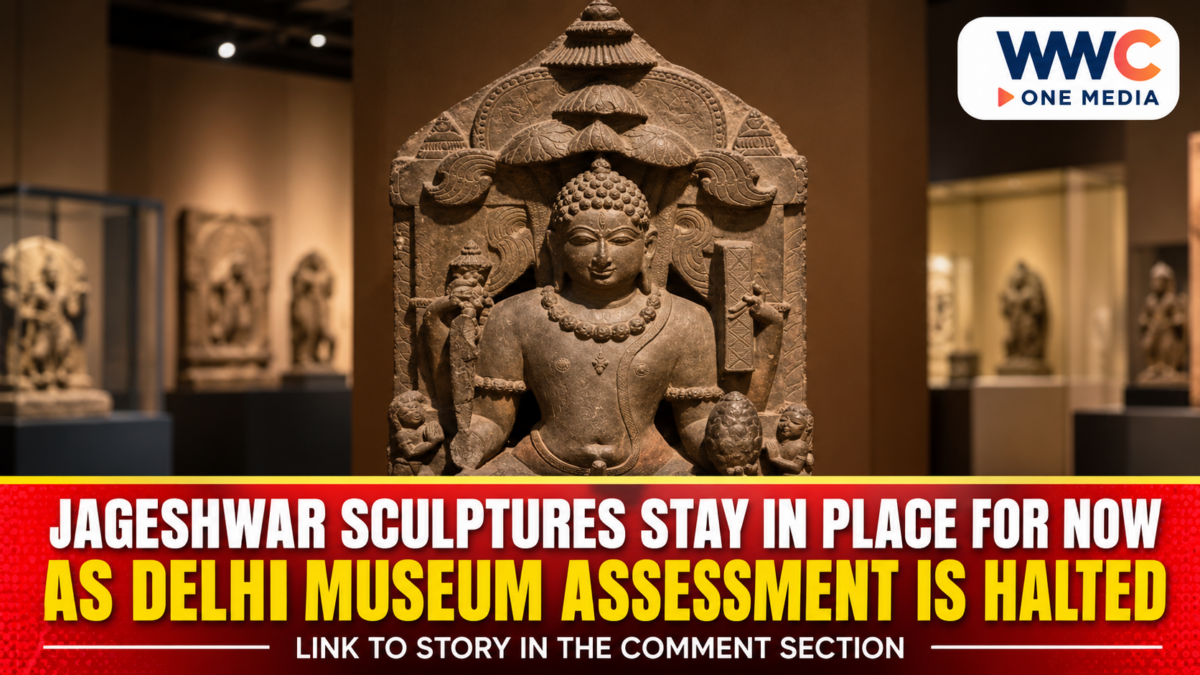
Ancient sculptures housed at the Jageshwar Archaeological Museum in Uttarakhand were not moved to New Delhi after an Archaeological Survey of India (ASI) expert committee halted a planned physical assessment on November 28, 2026, following representations from local residents and priests. The committee’s report was sent to the ASI Director General, while the district administration said no transfer was being carried out at present.
The episode has brought a practical heritage-management question into focus: how should nationally significant collections be presented without weakening the relationship between historic objects, the places where they are preserved and the communities that regard them as part of their living heritage? The proposed display was connected to the Yuge Yugeen Bharat Museum in New Delhi, a national museum project being developed by the Ministry of Culture.
Jageshwar sculptures were being considered for a national display
The district administration’s publicly reproduced statement says the ASI had formed an expert committee to examine the condition of selected sculptures and conduct a preliminary assessment connected with a possible display at the Yuge Yugeen Bharat Museum.
The committee reached Jageshwar on November 28. After local priests and residents presented concerns about the artefacts’ religious, cultural and historical importance, the committee did not proceed with the proposed physical inspection and assessment. Its report recommended that the selected sculptures should not be forwarded for further consideration under the circumstances then prevailing.
The report was submitted to the ASI Director General. The district administration also said District Magistrate Anshul Singh had conveyed local concerns to the national archaeological authority.
The distinction between assessment and relocation is important. An examination of an object’s condition does not, by itself, establish that a transfer has been approved. The administration’s stated position was that no shifting was taking place at the time of its clarification.
Why Jageshwar’s heritage carries local significance
Jageshwar Dham is a group of temples dedicated to Lord Shiva in Almora district. The district government describes the complex as containing 124 large and small temples, with stone lingams, sculptures and carved altars among its notable features. It places the site’s architectural history in the post-Gupta and pre-medieval periods.
The nearby archaeological museum adds another layer to that heritage setting. The objects are not simply isolated exhibition pieces: they are part of a wider landscape of temples, religious practice, local history and archaeological interpretation.
That relationship helps explain why a proposal involving the movement of selected sculptures can prompt questions beyond transport and display arrangements. For residents, the issue can concern whether objects associated with a particular place should remain accessible in that setting, even when a larger museum could offer a different form of public exposure.
WWC has examined similar questions in its coverage of Sarkhej Roza’s historic religious and architectural landscape, where the relationship between individual structures and the wider heritage environment is central to understanding the site.
The Delhi museum project has a national collection brief
The Yuge Yugeen Bharat Museum is being developed by the Ministry of Culture as part of the Central Vista Redevelopment Project. In its 2025 request for proposals for content development, the ministry described a museum planned for the North and South Blocks in New Delhi and intended to present connected themes across periods and regions of Indian history.
The document says the content-development work would involve collections drawn from across the country, with artefacts identified and placed in historical context for the museum’s galleries. It also describes the museum as a space for public education, cultural representation and knowledge dissemination.
That national remit explains why objects from different regions may be considered for wider exhibition. It does not, however, establish that any particular Jageshwar sculpture has been formally approved for permanent transfer. The ministry’s procurement document sets out the museum’s design and interpretive ambitions; it does not identify the Jageshwar objects or authorise their removal.
The distinction matters because a museum’s national scope and the legal or administrative status of an individual artefact are separate questions. Each proposed loan, movement or transfer requires its own documented basis and safeguards.
What the dispute says about heritage decisions
The Jageshwar episode illustrates the need for transparent procedures when authorities consider moving culturally significant objects. A credible process should make clear which objects are under consideration, why they are being considered, whether the proposal is for temporary exhibition or permanent transfer, and what conservation and security arrangements would apply.
It should also explain how the views of local custodians, religious institutions and residents are recorded and considered. Consultation does not automatically determine the final administrative decision, but it can identify risks and concerns that a technical inspection alone may not capture.
Other heritage projects show that public access and preservation can be managed through different approaches. WWC’s report on Shuri Castle’s restoration and visitor controls examined how access arrangements can be designed around the protection of a historic site. Its coverage of the Old Acropolis Museum’s renewed public role also explored how museums can broaden public engagement while retaining their historical purpose.
These examples do not determine what should happen at Jageshwar. They show why the question should be approached as a matter of conservation, interpretation and public accountability rather than as a simple choice between a local museum and a national institution.
What happens next
The next formal step rests with the ASI Director General, who received the committee’s report. The publicly reproduced administrative statement does not establish that the Director General has issued a final decision on whether the selected sculptures may be reconsidered for the Delhi museum.
Until an official order or further statement is published, the safest reading is that the proposed physical assessment did not proceed and no transfer was being carried out at the time of the district administration’s clarification.
A further public document would help settle the remaining questions: the committee’s report, a formal ASI decision, or a written clarification identifying the objects under consideration and the status of any proposed exhibition arrangement.
For now, Jageshwar’s sculptures remain at the centre of a broader discussion about how India presents its heritage while recognising the historical and cultural settings from which that heritage comes.
Frequently asked questions
Were Jageshwar’s ancient sculptures moved to Delhi?
The district administration’s publicly reproduced statement said no shifting was taking place at the time of its clarification. The proposed physical assessment was not carried out.
Why did the ASI committee visit Jageshwar?
The committee was formed to examine the condition of selected sculptures and conduct a preliminary assessment linked to a possible display at the Yuge Yugeen Bharat Museum in New Delhi.
Did the committee approve the transfer of the sculptures?
The available administrative statement says the committee did not proceed with the assessment and recommended that the selected sculptures not be forwarded for further consideration under the prevailing circumstances.
Where is Jageshwar Dham?
Jageshwar Dham is in Almora district, Uttarakhand, India. The district government describes it as a group of temples dedicated to Lord Shiva.
What happens to the committee’s report?
The report was sent to the ASI Director General. A final decision on any future consideration of the sculptures was not established in the records reviewed for this report.