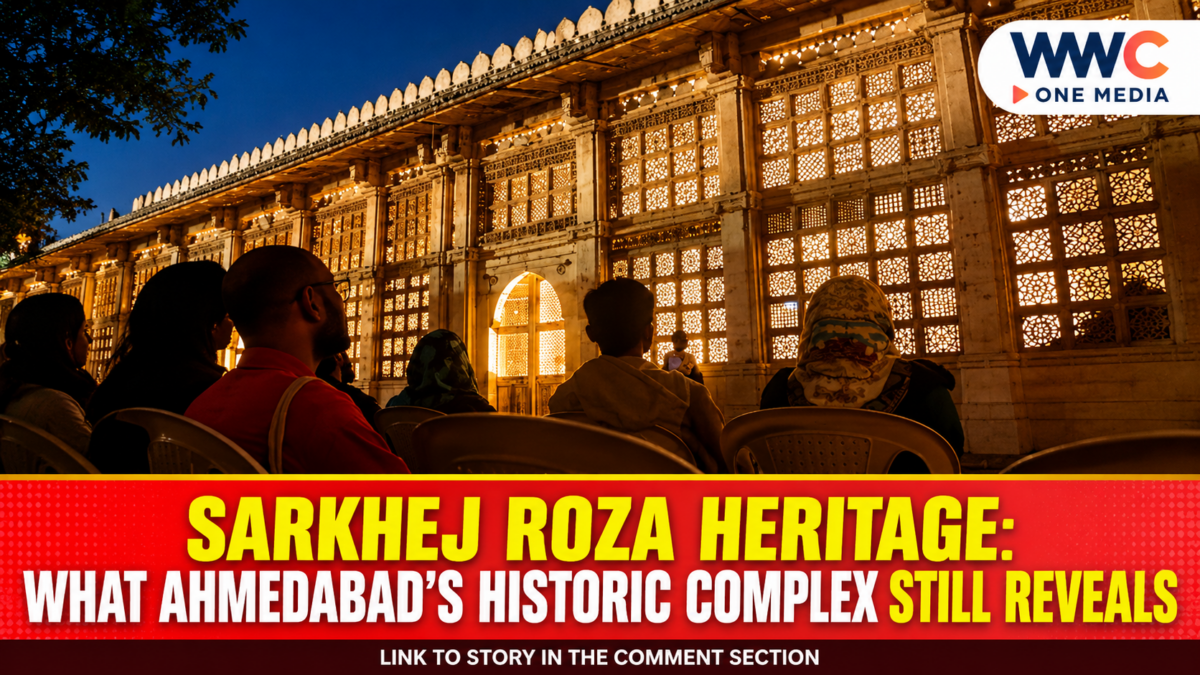
AHMEDABAD, India — Southwest of Ahmedabad’s historic centre, Sarkhej Roza preserves a layered record of the Gujarat Sultanate through its mosque, tombs, palace structures and expansive tank. The complex is associated with the Sufi saint Shaikh Ahmed Khattu Ganj Baksh and the rulers who expanded the site during the 15th century.
Its significance extends beyond the presence of individual monuments. Sarkhej Roza reflects a period when religious life, royal patronage, local craftsmanship and regional architectural traditions came together in a single landscape. That combination gives the site an important place in understanding Ahmedabad’s early history.
The complex is also a reminder that heritage tourism involves more than making old buildings accessible. Visitors need enough historical context to understand what they are seeing, while conservation efforts must protect the structures and their setting.
Sarkhej Roza heritage began with a Sufi centre
The history of Sarkhej is closely connected to Shaikh Ahmed Khattu Ganj Baksh, a Sufi saint who was associated with Sultan Ahmed Shah I, the ruler credited with establishing Ahmedabad as the Gujarat Sultanate’s capital.
The monument’s historical account identifies Sarkhej as a village during Ahmed Shah’s reign. It describes the settlement as having a predominantly Hindu population involved in weaving and indigo-dyeing before the area became closely associated with the saint.
Shaikh Ahmed Khattu later retired to Sarkhej, where he died in 1445. A mausoleum and mosque were commissioned in his honour by Muhammad Shah, Ahmed Shah’s successor. The construction was completed in 1451 during the reign of Qutb’ud-Din Ahmed Shah.
This sequence matters because it places the earliest major structures within the political and religious environment of the Gujarat Sultanate. The site developed around a spiritual figure whose influence extended into the ruling establishment, rather than beginning as a conventional royal palace or military fort.
The relationship between religious authority and political patronage helped shape the complex that visitors encounter today.
Mahmud Begada expanded the complex beyond a shrine
Sarkhej Roza grew substantially during the rule of Sultan Mahmud Begada, who expanded the site in the latter half of the 15th century.
The additions included a large central tank, pavilions and a private mosque. Mahmud Begada also commissioned a mausoleum for himself and members of his family opposite the tomb associated with Ganj Baksh.
The result was a complex with several functions. It served as a religious and commemorative site, but its royal buildings and water features also made it a place of retreat for the ruling family.
The great tank is particularly important to the layout. Rather than treating the water feature as an isolated attraction, the complex places it in relation to the surrounding religious and royal structures. The relationship between the buildings and the water gives the site much of its architectural character.
The wider significance of this kind of development can be understood alongside other heritage destinations where visitor access and historical interpretation are being reconsidered. WWC’s coverage of the restoration and public reopening of the Old Acropolis Museum examined how historic places can remain relevant through interpretation and public engagement.
Its architecture records a meeting of traditions
Sarkhej Roza is notable for an architectural style that combines influences rather than following a single design tradition.
The Ahmedabad district government describes the complex as an example of early Islamic architectural culture in the region, incorporating Persian influences alongside indigenous Hindu and Jain features. The monument’s own historical description also highlights the relationship between Hindu craftsmanship and Islamic approaches to geometry and scale.
This combination is significant in the context of Gujarat’s architectural history. The buildings show how construction practices and decorative ideas can develop through contact between communities and artistic traditions.
The site’s visual character is not limited to its domes or tomb structures. Its carved stonework, screens, courtyards, pavilions and spatial arrangement contribute to the overall experience.
For visitors, understanding these features requires more than identifying a building by name. The details reveal how different traditions were incorporated into a shared architectural environment.
That is also why interpretation matters. A guided visit, exhibition or educational programme can help explain the relationship between the complex’s individual structures and the historical period in which they developed.
The protected structures make conservation a continuing responsibility
Sarkhej Roza is represented in the national list of centrally protected monuments through several separate entries. These include the Great Mosque, Great Tank, Palace and Harem, the pavilion before the tomb of Shaikh Ahmed Khatau Ganj Baksh, and the tombs associated with the site.
The listing is important because it shows that the heritage value of Sarkhej Roza is not confined to one building. Its significance is distributed across a group of structures that together form a larger historical landscape.
Conservation therefore requires attention to the relationship between the monuments, not only the appearance of individual buildings.
Water features, surrounding spaces, stone surfaces and architectural details all contribute to how the complex is understood. If one element deteriorates or becomes disconnected from the wider setting, visitors may lose part of the context that gives the place meaning.
WWC has examined similar questions in its report on heritage tourism infrastructure at San Juan’s Pinaglabanan Shrine. That project highlights the importance of connecting visitor facilities with historical interpretation while respecting the character of a protected site.
For Sarkhej Roza, the challenge is to make the complex understandable and accessible without reducing its historical and religious character to a tourist backdrop.
Heritage experiences need historical accuracy, not just atmosphere
The appeal of historic sites often depends on how people experience them. Lighting, guided interpretation, audio presentations and organised visits can help visitors notice architectural details that might otherwise be overlooked.
But presentation should support historical understanding rather than replace it.
A programme at a site such as Sarkhej Roza would need to distinguish documented history from local tradition, identify the different periods of construction and explain the significance of the religious and royal structures. It would also need to respect the site’s continuing religious associations.
WWC’s reporting on Museo del Galeón’s after-hours and educational programmes offers another example of how cultural institutions can broaden public engagement beyond conventional daytime visits.
The lesson is not that every monument should adopt the same visitor format. Each site has its own physical conditions, community relationships and conservation requirements. What works in a museum may not be appropriate for an active religious complex.
For Sarkhej Roza, the priority should remain accurate interpretation and careful management of the historic environment.
What happens next
Sarkhej Roza’s historical importance is already established by its documented development and its inclusion in the national protected-monument list. The continuing task is to ensure that visitors can understand the complex as a connected cultural landscape rather than a collection of disconnected structures.
Any new visitor programme should be assessed through clear information about its organisers, access arrangements, route, schedule and conservation safeguards. Those details are particularly important when activities take place outside ordinary visiting hours or within spaces that retain religious significance.
The public records reviewed for this article establish the monument’s historical background and protected components, but do not independently confirm the reported night-walk programme or its operating arrangements.
For Ahmedabad, Sarkhej Roza remains an important reminder that the city’s past is preserved not only in its best-known landmarks, but also in places where religious, political and architectural histories meet.
Frequently asked questions
1. Where is Sarkhej Roza located?
Sarkhej Roza is in the Makarba area, southwest of Ahmedabad in Gujarat, India.
2. Who is associated with Sarkhej Roza?
The complex is closely associated with the Sufi saint Shaikh Ahmed Khattu Ganj Baksh and the Gujarat Sultanate rulers who commissioned and expanded its structures.
3. When was the original tomb and mosque completed?
The tomb and mosque associated with Shaikh Ahmed Khattu were completed in 1451 during the reign of Qutb’ud-Din Ahmed Shah.
4. Why is Sarkhej Roza architecturally significant?
Its architecture combines early Islamic influences, including Persian elements, with indigenous Hindu and Jain craftsmanship and design traditions.
5. Is Sarkhej Roza a protected monument complex?
Yes. Several structures at Sarkhej, including the Great Mosque, Great Tank, Palace and Harem, and associated tombs, appear in the national list of centrally protected monuments.