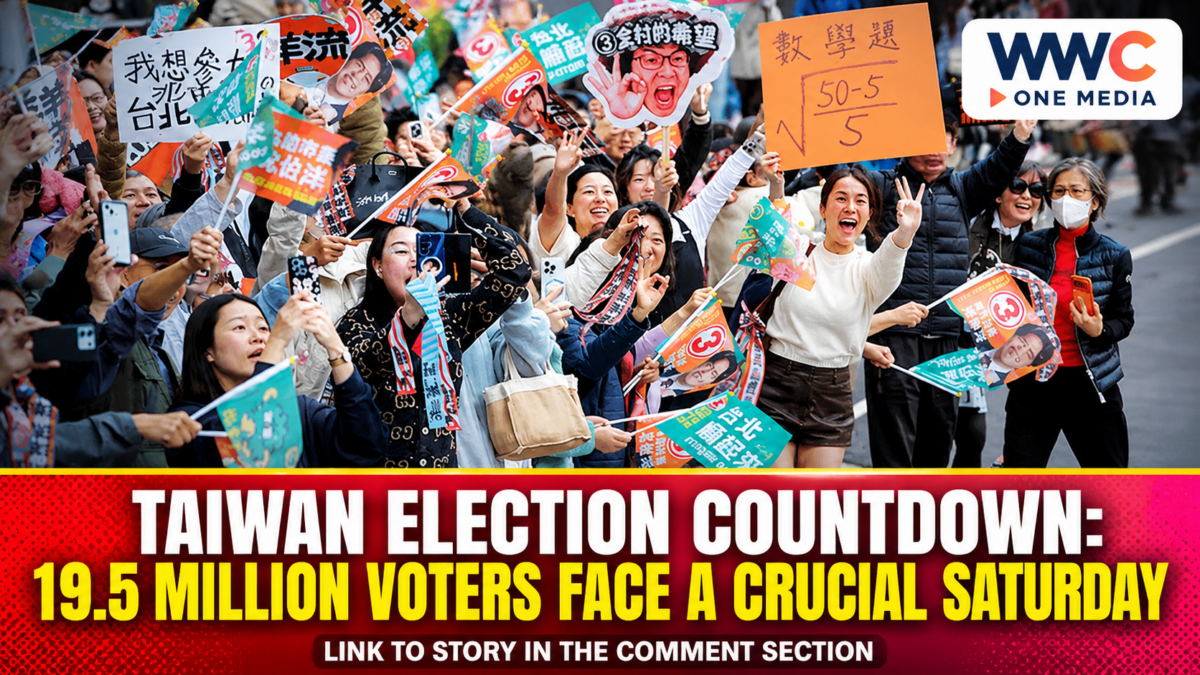
Taiwan is entering the final stretch before its November 28, 2026 local elections, with the Central Election Commission confirming 19,100 qualified candidates competing for 11,051 local government positions. The vote will also coincide with a nationwide referendum on nuclear energy, placing local leadership choices and a major energy-policy question before voters on the same day.
The scale of the election goes beyond the contest between Taiwan’s major political parties. The results will determine local leadership across cities, counties and communities, while the referendum will test public support for a possible change in the government’s nuclear-free energy policy. Election authorities are also preparing for risks involving misinformation, unlawful campaign financing and election-related security.
Taiwan election countdown: The numbers behind the vote
The Central Election Commission’s November 19 election briefing recorded 19,695 applications for candidacy across nine categories of local elections. After qualification reviews, 19,100 candidates were eligible to run for 11,051 positions.
The largest category is the village and neighborhood chief election, with 13,572 qualified candidates competing for 7,780 positions. Municipal council elections have 605 candidates for 381 seats, while six special-municipality mayoral contests have 23 candidates.
Other races include county and city leadership, county and city councils, township and city mayors, township representatives and representatives in mountain Indigenous districts.
These figures show why the vote cannot be reduced to a single contest between the Democratic Progressive Party (DPP) and the Kuomintang (KMT). Local government positions carry separate responsibilities, and voters will be choosing representatives at several levels of administration.
For the six special municipalities — Taipei, New Taipei, Taoyuan, Taichung, Tainan and Kaohsiung — the mayoral contests will be closely watched because these cities are major centres of population, commerce and public services.
What the official voter figures reveal
The commission published final voter counts on November 24. For city and county chief elections, the number of eligible voters is 19,576,028. The corresponding figure for city and county council elections is 19,486,232.
Other categories have their own electorates. The number for township and city chief elections and special-municipality mountain Indigenous district chiefs is 5,043,956. For village and neighborhood chief elections, it is 19,439,382.
The nationwide referendum has a separate electorate of 20,003,835.
These figures should not be added together. Voters may be eligible to participate in more than one election category, and the commission publishes separate counts according to the ballot being cast.
For election administrators, the challenge is to ensure that voters receive the correct ballots and that counting procedures remain orderly. For the public, the figures provide a clearer picture of the size and complexity of the exercise.
Nuclear energy referendum adds a national policy dimension
Alongside local elections, voters will decide National Referendum No. 22.
The official question asks whether voters support the government using nuclear power to revive the economy and abolishing the nuclear-free homeland energy policy.
The referendum gives the election a policy dimension beyond municipal administration. Nuclear energy has implications for electricity supply, industrial demand, energy security and the direction of Taiwan’s energy transition.
However, the referendum result should be distinguished from the local election outcomes. Choosing mayors and councillors determines local representation, while the referendum records voters’ position on a nationwide policy question.
The issue is particularly relevant to Taiwan’s industrial economy, which includes major semiconductor and technology supply chains that depend on reliable electricity. The result could become an important political signal in the debate over future energy policy, but it does not by itself resolve every technical, regulatory or implementation question.
Election security remains part of the final preparations
The government’s November 12 election-security report identified several areas requiring attention: foreign influence and funding, disinformation, vote-buying and election-related violence.
The report said the National Police Agency’s special command centre began operating on October 28 under the supervision of Interior Minister Liu Shih-fang. Police and relevant agencies were assigned to coordinate election-security and investigative work.
These preparations are not proof that a particular candidate or party has committed an offence. They describe the government’s stated security priorities and the measures intended to protect the election process.
The wider information environment is also relevant. WWC has previously examined Taiwan’s election-security rules and restrictions on foreign campaign financing, including the legal distinction between political contact and conduct prohibited under the Anti-Infiltration Act.
Artificial intelligence adds another challenge for voters who encounter political material online. As explored in WWC’s coverage of AI-related election manipulation risks in Taiwan, manipulated images, fabricated recordings and misleading digital content can make it harder to assess political claims. Specific allegations still require evidence and should not be treated as established merely because they circulate during an election.
Party competition and local political alliances
The DPP and KMT remain central to Taiwan’s political contest, but local elections also involve candidate coordination, local issues and the strength of political organisations in individual districts.
The opposition’s campaign relationships have faced their own complications. WWC previously examined the KMT–Taiwan People’s Party dispute over electoral cooperation in Hsinchu County, illustrating how disagreements over candidate selection can affect local contests.
The final campaign period is therefore about more than national party branding. Candidates must persuade voters that their local programmes, public-service priorities and leadership records deserve support.
For voters, the most useful comparison is between specific proposals and the responsibilities of the office being contested. Local officials have influence over municipal services, infrastructure, planning and community administration, but they do not independently determine every national policy.
What happens next
Taiwan’s polling day is Saturday, November 28. The Central Election Commission’s election information service lists voting hours as 8 a.m. to 4 p.m. local time.
The commission’s published timetable provides for the review and confirmation of elected candidates by December 4, with the election results scheduled for announcement that day. Election certificates are scheduled to be issued by December 18.
The referendum will be counted as a separate national vote. Its outcome will provide a measure of public support for the energy-policy question, while the local results will determine who assumes the relevant elected offices.
The immediate test is the orderly conduct of voting and counting. The longer-term political test will come when elected officials begin turning campaign commitments into local government decisions.
Frequently asked questions
When are Taiwan’s 2026 local elections?
They are scheduled for Saturday, November 28, 2026. Voting is scheduled from 8 a.m. to 4 p.m. local time.
How many candidates are running in Taiwan’s 2026 local elections?
The Central Election Commission recorded 19,100 qualified candidates competing for 11,051 local government positions across nine election categories.
How many people can vote in the nationwide referendum?
The commission’s final published figure for the national referendum is 20,003,835 eligible voters.
What is Taiwan’s 2026 nuclear energy referendum about?
National Referendum No. 22 asks whether voters support using nuclear power to revive the economy and abolishing the nuclear-free homeland energy policy.
When are the election results expected to be announced?
The official timetable schedules confirmation and announcement of elected candidates by December 4, 2026. The actual timing of individual counts and announcements may vary by electoral jurisdiction.