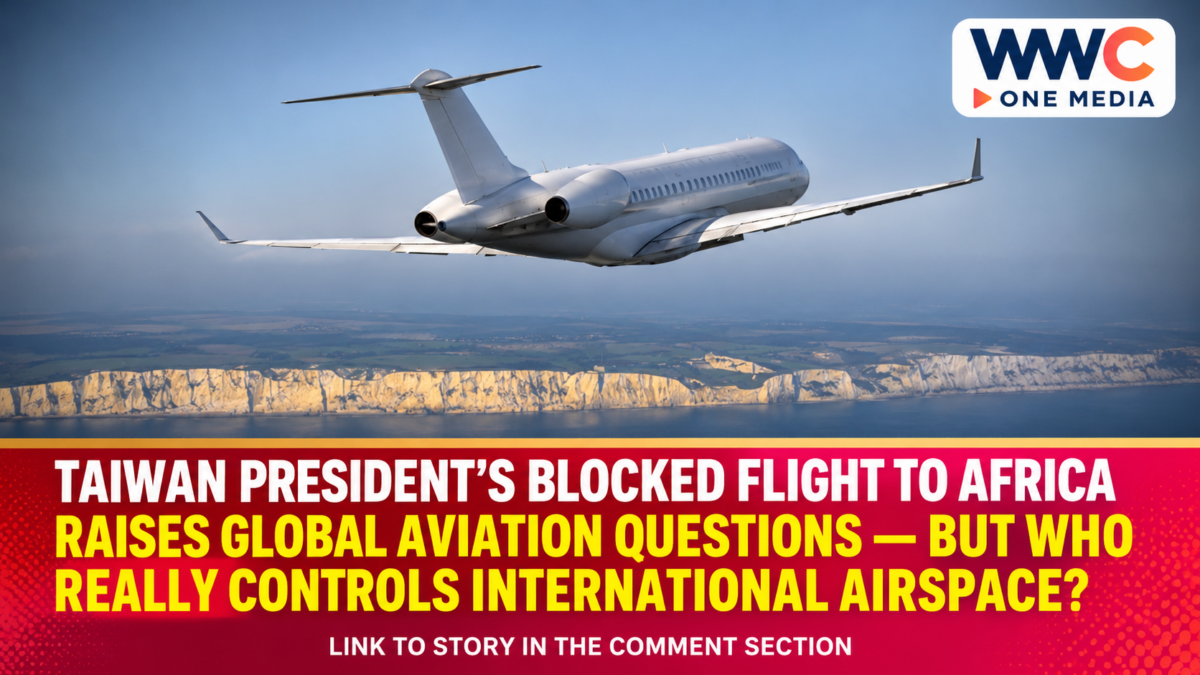
Taiwan flight restrictions have renewed international attention on the relationship between diplomatic disputes, airspace management and aviation regulations following the disruption of President Lai Ching-te’s planned April 2026 visit to Eswatini.
Seychelles reaffirmed its longstanding One-China policy on November 19, while Lai reiterated Taiwan’s concerns over the cancellation of presidential flight permissions during a meeting with French parliamentarians on November 20.
The developments bring a fundamental question into focus: does responsibility for managing international airspace give a government the authority to restrict aircraft movements for diplomatic reasons?
The distinction between territorial sovereignty and international air traffic management is central to understanding the controversy.
Taiwan Flight Restrictions Disrupted Presidential Visit
Lai was originally scheduled to depart Taiwan on April 22, 2026, for a diplomatic visit to the Kingdom of Eswatini.
However, Taiwan announced on April 21 that the trip would be postponed following the cancellation of flight permissions along the chartered aircraft’s intended route.
Taiwanese authorities identified Seychelles, Mauritius and Madagascar as the countries involved.
Taipei alleged that pressure from Beijing, including economic coercion, influenced the decisions. These allegations represent Taiwan’s official position and should not be treated as independently established findings.
Taiwan postponed the journey following a national security assessment covering the safety of the president, his delegation and the aircraft.
Lai subsequently travelled to Eswatini on May 2 at the invitation of King Mswati III, completing the state visit after the earlier disruption.
The episode demonstrates why regulatory permissions remain an important consideration in international connectivity, including proposed commercial services such as IndiGo’s expansion into Southeast Asian aviation markets.
Seychelles Maintains Its One-China Policy
Seychelles has defended its aviation clearance procedures within the framework of its diplomatic position and interpretation of international law.
In April, the Seychelles government explained that it does not recognise Taiwan as a sovereign state or maintain official diplomatic relations with Taipei.
It maintained that aviation clearance decisions involving state-linked movements are assessed within its national regulatory and foreign policy framework.
On November 19, Seychelles reaffirmed its commitment to the One-China policy, which has remained part of its diplomatic position since establishing relations with the People’s Republic of China in 1976.
Beijing also welcomed the relevant countries’ adherence to the One-China principle in its April 22 response to the postponement of Lai’s visit.
Taiwan, meanwhile, maintains that its international diplomatic engagement should not be obstructed through external pressure.
These competing positions highlight the importance of distinguishing decisions concerning national airspace from responsibilities associated with international air navigation.
Who Controls International Airspace?
The Convention on International Civil Aviation, commonly known as the Chicago Convention, establishes that countries exercise sovereignty over the airspace above their territories.
However, international aviation also operates through designated Flight Information Regions, or FIRs.
An FIR is a defined area where designated authorities provide aviation services, including flight information and assistance related to safe aircraft operations.
These regions can extend beyond national territory into international airspace.
Responsibility for providing air navigation services over international waters does not, by itself, establish territorial sovereignty over that airspace.
This distinction is particularly important when examining disputes involving long-distance international flights.
Publicly available flight information can help explain aircraft movements, but it cannot necessarily establish the diplomatic or regulatory reasons behind operational decisions, as illustrated by WWC ONE MEDIA’s examination of SKY Airline’s international flight records.
Determining whether a particular restriction complies with international aviation rules requires examining the affected airspace, the aircraft’s legal classification and the applicable regulatory arrangements.
ICAO Expands Its Governing Council to 40 Members
The International Civil Aviation Organization (ICAO), a specialised agency of the United Nations, plays a central role in developing international civil aviation standards and supporting their implementation.
On November 20, 2026, Ethiopia, Indonesia, Oman and Türkiye were elected to the ICAO Council during an extraordinary session of its Assembly in Montréal, Canada.
Their election increased the Council’s membership from 36 to 40 countries following an amendment to the Chicago Convention that entered into force on June 12, 2026.
The expanded Council includes several major Asia-Pacific economies, including China, the United States, Canada, Japan, Australia, Malaysia, Singapore and the Republic of Korea.
Its responsibilities include examining aviation matters and addressing issues concerning implementation of the Convention.
The Council’s broader representation comes at a time when international cooperation remains essential to maintaining predictable and consistent aviation operations.
Why Airspace Regulations Matter Across APEC Economies
International aviation supports tourism, trade, investment and business travel across geographically dispersed economies.
Long-distance services frequently require coordination between multiple aviation authorities, making predictable regulatory arrangements important for operational planning.
The growth of intercontinental connectivity, including Philippine Airlines’ nonstop Manila–Chicago service, illustrates the importance of international aviation cooperation.
Unexpected changes to flight permissions could create operational difficulties for affected aircraft operators, including the potential need to reassess routes, fuel requirements and scheduling arrangements.
However, there is no independently verified evidence in the reviewed official records that the April presidential flight incident caused widespread commercial airline disruption across the Asia-Pacific.
The immediate controversy concerns a specific diplomatic journey rather than a general prohibition on Taiwanese commercial aviation.
What Happens Next?
Further clarity would require the publication of relevant aviation clearance documents, formal government explanations and any applicable ICAO decisions.
President Lai’s May visit demonstrated that the April postponement did not permanently prevent diplomatic engagement between Taiwan and Eswatini.
Nevertheless, the underlying disagreement over airspace administration and diplomatic recognition remains significant.
Whether future international aviation discussions produce additional regulatory clarification will depend on the proceedings and decisions of the relevant authorities.
The central question is how international aviation can maintain consistent technical standards while governments continue to navigate competing diplomatic interests.