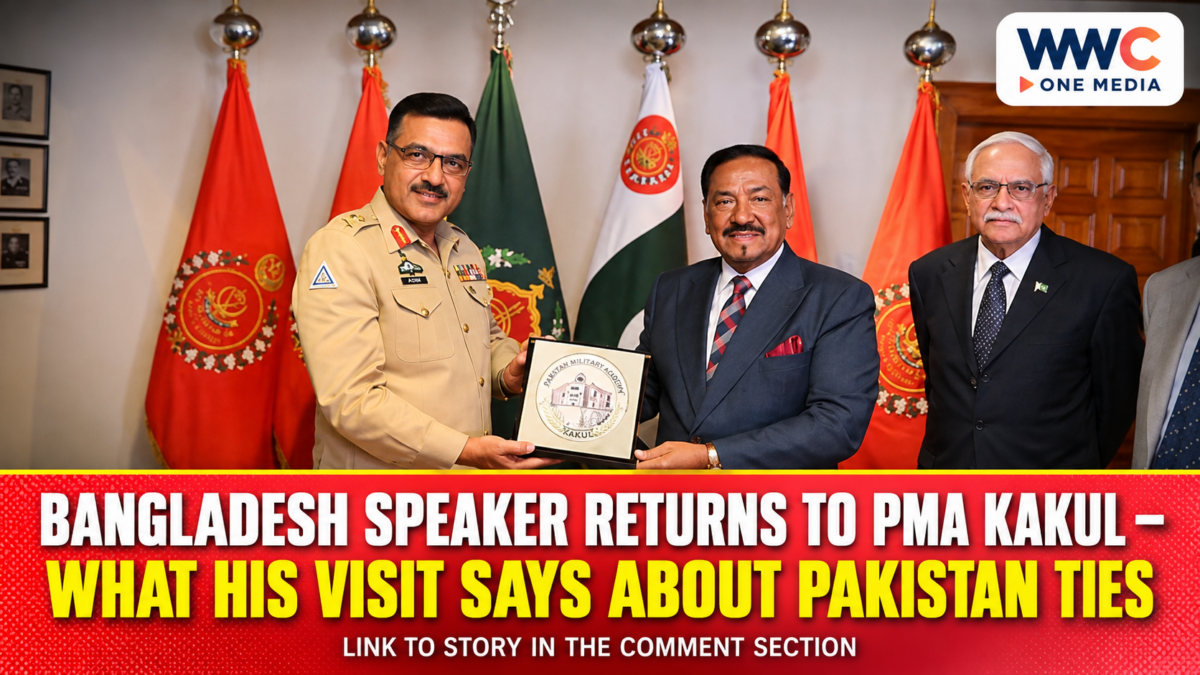
KAKUL, Pakistan, November 25, 2026 — Bangladesh Parliament Speaker Hafiz Uddin Ahmad, Bir Bikram, visited the Pakistan Military Academy (PMA) in Kakul on Wednesday during his official visit to Pakistan. The visit brought him back to the institution where he received military training before entering public life in Bangladesh.
The visit carried a personal and institutional dimension, but its diplomatic significance is broader. It comes during a high-level parliamentary exchange intended to strengthen relations between Islamabad and Dhaka after years in which official contacts between the two countries were limited. The public announcement, however, does not identify a new defence agreement, joint military programme or training commitment arising from the academy visit.
PMA Kakul visit reconnects the Bangladeshi Speaker with his military background
The National Assembly of Pakistan said Ahmad was received at the academy by its Commandant, Lieutenant General Iftikhar Hassan Chaudary. The official account described the visit as an opportunity for the Bangladeshi Speaker to see the academy’s training environment and renew professional and personal connections.
Ahmad recalled his military career in the Pakistan Army and his time at PMA. The parliamentary statement said he spoke about the lasting impression made by his formative years at the academy.
That background makes the visit different from a routine diplomatic stop. PMA is not simply another venue on the delegation’s itinerary: it is an institution connected to Ahmad’s own professional history.
The visit also gives both governments an opportunity to acknowledge a shared institutional connection while maintaining the distinction between personal history and current state policy. A former military connection can provide a point of familiarity, but it does not by itself establish a change in defence policy or a new operational relationship.
A first-ever visit by a Bangladesh Parliament Speaker
Ahmad’s visit to Kakul took place within a six-day official trip to Pakistan scheduled for November 23 to 29, 2026. The invitation came from Pakistan National Assembly Speaker Sardar Ayaz Sadiq.
Pakistan’s parliamentary announcement described the trip as the first-ever visit to Pakistan by a Speaker of the Bangladesh Parliament. It also characterised the visit as the first Bangladeshi parliamentary delegation visit to Pakistan in 16 years.
The delegation’s programme included engagements in Islamabad, with Lahore and Karachi also identified as destinations during the visit. The parliamentary schedule included a briefing by Pakistan’s foreign affairs and commerce ministries, followed by a meeting with the Pakistan-Bangladesh Parliamentary Friendship Group at Parliament House.
These engagements matter because parliamentary diplomacy can create regular channels for contact between elected representatives. Unlike a single executive-level meeting, friendship groups and institutional exchanges can provide a structure for continued discussion.
The wider diplomatic setting has also included renewed attention to Pakistan’s regional partnerships. WWC has examined Pakistan’s recent engagement with ASEAN on trade and cooperation, a separate process that illustrates Islamabad’s use of institutional dialogue to maintain regional relationships.
Military history does not automatically mean a new defence agreement
Ahmad’s return to PMA may attract attention because of the academy’s role in Pakistan’s officer training system and his own past there. But the official announcement is specific about what took place: a visit, a reception by the commandant, an opportunity to observe the training environment and a reflection on his earlier military career.
It does not announce a bilateral military pact, a new officer-exchange programme, joint exercises, weapons procurement or a defence-industrial agreement.
That distinction is important. Military visits can be symbolic, educational or part of broader diplomatic engagement. A formal defence arrangement would normally require more specific public documentation, such as an agreement, an announced programme, defined participating institutions or an official implementation plan.
Bangladesh’s wider defence-policy discussions have included other regional proposals. In a separate report, WWC examined Bangladesh’s consideration of the Makkah Joint Defence Agreement. That discussion is distinct from Ahmad’s PMA visit and should not be treated as evidence that Bangladesh has entered a new military arrangement with Pakistan.
For now, the Kakul announcement supports a narrower conclusion: the visit recognised a historical professional connection and formed part of a wider official exchange.
The diplomatic opportunity extends beyond the military
The parliamentary visit also sits within a broader effort to expand relations through political and institutional contact. Pakistan’s National Assembly has highlighted parliamentary friendship groups and regular exchanges as ways to improve communication between the two legislatures.
Such channels can support discussion on subjects beyond defence, including trade, education, culture and regional cooperation. They can also help lawmakers understand how each country approaches legislation, public administration and international affairs.
For businesses, the relevance is indirect but worth watching. Better diplomatic communication can help create a more predictable environment for future economic discussions. However, the Kakul visit itself does not establish a trade agreement, investment commitment or commercial project.
Pakistan’s recent bilateral economic initiatives show how governments often separate broad political engagement from practical commercial targets. WWC’s report on Pakistan and the Maldives’ proposed US$200-million trade target examines why diplomatic commitments still need transport links, buyers, suppliers and implementation to produce measurable results.
The same principle applies to Pakistan and Bangladesh. Institutional goodwill can open doors, but the value of closer relations will ultimately depend on concrete decisions and follow-through.
What happens next
The immediate next step is the completion of the Bangladeshi delegation’s official programme, which was scheduled to continue through November 29. Further statements from the two parliaments or relevant ministries may clarify whether the visit leads to additional institutional exchanges or formal cooperation proposals.
For the military relationship, any claim of a new training arrangement or defence commitment would require a separate official announcement. The Kakul visit statement does not provide one.
For parliamentary relations, the more meaningful indicators will be whether the friendship group continues meeting, whether further delegations are exchanged and whether the two sides identify specific areas for cooperation.
Ahmad’s return to PMA Kakul therefore carries a clear historical meaning. Whether it becomes a practical turning point in Pakistan-Bangladesh relations will depend on what both governments do after the visit.
Frequently asked questions
Why did Bangladesh Speaker Hafiz Uddin Ahmad visit PMA Kakul?
He visited the Pakistan Military Academy on November 25, 2026, during an official trip to Pakistan. He had previously received military training at the academy.
Who received the Bangladeshi Speaker at PMA Kakul?
The official Pakistani parliamentary announcement said he was received by the academy’s Commandant, Lieutenant General Iftikhar Hassan Chaudary.
Was a new Pakistan-Bangladesh defence agreement announced during the visit?
No new defence agreement, joint military exercise or training programme was announced in the official statement about the academy visit.
How long was the Bangladeshi parliamentary delegation’s Pakistan visit?
The official parliamentary schedule listed the visit from November 23 to 29, 2026.
Why is the visit significant for Pakistan-Bangladesh relations?
It combines a personal connection to Pakistan’s military academy with a wider parliamentary exchange intended to strengthen institutional contact between the two countries.