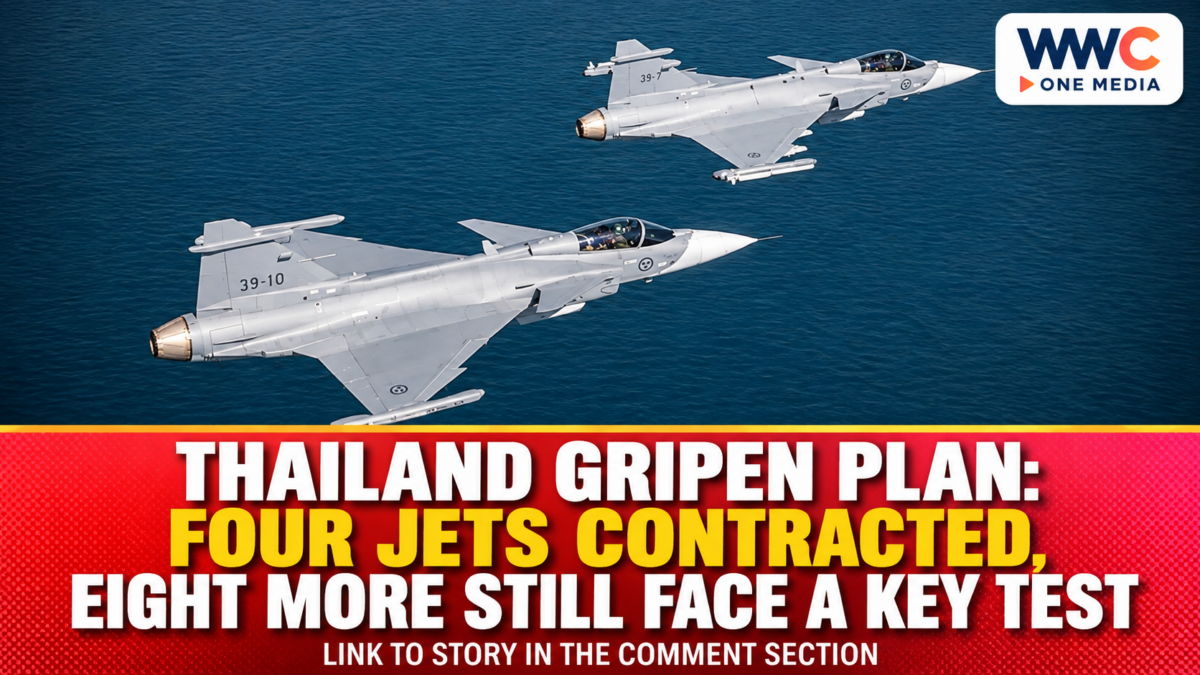
BANGKOK, November 26, 2026 — Thailand’s Royal Thai Air Force has a documented plan to acquire 12 Saab Gripen E/F fighters over a 10-year period, but the signed first-phase contract covers only four aircraft. The next question is whether the remaining eight will move forward together as a single procurement package or remain subject to separate budget and government decisions.
The distinction matters because a long-term military acquisition plan is not the same as an approved purchase. Thailand has already moved beyond aircraft selection and signed its initial contract with Sweden, but the public records reviewed do not establish that the remaining eight fighters have been approved, funded or ordered.
Thailand Gripen plan began with a 12-aircraft replacement programme
The Royal Thai Air Force selected the Gripen E/F in August 2024 for its replacement fighter programme. Its stated objective was to replace ageing F-16 A/B aircraft assigned to Wing 1, which had been in service for more than three decades.
In a June 4, 2025 briefing, the Thai air force described a replacement programme covering 12 fighter aircraft over 10 years. The announcement placed the acquisition within a broader effort to maintain the country’s fighter capability as older aircraft approach retirement.
The selection process was not itself a purchase contract. Saab’s June 4, 2025 announcement explicitly said the company had not yet signed a contract or received an order at that stage. The procurement still needed to proceed through the relevant government and contracting steps.
That distinction was resolved for the first phase later in August 2025, when Thailand and Sweden signed the initial procurement agreement.
The first contract covers three Gripen E jets and one Gripen F
On August 25, 2025, Saab announced that it had received an order from the Swedish Defence Materiel Administration (FMV) for four Gripen E/F aircraft for Thailand.
The contract is valued at approximately SEK 5.3 billion. It covers three single-seat Gripen E aircraft and one two-seat Gripen F, together with associated equipment, support and training. Saab said deliveries would take place between 2025 and 2030.
Thailand’s Ministry of Foreign Affairs separately confirmed the signing ceremony in Stockholm. It identified Air Chief Marshal Punpakdee Pattanakul, then Chief of Command of the Royal Thai Air Force, as Thailand’s official signatory.
The Thai government also signed an offset policy agreement connected to the acquisition. Such arrangements are intended to create benefits beyond the direct purchase of military equipment, including industrial cooperation and technology-related activities.
The first contract therefore represents a defined procurement commitment. It should not be confused with the full 12-aircraft programme or interpreted as proof that the remaining eight have already been ordered.
The remaining eight fighters are the unresolved part
The original 12-aircraft plan leaves eight aircraft beyond the first four contracted jets. A proposal to combine the remaining purchases into one order would be a significant next step, but it requires confirmation through official procurement or budget documentation.
As of November 26, the primary records reviewed for this report confirm the 12-aircraft planning objective and the four-aircraft contract. They do not establish a signed contract, final budget approval or formal order for the remaining eight fighters as a single package.
That does not mean the additional aircraft have been cancelled. It means their procurement status should not be upgraded from a plan or proposal to a completed government commitment without supporting documentation.
For taxpayers and defence planners, the next relevant documents would include a formal Royal Thai Air Force procurement announcement, a government budget approval, a contract disclosure or a corresponding order announcement from Saab or FMV.
Analysis: Buying the remaining aircraft together could help the air force plan a more consistent fleet, training pipeline and support structure. But a larger single procurement would also require a clear funding decision and an assessment of the full cost of operating the aircraft over their service lives. The number of aircraft alone does not reveal the total long-term financial commitment.
The offset agreement adds an industrial dimension
Thailand’s first-phase agreement includes more than the delivery of aircraft. The offset arrangement between the Royal Thai Air Force and Saab is intended to support technology transfer, industrial cooperation and investment in sectors outside defence.
Thailand’s foreign ministry identified possible areas of cooperation that include education and skills training, technology transfer, food and agricultural innovation, green transition and cybersecurity.
The Royal Thai Air Force’s own announcement also described the offset agreement as a way to extend the benefits of the procurement into areas such as economic development, education, agriculture, technology and human-resource development.
These commitments are important because major defence purchases can affect domestic industry as well as military capability. However, an offset policy should not be treated as proof that every proposed investment or technology project has already been completed.
The practical test will be whether individual projects are formally agreed, funded and delivered, and whether Thai institutions and companies gain capabilities that can be maintained after the initial programme.
WWC has examined similar procurement questions in its report on Poland’s effort to expand defence cooperation with the Philippines after the Black Hawk programme. Defence partnerships can extend beyond the aircraft or equipment purchase, but the actual benefits depend on the agreements and projects that follow.
Thailand’s fighter modernisation is about long-term readiness
The Gripen programme is part of a wider challenge for an air force operating different generations of aircraft. Replacing older fighters requires more than acquiring new airframes. It also involves pilot training, maintenance, spare parts, technical support, weapons integration and the systems needed to coordinate operations.
The Saab contract includes associated equipment, support and training, reflecting some of those requirements. The Royal Thai Air Force has also described the need to maintain sufficient fighter capability as older F-16 aircraft approach retirement.
This is why the delivery schedule matters. The first four aircraft are scheduled for delivery over the 2025–2030 period, while the full 12-aircraft programme was originally framed as a 10-year undertaking.
For comparison, other countries in the region are also reviewing how to translate defence announcements into operational capabilities. WWC’s coverage of the Philippines’ approved arms sales and what the figures actually mean explains why an approval, a contract and a completed delivery are separate stages of military procurement.
The same discipline applies to Thailand: the first four aircraft have a disclosed contract, while the remaining eight still need their own documentary trail.
What happens next
The next milestone is an official update on the remaining eight aircraft. A confirmed procurement decision should identify the approved quantity, funding source, procurement phase and contracting arrangements.
Further disclosures may also clarify how the offset programme is progressing, which industrial projects have moved into implementation and how the new aircraft will be integrated with Thailand’s existing Gripen C/D fleet.
Until those records are published, the safest description is that Thailand has contracted four Gripen E/F fighters within a broader 12-aircraft replacement plan. Any single-order proposal for the other eight should remain identified as unconfirmed.
Frequently asked questions
How many Gripen E/F fighters has Thailand officially ordered?
The disclosed first-phase contract covers four aircraft: three Gripen E fighters and one Gripen F.
Does Thailand plan to acquire 12 Gripen fighters?
The Royal Thai Air Force described a 12-aircraft replacement programme over 10 years in its June 2025 announcement. The first four were subsequently contracted.
Has Thailand officially approved the remaining eight Gripen fighters?
The primary records reviewed confirm the first four-aircraft contract but do not establish a final approval or signed order for the remaining eight.
How much is Thailand’s first Gripen E/F contract worth?
Saab disclosed an order value of approximately SEK 5.3 billion for the four aircraft and associated equipment, support and training.
What is included in the Gripen offset agreement?
The offset arrangement is intended to support technology transfer and industrial cooperation, with areas identified by Thailand including education, skills training, agriculture, green transition and cybersecurity.