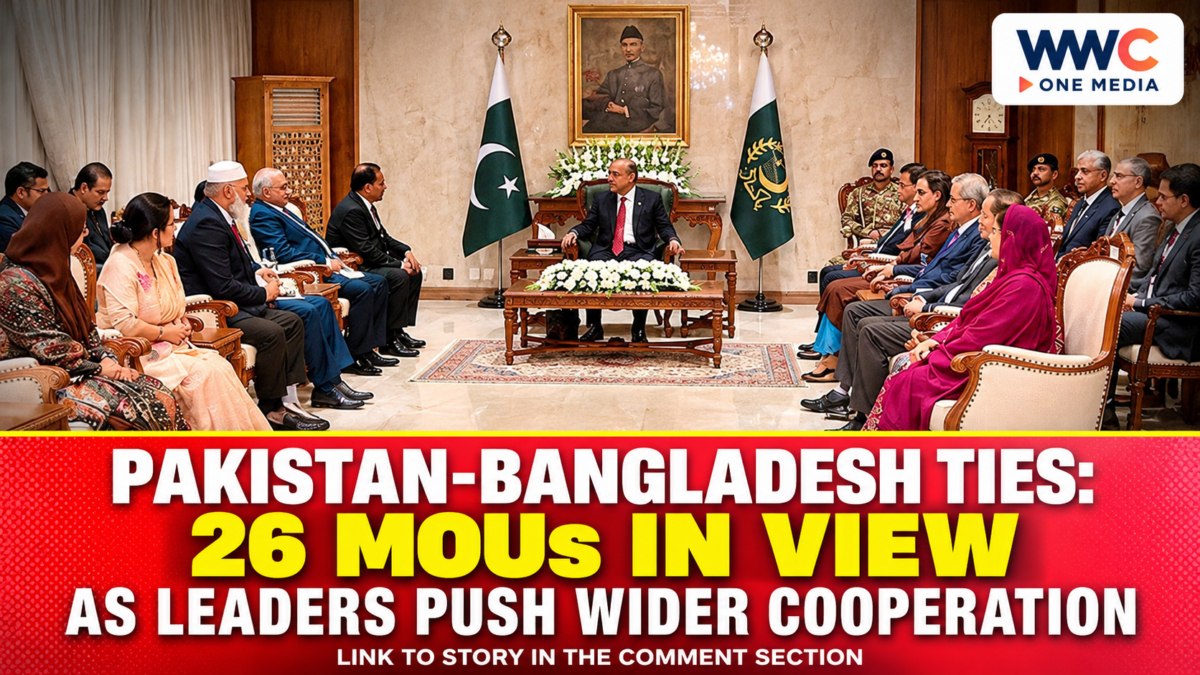
ISLAMABAD, November 26, 2026 — Pakistan President Asif Ali Zardari met Bangladesh Parliament Speaker Hafiz Uddin Ahmad in Islamabad on November 25, with discussions covering trade, education, parliamentary exchanges, connectivity and defence cooperation. Zardari also expressed hope that around 26 memorandums of understanding under consideration between the two countries could be finalised.
The discussions place practical economic and institutional cooperation at the centre of a renewed diplomatic engagement. But the distinction between proposals and completed agreements is important: the 26 memorandums have not been announced as signed, and the meeting statement does not provide a final list, implementation schedule or financial value for them.
Pakistan-Bangladesh ties move beyond diplomatic exchanges
The meeting formed part of a six-day visit by a high-level Bangladeshi parliamentary delegation led by Ahmad, who holds the title Bir Bikram. A National Assembly Secretariat notice dated November 23 scheduled the delegation’s visit from November 23 to 29.
The visit also included a planned meeting with Pakistan’s Parliamentary Friendship Group for Bangladesh at Parliament House on November 24. The programme listed a briefing by the foreign affairs and commerce ministries before the parliamentary group meeting.
The presidential discussion the following day broadened the agenda beyond parliamentary relations. Zardari identified agriculture, industry, food security, disaster management, digital governance, space research and defence as areas with potential for cooperation.
For both countries, the significance lies in whether these areas can move from diplomatic discussion into sustained institutional work. A meeting can establish political interest, but businesses, universities and public agencies need specific arrangements before cooperation can produce measurable results.
The 26 proposed MoUs are not yet completed agreements
The most consequential number in the presidential statement was around 26 memorandums of understanding that Zardari said he hoped could be finalised early.
An MoU generally records an understanding or framework for cooperation between participating institutions or governments. Its practical effect depends on the wording, the parties involved and whether it creates specific obligations. It should not automatically be treated as a completed commercial contract, a funded project or a binding trade agreement.
The public statement did not identify all 26 proposed memorandums, their individual sectors, signatories or expected value. It also did not set out a timetable for signing.
That leaves an important question for the next stage of the relationship: which proposals are ready for approval, and which still require technical discussions or government clearances?
Analysis: The value of the proposed MoUs will be measured less by their number than by the work that follows. Clear implementing agencies, timelines, funding arrangements and progress reports would help show whether the framework is producing practical outcomes.
Trade and transport are central to the economic agenda
Zardari said bilateral trade remained below its potential and called for existing mechanisms, including the Joint Economic Commission and the Joint Working Group on Trade, to be used more effectively.
He also referred to preferential trade arrangements as an area to explore. That wording signals an avenue for further discussion, not a newly implemented tariff concession or a concluded free-trade agreement.
The president cited ongoing Pakistani rice exports under a government-to-government agreement as a possible foundation for wider cooperation in food security and essential commodities. He also said Pakistan was ready, in response to a Bangladeshi request, to provide technical expertise for the refurbishment of sugar plants in Bangladesh.
The president encouraged greater private-sector engagement in textiles, pharmaceuticals, leather, automobiles, construction materials, minerals, chemicals, ceramics and jute.
Connectivity also featured in the discussion. Zardari welcomed the commencement of direct flights by Biman Bangladesh Airlines and called for more flight frequency and destinations. He also urged both sides to explore direct maritime links to support trade and economic cooperation.
These proposals matter because commercial ties depend on more than diplomatic goodwill. Reliable transport, predictable trade rules and regular contact between businesses can help companies assess suppliers, customers and investment opportunities.
WWC has examined Pakistan’s wider regional economic priorities in its report on Pakistan’s diplomacy, trade and regional connectivity agenda. The Pakistan-Bangladesh discussions are a separate bilateral track, but both illustrate the importance Islamabad places on regional economic links.
Education and parliamentary cooperation offer practical channels
Education was another part of the agenda. Zardari highlighted the Pakistan-Bangladesh Knowledge Corridor, which he said was launched the previous year and offers 500 fully funded scholarships to Bangladeshi students at Pakistani universities.
He said 170 Bangladeshi students had already joined Pakistani universities, with another 20 expected to join shortly. These figures were presented as part of the presidential account of the programme; the statement did not provide a university-by-university breakdown or a schedule for the expected arrivals.
Zardari also referred to a leadership training programme for senior Bangladeshi civil servants at Pakistan’s National School of Public Policy in Lahore. He offered assistance with training Bangladeshi parliamentary officials at the Pakistan Institute for Parliamentary Services and sharing Pakistan’s experience with a bicameral legislature.
The president also welcomed efforts to establish a Pakistan-Bangladesh Parliamentary Friendship Group. Such a group could provide a regular channel for legislators to exchange views and maintain contact beyond individual official visits.
The wider regional context includes Bangladesh’s engagement with other partners. WWC previously examined Bangladesh’s consideration of a proposed regional defence arrangement, a separate issue that should not be confused with any new defence pact arising from this visit. The current presidential statement records Pakistan’s readiness to extend defence cooperation, but does not announce a new defence treaty.
Why the next steps matter for businesses
The meeting covered a broad list of possible cooperation areas, from food security and industrial development to digital governance and defence. For companies, however, broad sector lists are only an opening signal.
Businesses will need clarity on the actual rules governing trade, investment and procurement. Exporters need to know whether any preferential arrangement changes the costs or conditions of entering a market. Investors need identifiable projects, responsible agencies and regulatory requirements.
Bangladesh’s other regional trade discussions show why the distinction between an operating connection and a proposal matters. In a separate report, WWC reviewed Bangladesh-Thailand trade and the status of their shipping and free-trade discussions. A transport service already in operation is different from a trade arrangement still being discussed.
The same standard should apply to Pakistan and Bangladesh: announcements of interest are useful, but the public record should eventually show which commitments have been signed and implemented.
What happens next
The next milestones to watch are the formalisation of the proposed MoUs, follow-up meetings under the Joint Economic Commission and Joint Working Group on Trade, and any published details on preferential trade arrangements or direct maritime connectivity.
Further announcements could also clarify the scope of education exchanges, parliamentary training and defence cooperation. Until those details are released, the 26 MoUs should be treated as proposals under consideration rather than completed agreements.
For now, the visit has put a wide cooperation agenda on the table. Whether it changes trade flows or institutional ties will depend on the decisions and implementation work that follow.
Frequently asked questions
1. Why did Bangladesh Parliament Speaker Hafiz Uddin Ahmad visit Pakistan?
Ahmad led a parliamentary delegation on a six-day official visit from November 23 to 29, 2026, for meetings and exchanges with Pakistani parliamentary and government officials.
2. What are the 26 MoUs between Pakistan and Bangladesh?
They are memorandums of understanding described by President Zardari as being under consideration. The public statement did not list all the proposed MoUs or announce that they had been signed.
3. Did Pakistan and Bangladesh sign a new free-trade agreement?
The presidential statement called for exploring preferential trade arrangements through existing bilateral mechanisms. It did not announce a newly signed free-trade agreement.
4. Which sectors could see greater cooperation?
The stated areas include agriculture, industry, food security, disaster management, digital governance, space research, defence, textiles, pharmaceuticals, construction materials and jute.
5. What education opportunities were discussed?
Zardari highlighted the Pakistan-Bangladesh Knowledge Corridor, which he said offers 500 fully funded scholarships to Bangladeshi students at Pakistani universities.