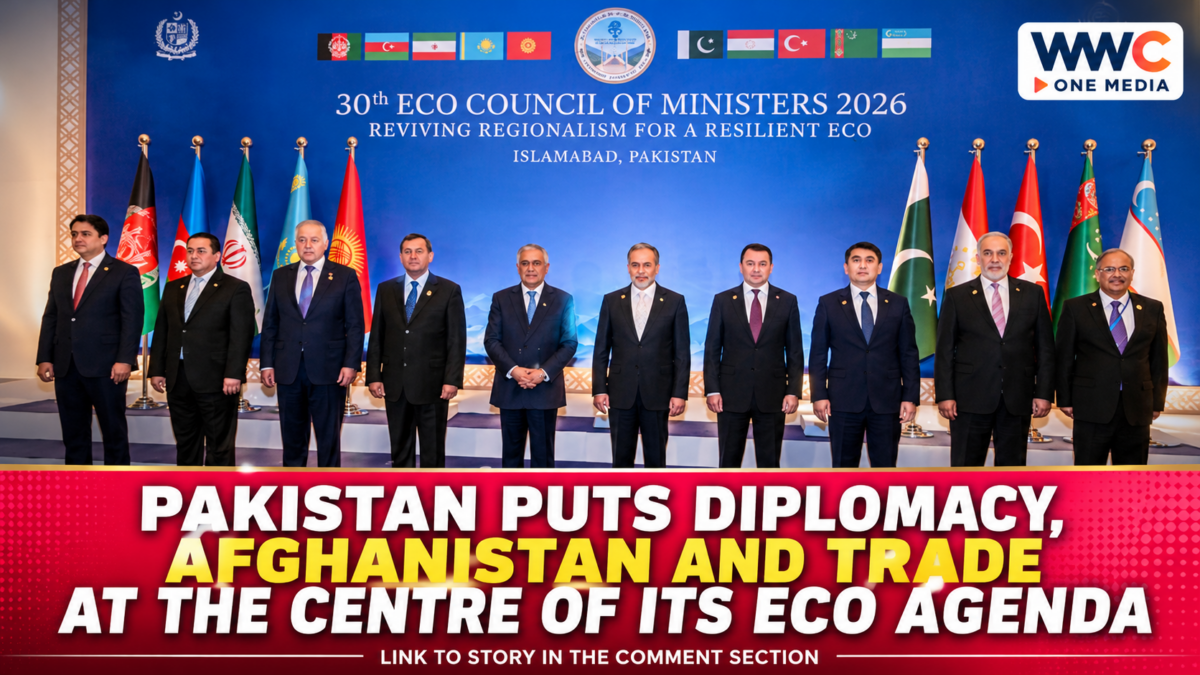
Pakistan has used the 30th meeting of the Economic Cooperation Organization (ECO) Council of Ministers in Islamabad to renew its call for regional dialogue, de-escalation and stronger economic cooperation. Deputy Prime Minister and Foreign Minister Senator Mohammad Ishaq Dar delivered the message on Nov. 16, as Pakistan prepares to lead the organisation’s 2026–2027 chairmanship.
The meeting places diplomacy alongside trade, transport links and regional security. Islamabad is presenting the ECO as a platform where political stability and economic integration must advance together, although the official account of Dar’s Nov. 16 remarks does not identify the United States or Iran by name.
That distinction matters. Pakistan has a documented role in earlier US-Iran diplomatic efforts, while its current ECO statement makes a broader appeal for dialogue and regional stability. The two strands are related, but they should not be treated as a newly announced mediation agreement.
Pakistan ECO diplomacy returns to the regional agenda
In his Nov. 16 address, Dar called on ECO members to turn their geographic proximity into stronger transport connections and economic cooperation. He said Pakistan supports dialogue, de-escalation and lasting regional stability amid geopolitical uncertainty and economic pressure.
The meeting was the 30th session of the ECO Council of Ministers, held in Islamabad on Nov. 15 and 16. Pakistan’s chairmanship for 2026–2027 is guided by the theme “Reviving Regionalism for a Resilient ECO”.
The chairmanship programme focuses on regional connectivity, market access, stronger value chains and a more digitally enabled regional trade framework. Pakistan also wants better transport and transit links between Central Asia, South Asia and Pakistani seaports on the Arabian Sea.
These priorities place Pakistan in a strategic position: the country wants to serve as a route linking landlocked Central Asian economies with wider regional and international markets. But the benefits depend on more than geography. Border procedures, predictable transit arrangements, security and political trust all affect whether trade corridors can operate reliably.
What Pakistan’s US-Iran diplomatic record shows
Pakistan’s current appeal for dialogue comes against the background of its earlier involvement in efforts to reduce tensions between Washington and Tehran.
On June 18, Pakistan’s President Asif Ali Zardari publicly welcomed the signing of the Islamabad Memorandum of Understanding between the United States and Iran. His official statement credited Pakistan’s diplomatic efforts and those of regional partners with contributing to the agreement, and urged the parties to implement it and work towards a final agreement.
That public record establishes Pakistan’s involvement in the June diplomatic process. It does not, by itself, establish that the Nov. 16 ECO meeting produced a new US-Iran agreement, a fresh round of negotiations or formal support from every ECO member.
Dar’s current statement, as published by Pakistan’s state broadcaster, says Islamabad will continue diplomatic efforts supporting dialogue and de-escalation. It does not name the two governments in that specific passage.
The distinction is important for readers following the wider negotiations. A government can reaffirm its commitment to diplomacy without announcing a new mediation initiative or confirming that the parties have accepted a proposal.
WWC has followed the wider diplomatic environment in its report on the stalled Iran talks and continuing risks around the Strait of Hormuz. That context helps explain why regional governments have an interest in preventing renewed confrontation, but it does not prove that the ECO meeting changed the status of US-Iran negotiations.
Afghanistan remains a security concern in Pakistan’s regional policy
Afghanistan is another important part of Pakistan’s regional agenda, particularly because cross-border security concerns can affect trade, transit and connectivity plans.
In a separate official address to an informal ECO Council of Ministers meeting in New York on Sept. 26, Dar said Pakistan wanted a peaceful, prosperous and stable Afghanistan integrated into the region. He also said Pakistan expected Afghan authorities to address its security concerns and take concrete, verifiable action against groups that Islamabad identified as threats.
Those remarks represent Pakistan’s stated position. They should not be presented as independently established findings about the activities of any group, nor should allegations about militant activity be treated as proven simply because they appear in a government statement.
The economic connection is nevertheless clear. A regional transport corridor requires predictable border operations and confidence that goods and people can move safely. Political tension or insecurity can raise costs, delay shipments and discourage businesses from relying on a route.
Pakistan’s position therefore combines two objectives: keeping Afghanistan connected to regional economic arrangements while pressing its authorities on security issues. Whether that approach leads to improved cooperation will depend on actions and agreements beyond speeches at ministerial meetings.
ECO trade plans depend on practical delivery
Dar’s Nov. 16 address also outlined the economic priorities Pakistan wants to advance during its chairmanship.
These include wider market access, stronger regional value chains and greater private-sector participation, particularly by small and medium-sized enterprises. He also called for functional transport corridors, more efficient border procedures and predictable transit arrangements.
For businesses, these are practical concerns rather than abstract diplomatic goals. Delays at borders can increase inventory and transport costs. Uncertain transit rules can make cross-border contracts harder to plan. Weak connections between ports, railways and roads can prevent companies from reaching new markets efficiently.
The ECO framework offers member states a place to coordinate on these issues, but the announcement of priorities is not the same as implementation. Governments will need to agree on procedures, infrastructure investment and measurable steps that can be monitored over time.
Pakistan’s diplomatic activity with other regional partners also shows why it is trying to keep communication channels open while addressing security concerns. In October, WWC covered Pakistan, Saudi Arabia and Türkiye’s planned talks on political engagement with the Houthis, a separate initiative that illustrated Islamabad’s interest in diplomatic channels alongside its security partnerships.
Why the ECO meeting matters beyond Islamabad
The ECO brings together countries across Central and West Asia, including states with important energy resources, transport routes and access to major markets. Its ability to support trade depends on whether members can coordinate despite political differences.
Iran’s participation gives the organisation a direct regional dimension to discussions about energy security and connectivity. However, the public record reviewed for this article does not establish a collective ECO position on the US-Iran dispute.
That is why Pakistan’s call for dialogue should be understood as a diplomatic position, not proof that the organisation has adopted a common policy on the conflict.
For Asian economies, regional stability matters because disruptions to energy routes and commercial shipping can affect import costs, freight and supply-chain planning. WWC has also examined China’s call for Iran and the United States to resume talks, another example of diplomatic efforts being framed around the wider economic consequences of regional tension.
What happens next
Pakistan’s chairmanship will be judged by whether the ECO’s stated priorities translate into working transport links, improved trade procedures, stronger regional business connections and sustained cooperation among member states.
The Nov. 16 meeting confirms Pakistan’s public commitment to dialogue and regional stability. It does not confirm a new US-Iran deal or establish that Afghanistan has accepted Pakistan’s security demands.
The next evidence to watch will be official meeting outcomes, any final Islamabad Communiqué, follow-up diplomatic announcements and concrete steps on trade and transit cooperation.
For now, Pakistan is using its ECO role to argue that regional economic integration cannot be separated from political stability. The challenge will be turning that argument into results.
Frequently asked questions
1. What did Ishaq Dar say at the ECO meeting on Nov. 16, 2026?
Pakistan’s deputy prime minister called for stronger regional economic cooperation and said Pakistan would continue diplomatic efforts supporting dialogue, de-escalation and lasting regional stability.
2. Did Pakistan announce a new US-Iran agreement at the ECO meeting?
The official account of Dar’s Nov. 16 remarks does not announce a new US-Iran agreement. Pakistan’s earlier diplomatic role is documented in the June 18 presidential statement on the Islamabad Memorandum of Understanding.
3. What is Pakistan’s position on Afghanistan?
In official remarks on Sept. 26, Dar said Pakistan wanted a peaceful, stable Afghanistan integrated into the region, while calling on Afghan authorities to address Pakistan’s stated security concerns.
4. What is Pakistan seeking through its ECO chairmanship?
Pakistan has identified regional connectivity, trade and investment, market access, stronger value chains, improved transit arrangements and sustainable development as priorities for its 2026–2027 chairmanship.
5. Why does regional stability matter to ECO trade?
Uncertainty and insecurity can disrupt transport routes, increase shipping and logistics costs, delay goods and weaken business confidence. Stable cross-border arrangements help regional trade operate more predictably.