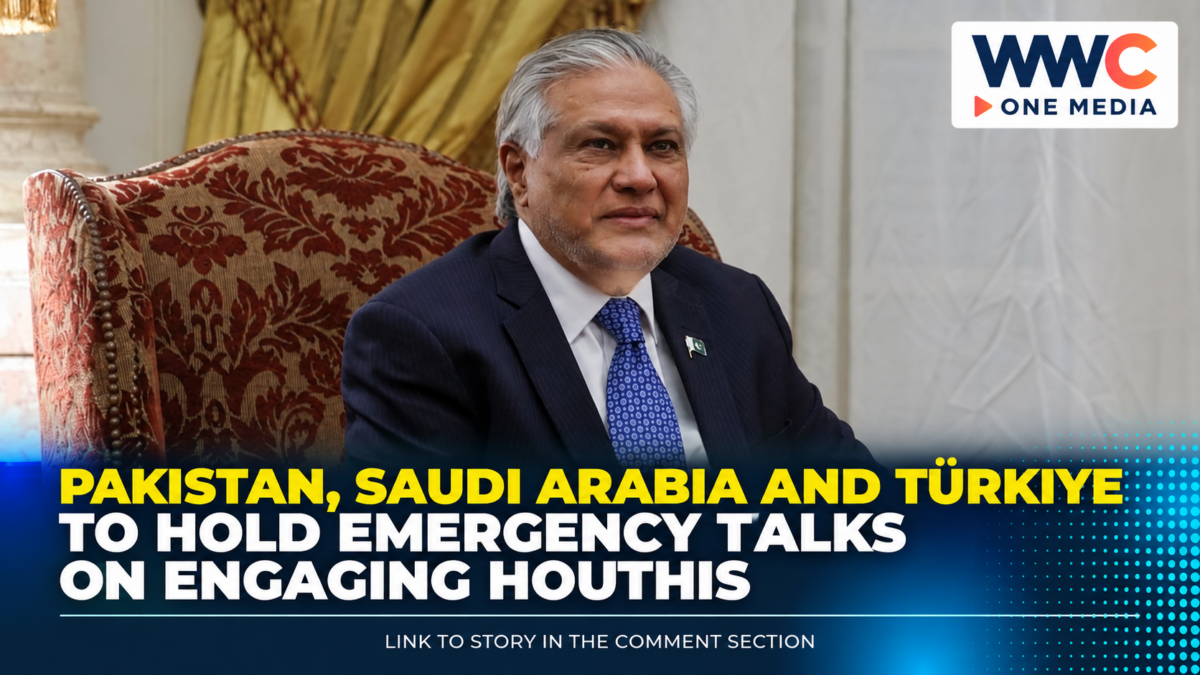
Pakistan, Saudi Arabia and Türkiye will hold an emergency meeting in Riyadh next week to discuss the escalating conflict involving Yemen’s Houthi movement, including an Iranian suggestion to pursue political engagement with the group rather than immediately resorting to further military action.
Pakistan’s Foreign Minister Ishaq Dar said the meeting would take place under the framework of the Mecca Joint Defence Agreement, which brings Saudi Arabia, Türkiye and Pakistan together in a mutual defence arrangement. The three countries will determine their next steps as Houthi attacks against Saudi Arabia continue to intensify.
Dar said Iran had suggested opening a political channel with the Houthis following the recent attacks. He described the proposal as an idea exchanged between officials rather than a formal, written offer from Tehran.
“There is no written, solid offer,” Dar said, describing the proposal as diplomatic brainstorming. The possibility of engaging the Houthis politically will be considered as an alternative to what he called “kinetic action.”
The proposal comes as Saudi Arabia faces a growing security challenge from the Houthis. Riyadh has accused the Iran-aligned group of carrying out attacks that have threatened Saudi territory and raised particular concern over the security of Islam’s holiest sites.
Saudi authorities have reported attacks and security alerts involving areas including Mecca, Jeddah and other parts of the kingdom in recent weeks. The Houthis have denied targeting Islamic holy sites and have disputed some of Saudi Arabia’s accusations.
Dar also said Iran had been distancing itself from the Houthis and Iraqi militias. He said Iranian President Masoud Pezeshkian and Foreign Minister Abbas Araqchi wanted the issue resolved and that he had briefed Tehran on the Mecca defence agreement and Pakistan’s commitments under the pact.
The Mecca Joint Defence Agreement was signed on Aug. 7 by Saudi Arabia, Türkiye and Pakistan. Under the agreement, an armed attack against one member is treated as an attack against all three, creating a framework for collective defence.
The pact has already been tested by the latest escalation. Military chiefs from the three countries met in Riyadh on Sept. 25 and condemned Houthi attacks, while Pakistan’s military said it stood in solidarity with Saudi Arabia and supported efforts to protect the kingdom and Islamic holy sites.
The crisis has also placed Pakistan in a delicate diplomatic position. Islamabad maintains close defence ties with Saudi Arabia while keeping communication channels open with Iran. Pakistani officials have previously sought to use their relationships with both sides to support negotiations and prevent a wider regional conflict.
The Houthi escalation is taking place amid a broader Middle East conflict involving Iran, the United States and regional actors. Recent fighting has also raised concerns over maritime security around the Red Sea and the Bab el-Mandeb Strait, an important route for international shipping.
More than six countries have reportedly expressed interest in joining the Mecca defence pact, Dar said. However, he said new membership applications would not be considered until the agreement becomes fully operational, a process that could take up to a year.
Dar also addressed the strategically important Strait of Hormuz, saying there should be no fees or charges for ships crossing the waterway. The strait has become a major issue in negotiations surrounding the wider US-Iran conflict because of its importance to global energy and commercial shipping.
The emergency Riyadh meeting will therefore bring together security and diplomatic concerns at the same time. While the three countries are preparing to coordinate under their mutual defence agreement, officials will also examine whether political engagement with the Houthis could provide an alternative path to further escalation.