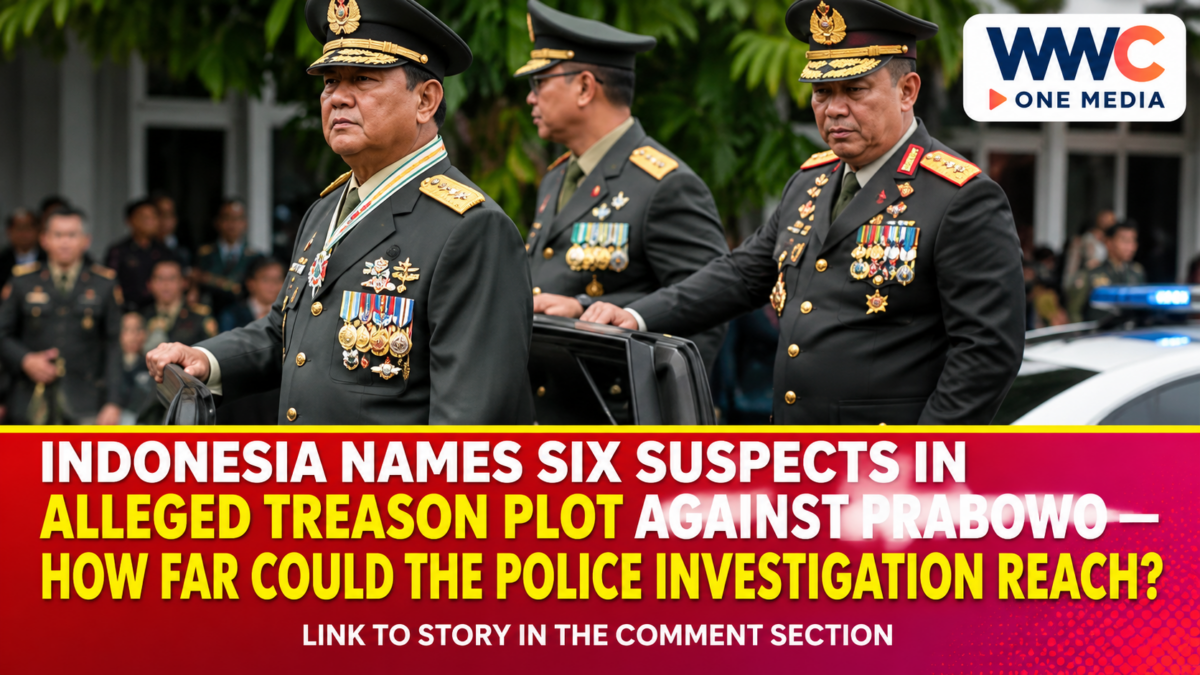
JAKARTA, INDONESIA — Indonesia’s investigation into alleged illegal surveillance targeting President Prabowo Subianto has entered a more serious phase after the Indonesian National Police designated six individuals as suspects in a related treason case, intensifying scrutiny of the country’s law enforcement institutions.
The Indonesia treason investigation has expanded beyond suspected unauthorised wiretapping, with criminal investigators examining possible activities intended to undermine the government and internal disciplinary authorities pursuing separate professional misconduct proceedings.
On Nov. 24, 2026, police also disclosed the discovery of six online accounts suspected of being used to conduct cyberattacks against the government.
The developments raise a fundamental question about institutional accountability: how can a government protect national security while ensuring that the agencies entrusted with protecting it operate within the boundaries of the law?
Indonesia treason investigation enters a critical phase
Indonesia’s Criminal Investigation Agency, commonly known as Bareskrim Polri, has identified six suspects in the alleged treason case.
The investigation is connected to earlier allegations involving illegal surveillance, unauthorised electronic access and the deletion of electronic evidence.
Investigators suspect that the individuals may have participated in activities intended to restrict the president’s ability to exercise authority, interfere with the functioning of the government or overthrow the administration.
These remain criminal allegations that must be established through the legal process.
The designation of suspects does not mean that a treason plot has been conclusively established or that the individuals involved have been convicted.
Nevertheless, the expansion of the investigation represents a significant development in a controversy that has already generated questions about the oversight of sensitive police capabilities.
WWC ONE MEDIA previously examined the origins of the controversy in its coverage of the arrest of Indonesia’s former police chief and two generals over alleged surveillance targeting President Prabowo.
The latest developments introduce a broader legal dimension, requiring investigators to establish not only whether surveillance powers were misused but also whether the alleged activities satisfy the legal requirements of treason-related offences.
Six online accounts emerge in widening investigation
The investigation has also expanded into the digital environment.
On Nov. 24, Brigadier General Susatyo Purnomo Condro, director of general criminal offences at Bareskrim Polri, disclosed that investigators had identified six online accounts suspected of being used to conduct cyberattacks against the government.
The findings followed examinations of electronic evidence obtained during the investigation.
Authorities are continuing to assess the suspected activities and the possible involvement of additional individuals.
However, identifying suspicious online accounts does not independently establish who controlled them, whether their activities were coordinated or whether they successfully disrupted government operations.
Those questions require further forensic examinations and supporting evidence.
The digital dimension of the case underscores the importance of maintaining reliable records, protecting sensitive information and ensuring that electronic evidence can withstand legal scrutiny.
For investigators, establishing the relationship between suspected online activities and the wider criminal allegations will be an important part of determining individual responsibility.
Police disciplinary proceedings intensify
Separate from the criminal investigation, Indonesia’s National Police is pursuing internal proceedings involving suspected violations of professional ethics.
The police professional standards division has confirmed that additional ethics hearings were scheduled for Nov. 25 and Nov. 26.
Inspector General Mahmud Nazly Harahap, head of the police professional standards and security division, outlined the schedule during a press conference on Nov. 23.
Police also confirmed that two individuals identified by the initials ASN and EH had previously received dishonourable discharge sanctions through internal ethics proceedings connected to the alleged illegal surveillance case.
These disciplinary measures represent an institutional accountability mechanism.
However, dismissal from the police force must not be confused with a criminal conviction for treason.
Internal ethics commissions assess compliance with professional standards, while criminal responsibility must be established through the appropriate judicial process.
The distinction is especially important in politically sensitive investigations involving government officials and senior law enforcement personnel.
The wider accountability questions surrounding the controversy were previously explored in WWC ONE MEDIA’s coverage of Indonesia’s wiretapping scandal and parliamentary scrutiny of police leadership.
Prabowo’s government confronts sensitive security questions
President Prabowo Subianto had previously expressed concern over suspected illegal surveillance involving the head of state and other prominent individuals.
On Nov. 4, Minister of State Secretary Prasetyo Hadi outlined the government’s concerns regarding alleged wiretapping, unauthorised electronic access and the removal of electronic evidence.
The administration also announced that Prabowo had signed a presidential decision dismissing Listyo Sigit Prabowo from his position as presidential chief of staff.
Lieutenant General Aryo Windutomo was appointed acting presidential chief of staff to maintain continuity in the office’s responsibilities.
The government considered the alleged activities potentially harmful to national interests and the security of state leadership.
However, the executive branch’s assessment of the alleged activities does not replace the need for judicial proceedings and independently evaluated evidence.
The controversy illustrates the sensitive relationship between government communications, institutional authority and surveillance oversight.
These concerns also feature in WWC ONE MEDIA’s earlier examination of Indonesia’s presidential palace security and proposed safeguards against unauthorised surveillance.
Densus 88 and the importance of institutional oversight
Indonesia’s Special Detachment 88, commonly known as Densus 88, continues to carry out counterterrorism responsibilities.
In a separate announcement published on Nov. 19, the Indonesian National Police confirmed that Densus 88 had detained 15 terrorism suspects across six provinces between Nov. 13 and 18.
The police described those operations as part of continuing efforts to prevent extremist networks from expanding their activities.
The operations involved Aceh, West Sumatra, Riau, West Java, Central Java and West Nusa Tenggara.
WWC ONE MEDIA previously covered the Densus 88 investigation involving 15 terrorism suspects across six Indonesian provinces.
Those counterterrorism operations are separate from the alleged treason case and should not be treated as evidence of a connection between the detained terrorism suspects and the police misconduct investigation.
The distinction reinforces a broader institutional principle: allegations involving individual officers should be investigated without automatically attributing responsibility to an entire organisation.
Effective oversight must protect legitimate counterterrorism work while ensuring that specialised law enforcement powers are not diverted towards unauthorised purposes.
Why the investigation matters across ASEAN and APEC
The controversy raises wider governance questions relevant to governments throughout the Asia-Pacific region.
Law enforcement institutions must balance legitimate national security requirements with privacy protections, professional accountability and legal restrictions on surveillance.
Where allegations involve individuals occupying positions of public trust, transparent disciplinary procedures and credible criminal investigations become particularly important.
For businesses, international organisations and diplomatic institutions, confidence in government institutions can also influence assessments of regulatory predictability and the security of sensitive information.
However, the current investigation does not independently establish that Indonesia faces an economic crisis or widespread institutional instability.
Such conclusions would require separate supporting evidence.
The more immediate issue is whether the authorities can demonstrate that alleged misconduct is being investigated consistently, regardless of the positions held by those involved.
What happens next?
Indonesia’s criminal investigators are continuing to examine the alleged treason activities, digital evidence and possible involvement of additional individuals.
The scheduled police ethics hearings represent another stage in the separate disciplinary process.
Future official announcements may provide greater clarity regarding individual responsibilities, additional sanctions and the progress of criminal proceedings.
Until the evidence has been assessed through the appropriate legal processes, the allegations must remain distinct from established criminal findings.
For President Prabowo’s administration, the investigation presents a significant test of institutional accountability.
For Indonesia’s police force, the challenge is demonstrating that professional misconduct can be addressed without compromising legitimate security responsibilities.
The central question is no longer simply whether unauthorised surveillance occurred, but whether Indonesia’s institutions can establish responsibility through a credible and lawful process.
Frequently Asked Questions
What is the Indonesia treason investigation about?
The investigation concerns suspected activities connected to alleged illegal surveillance, unauthorised electronic access and possible attempts to undermine President Prabowo Subianto’s government.
How many suspects have been identified?
The Indonesian National Police has officially designated six individuals as suspects in the alleged treason case.
What did investigators discover on November 24, 2026?
Police disclosed that they had identified six online accounts suspected of being used to conduct cyberattacks against the government.
What is Densus 88?
Densus 88 is a specialised counterterrorism unit within the Indonesian National Police responsible for investigating and preventing terrorism-related activities.
Does dismissal from the Indonesian police establish criminal guilt?
No. Police dismissal is an administrative and professional disciplinary sanction. Criminal guilt must be established separately through the judicial process.