
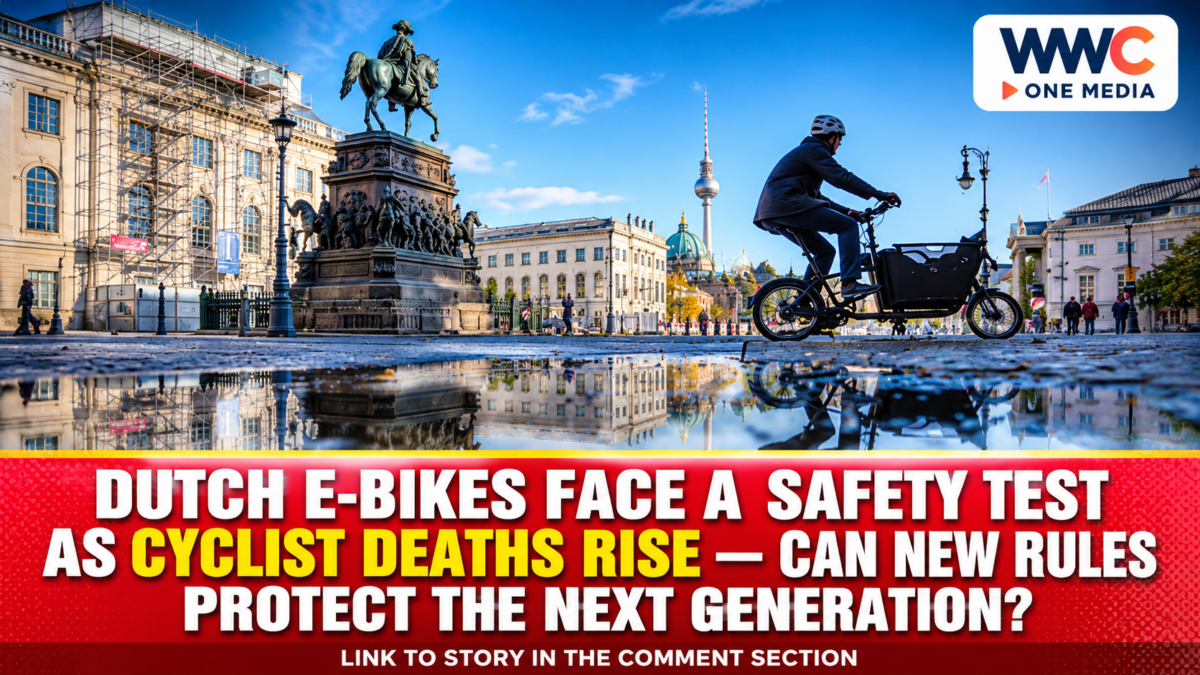
The Netherlands recorded 281 cyclist deaths in 2025, the highest annual figure in the latest official five-year comparison, as electric bicycles become a larger part of everyday travel. The Dutch government is now advancing a helmet requirement for riders and passengers under 18 on e-bikes and other light electric vehicles, with implementation targeted for September 2027 if parliament approves the proposal.
The figures raise a difficult question for a country whose transport system has long treated cycling as an everyday alternative to driving: how can it preserve that accessibility while responding to changing vehicles, traffic conditions and injury risks?
The challenge is not simply whether electric bicycles should be restricted. It is whether road rules, infrastructure, rider behaviour and vehicle standards can adapt to a transport network increasingly used by different kinds of two-wheeled vehicles.
Dutch e-bikes are changing the scale of the road-safety challenge
Statistics Netherlands recorded 281 cyclist deaths in 2025, compared with 246 in 2024 and 185 in 2015. The increase between 2015 and 2025 amounts to approximately 52%.
Cyclists accounted for the largest category of road deaths in 2025. The figures also show that at least 41% of the cyclists who died were riding electric bicycles. Eight fat-bike riders were among those killed.
Head injuries were the main cause of death in 63% of cyclist fatalities that year. The proportion is an important indicator of the severity of cycling injuries, although it does not establish that a particular bicycle type or rider behaviour caused an individual collision. CBS+1
The electric-bicycle figures also require careful interpretation. Statistics Netherlands explains that its recorded number of e-bike fatalities is a lower limit because official records do not always distinguish electric bicycles from conventional bicycles. Some deaths are therefore classified simply as bicycle fatalities.
That limitation matters. The available data confirms that e-bikes feature prominently in fatal cycling incidents, but it does not provide a complete count of every death involving an electric bicycle.
A cycling network built for access faces a different mix of vehicles
The Netherlands has invested heavily in making bicycles a practical part of daily transport. The national government describes a network of approximately 35,000 kilometres of bicycle tracks, supporting both everyday journeys and recreational cycling.
The country’s cycling infrastructure is not a minor transport feature. Government figures say bicycles fulfil more than one quarter of overall transport needs. Government.nl
However, the vehicles using that network have become more varied. Conventional pedal bicycles now share space with electric cargo bikes, fat bikes, speed pedelecs and other forms of powered mobility.
Research published by the Dutch road-safety institute SWOV highlights the scale of the change. Between 2012 and 2022, the e-bike share of total distance travelled by bicycle increased from 5% to 37%.
The same research identifies an ageing population and increased cycling among older people as important factors in the development of cycling injuries and fatalities. Older cyclists face higher injury risks, while electric assistance can make longer journeys and continued cycling more accessible. swov.nl+1
This creates a policy challenge that cannot be solved by treating every electric bicycle as inherently dangerous. The same technology that introduces new safety questions can also help people maintain mobility as they age.
The practical issue is how to accommodate different speeds, vehicle sizes and rider capabilities without making shared routes less predictable.
The proposed helmet rule targets riders under 18
The Dutch government announced on Nov. 13 that a proposed helmet requirement for people under 18 using electric bicycles and other light electric vehicles had been sent to parliament.
The proposal covers both riders and passengers. It includes e-bikes, fat bikes, electric cargo bikes, electric scooters and Segways.
The government is targeting Sept. 1, 2027, for the measure to take effect, but the proposal must still pass the Tweede Kamer, or House of Representatives, and the Eerste Kamer, or Senate. It is therefore not yet an enforceable nationwide requirement. rijksoverheid.nl+1
The government has linked the proposal to a rise in head injuries among young e-bike users. Its published information says the number of young people sustaining brain injuries while riding e-bikes in 2024 was more than six times the 2020 figure.
The proposed requirement would apply to passengers as well as drivers. That distinction is significant for families using electric cargo bicycles or carrying children on e-bikes.
The measure is also part of a wider policy approach. The government has discussed creating a separate legal category for fat bikes, potentially allowing measures such as minimum-age requirements and restrictions in designated areas.
Local authorities are also focusing on road behaviour
National legislation is only one part of the response. Local authorities are also trying to address how people interact on shared roads and paths.
In Leiden, a public campaign called Verkeer is een teamsport — or “Traffic is a team sport” — ran from Nov. 9 to Nov. 23, 2026.
The campaign used posters, specially marked bicycles and activities designed to encourage young people to think about their behaviour in traffic. The municipality highlighted practical actions including giving way, reducing speed, stopping at red lights, signalling and remaining focused. Gemeente Leiden
The approach recognises that cycling safety is not determined by vehicle technology alone. A bicycle lane can provide physical separation from motor traffic, but conflicts can still occur when users travel at different speeds, fail to signal or do not anticipate one another’s movements.
This is a shared responsibility. Cyclists must follow traffic rules and ride predictably, while motorists must account for vulnerable road users and avoid unsafe manoeuvres around them.
WWC has examined similar questions in its coverage of an e-bike collision in Queensland and the legal issues that investigators must establish. The circumstances are different, but the case illustrates why allegations, road-user conduct and the evidence surrounding a collision must be assessed separately.
Why a helmet rule cannot solve every cycling problem
A helmet requirement could reduce the severity of some head injuries, but it cannot prevent every collision or address every risk associated with mixed traffic.
The Netherlands’ own figures point to a broader challenge. The rise in cyclist deaths involves a population with different ages and mobility needs, while e-bike use has expanded substantially. The data does not establish that one policy measure can reverse the trend.
Infrastructure remains important. Routes must account for differences in speed and vehicle dimensions, especially where cargo bicycles, conventional bicycles and faster electric models use the same space.
Enforcement also has a role. Rules covering vehicle classification, speed, equipment and rider conduct have limited value if users do not understand them or authorities cannot apply them consistently.
The issue is relevant beyond the Netherlands. Other countries are also dealing with the growth of electric mobility and the need to protect people using bicycles and shared paths. WWC previously examined rising cyclist-accident figures in Singapore, where road safety has also become a concern as cycling activity expands.
The Netherlands has an established cycling network and decades of experience making bicycles part of everyday transport. That foundation gives it an opportunity to adapt, but it does not remove the need for evidence-based policy.
What happens next
The immediate test is whether the proposed under-18 helmet requirement secures approval from both chambers of the Dutch parliament.
If approved, the government aims to introduce it on Sept. 1, 2027. The details of enforcement, including the penalty for non-compliance, remain part of the implementation picture.
Further measures concerning fat-bike classification, minimum ages and designated restrictions could also shape how electric bicycles are regulated.
For now, the official figures establish the scale of the concern: cyclist deaths reached 281 in 2025, and at least 41% of those killed were riding e-bikes.
The larger policy question is whether the Netherlands can make its cycling network safer without undermining the accessibility that made it a model for bicycle transport in the first place.
Frequently asked questions
1. How many cyclists died in the Netherlands in 2025?
Statistics Netherlands recorded 281 cyclist deaths in 2025, up from 246 in 2024.
2. What percentage of cyclists killed in 2025 were riding e-bikes?
At least 41% of the cyclists who died in 2025 were riding electric bicycles. The figure is a lower limit because some official records do not distinguish e-bikes from conventional bicycles.
3. Will the Netherlands require helmets for everyone riding an e-bike?
The proposal announced in November 2026 covers riders and passengers under 18 using e-bikes and other specified light electric vehicles. It does not establish a universal helmet requirement for all adult e-bike users.
4. When could the Dutch under-18 e-bike helmet rule take effect?
The government is targeting Sept. 1, 2027. The proposal still needs approval from both the House of Representatives and the Senate.
5. Are fat bikes included in the proposed helmet requirement?
Yes. The government’s proposal includes fat bikes, alongside other electric bicycles and specified light electric vehicles.










