
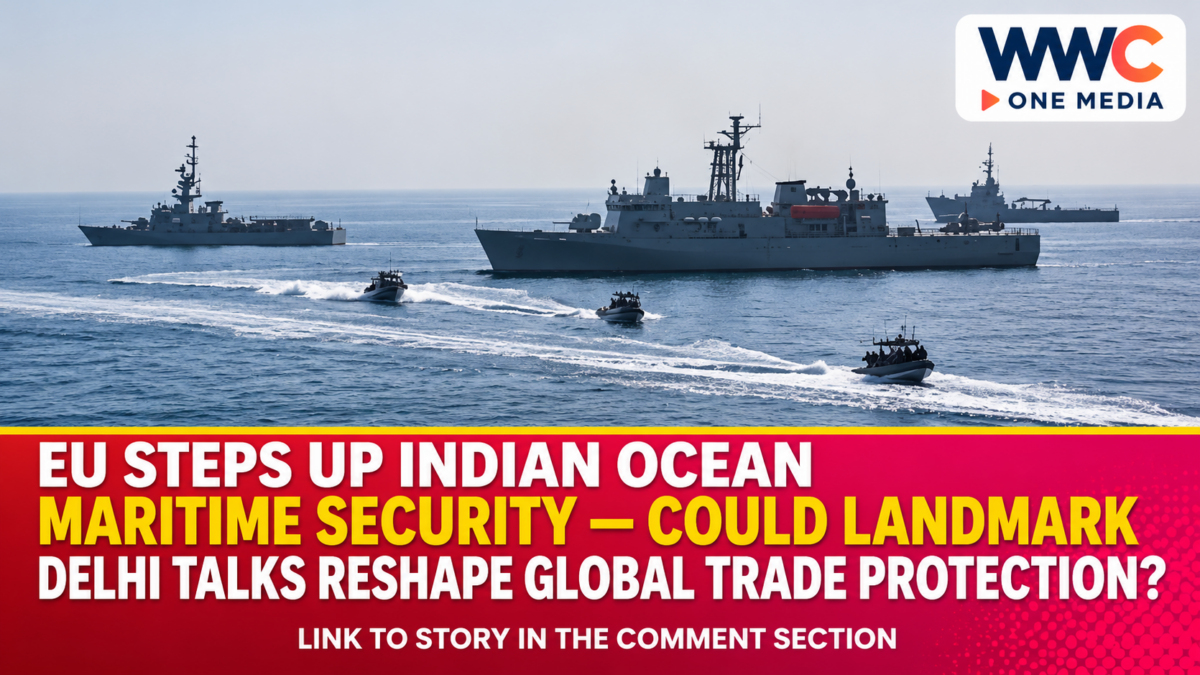
NEW DELHI, India — The European Union is intensifying its engagement on Indian Ocean maritime security after convening its first high-level roundtable with the Indian Ocean Rim Association (IORA) on November 24, 2026, placing the protection of international shipping routes and the fight against maritime crime higher on its regional agenda.
The meeting addressed piracy, illicit trafficking, maritime surveillance and opportunities for stronger cooperation among countries connected to one of the world’s most important commercial waterways.
For internationally connected economies, the discussions carry implications extending beyond defence diplomacy. Maritime security influences the reliability of supply chains, energy transportation, humanitarian deliveries and international digital connectivity.
The question now is whether stronger diplomatic cooperation can translate into practical protection for global commerce.
Indian Ocean Maritime Security Becomes a Strategic Priority
The New Delhi roundtable brought together representatives from countries including India, Australia, Sri Lanka, Kenya, Mauritius, Mozambique, Seychelles and Saudi Arabia.
The meeting preceded the 29th IORA Committee of Senior Officials Meeting, scheduled for November 25–26, 2026.
The EU’s engagement reflects its interest in maintaining dependable maritime connections between Europe and Asia while addressing security challenges that extend across national jurisdictions.
Piracy and the unlawful transportation of weapons, narcotics and people were among the concerns highlighted during the discussions.
Stronger maritime cooperation could help authorities overcome institutional barriers that complicate the investigation and prevention of cross-border criminal activity.
The initiative also complements India’s wider regional diplomatic engagement, including ASEAN–India cooperation and its evolving strategic priorities.
The November meeting represents an expansion of regional security dialogue rather than the establishment of a new military alliance.
Why Global Businesses Should Pay Attention
Maritime transport accounts for more than 80% of global trade, underscoring the economic importance of maintaining secure and accessible shipping routes.
The Indian Ocean provides a vital commercial connection between European and Asian markets.
For shipping companies and internationally active businesses, security disruptions can create challenges involving delivery schedules, freight expenditure, insurance arrangements and inventory management.
A manufacturer relying on imported components, for example, could experience production difficulties if maritime disruptions delay critical shipments.
Energy importers and commodity traders could also face additional uncertainty when security concerns complicate transportation arrangements.
These potential consequences demonstrate why maritime stability is a commercial concern as well as a diplomatic and military priority.
However, the New Delhi meeting itself does not establish that freight charges, insurance premiums or shipping delays will decline.
Any measurable commercial improvement would depend on the effectiveness of subsequent security initiatives and wider conditions affecting international shipping.
Operation ATALANTA and Europe’s Naval Presence
Europe’s maritime engagement already has an operational component through European Union Naval Force Operation ATALANTA.
The naval mission operates in the western Indian Ocean and the Red Sea, contributing to the protection of vulnerable vessels and efforts against piracy.
Its humanitarian responsibilities include protecting vessels transporting assistance for the World Food Programme.
At the New Delhi meeting, Operation ATALANTA Commander Vice Admiral Ignacio Villanueva Serrano outlined the mission’s regional security responsibilities and announced plans for a Common Operational Framework Document with the Indian Navy.
The proposed document could support more structured cooperation between European and Indian naval authorities.
Its signing, however, had not been confirmed in the November 24 announcement.
The development forms part of a broader regional environment in which international partners are expanding their security relationships, including Japan’s growing defence cooperation across the Indo-Pacific.
For maritime operators, the distinction between diplomatic commitments and operational implementation remains essential.
Undersea Cables Bring Digital Security Into Focus
Modern maritime security extends beyond protecting ships and commercial cargo.
Submarine cables support up to 99% of international data flows, making their protection particularly important for economies dependent on digital communications.
Disruptions to these networks could affect businesses, financial institutions, telecommunications providers and other organisations relying on international connectivity.
On September 24, 2026, the EU and India held their fifth Maritime Security Dialogue in Brussels.
The two sides agreed to reinforce cooperation concerning unlawful maritime activities, critical maritime infrastructure, submarine cables and regional security capabilities.
This earlier dialogue demonstrates that the New Delhi roundtable builds upon an existing diplomatic process.
The protection of maritime infrastructure also fits into wider Indo-Pacific security discussions, including those examined in the Trump–Modi Quad meeting and its regional implications.
For internationally connected businesses, maritime security increasingly encompasses both the physical movement of goods and the digital infrastructure supporting commercial activity.
Protecting one without addressing vulnerabilities in the other could leave significant gaps in economic resilience.
India and Europe Expand Their Security Partnership
The EU has participated in IORA as a dialogue partner since October 2023.
India assumed the association’s chairmanship from Sri Lanka in November 2025 for the 2025–2027 term.
Meanwhile, India and the European Union signed a Security and Defence Partnership in January 2026, expanding the institutional framework for bilateral cooperation.
The agreement encompasses maritime affairs alongside defence technology, cybersecurity, hybrid threats, space and counterterrorism.
The November roundtable adds a regional dimension to these bilateral arrangements by involving countries with different maritime security capabilities and economic priorities.
This approach could help participating governments identify common areas of interest without requiring identical national security policies.
Regional collaboration remains particularly important when criminal networks operate across multiple jurisdictions.
However, successful implementation will require participating institutions to establish workable procedures, allocate resources and coordinate their respective responsibilities.
What Happens Next for Indian Ocean Security?
The EU’s EnMAR+ initiative provides an existing framework for continued maritime engagement.
Launched in September 2026, the programme is scheduled to continue until February 2028, expanding European maritime cooperation into the Red Sea and western Indian Ocean.
Its activities include support for regional security coordination and information exchange, alongside dialogue concerning strategic infrastructure and shipping protection.
The wider objective of improving maritime institutions is also reflected in regional initiatives such as the proposed ASEAN Maritime Centre and its security cooperation mandate.
The next important developments will be the implementation of announced cooperation measures and confirmation of any additional operational agreements.
For governments, the challenge is improving coordination without unnecessarily duplicating existing programmes.
For international businesses, the more meaningful test will be whether these efforts contribute to dependable commercial transportation and stronger protection against maritime disruptions.
The New Delhi meeting marks a diplomatic milestone. Its economic significance, however, will ultimately be determined by what happens after the discussions conclude.
Frequently Asked Questions
What happened at the EU maritime security meeting in New Delhi?
The European Union convened its first high-level maritime security roundtable with IORA on November 24, 2026, to explore stronger regional cooperation against maritime threats.
What is the Indian Ocean Rim Association?
IORA is an intergovernmental organisation promoting cooperation and development among countries bordering the Indian Ocean.
Why is Indian Ocean maritime security important?
The Indian Ocean connects major commercial markets. Security disruptions can potentially affect international shipping, energy transportation, supply chains and communications infrastructure.
What is Operation ATALANTA?
Operation ATALANTA is an EU naval mission supporting maritime security in the western Indian Ocean and Red Sea, including anti-piracy efforts and protection of vulnerable vessels.
Has the EU established a new military alliance with India?
No new military alliance was announced at the November 24 roundtable. The discussions focused on strengthening existing partnerships and expanding practical maritime security cooperation.










