
The World Health Organization reported one new human H5N1 avian-influenza infection in its Western Pacific Region for the week of Nov. 13–19, 2026, involving a man who lived in Viet Nam and regularly travelled to China. The update, published on Nov. 20, also recorded no new regional human H5N6 infections during the same reporting period.
The figures underline why public-health alerts across the Pacific need to be read carefully: a reported infection, an active outbreak and a signal requiring further investigation are not interchangeable. For governments and communities spread across thousands of islands and connected by regular travel, the ability to detect and verify disease events is as important as the response that follows.
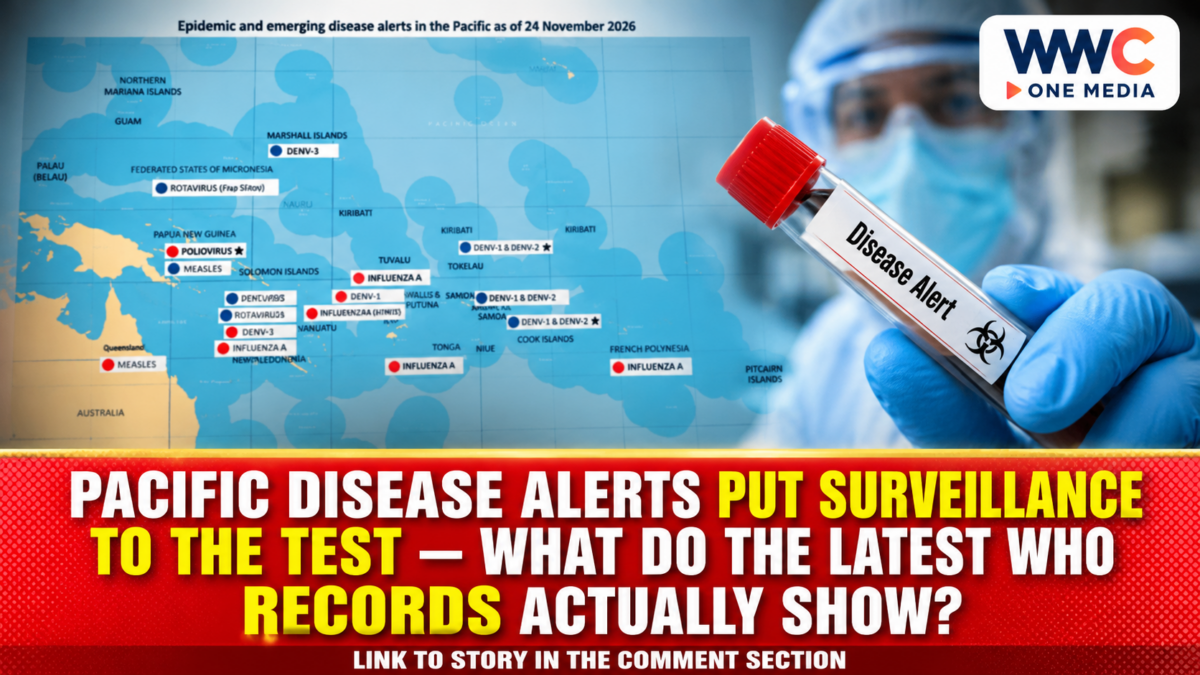
The latest regional alert picture also needs context. WHO’s Western Pacific Region covers a broad geographical area, including East Asian countries, Pacific island countries and territories. A regional update should not be interpreted as evidence that every Pacific island is facing the same disease threat.
Pacific disease alerts depend on more than a headline case count
Disease surveillance systems collect information from health facilities, laboratories, national health authorities and other reporting channels. Their purpose is to identify unusual patterns, verify potential threats and help public-health agencies decide whether additional investigation or response is needed.
The Pacific Public Health Surveillance Network uses PacNet to circulate information relevant to public-health surveillance across the region. The Pacific Community’s surveillance work includes compiling epidemic and emerging-disease alerts, while national situation reports undergo validation and review before they are shared through regional channels. phd.spc.int+1
That process matters because an alert is not automatically a declaration of an outbreak. A signal may describe an increase in reported illness, a laboratory finding, a suspected cluster or an event that requires more information.
For readers, the distinction is important. A disease alert is a reason to pay attention, not proof that a pathogen is spreading widely or that an emergency exists across an entire region.
WHO reports one new H5N1 infection in the Western Pacific
The WHO Western Pacific Regional Office’s Avian Influenza Weekly Update No. 1071, dated Nov. 20, reported one new human infection with influenza A(H5N1) from Nov. 13 to 19.
The case involved an adult man residing in Viet Nam who regularly travelled between Viet Nam and China for commercial activities. He developed symptoms on Nov. 1 and was detected during health screening at Dongxing Port in China on Nov. 2.
The report said a specimen collected at the point of entry in China tested positive for H5N1, while subsequent specimens collected in Viet Nam tested negative. Two household contacts in Viet Nam remained asymptomatic and tested negative for influenza A, including the H5 subtype. No additional cases had been reported at the time of the update. Western Pacific Region
The same WHO report recorded no new human H5N6 infections in the Western Pacific Region during the reporting period. It also said no new H5 infection involving an unsubtyped virus had been reported during that week.
These findings are specific to the reporting window. They should not be used to claim that no avian-influenza infections occurred anywhere else or after the report’s cut-off.
The WHO assessment does not describe sustained human transmission
The H5N1 update contains an important risk distinction. WHO said no sustained human-to-human transmission had been identified in association with the recent reported human H5 infections. Available evidence suggested the viruses had not acquired the ability to transmit efficiently between people, making sustained person-to-person transmission unlikely at that time.
WHO nevertheless described the zoonotic threat as elevated because of the spread of viruses among birds. It advised member states to remain vigilant and consider measures that reduce human exposure to potentially infected birds and contaminated environments. Western Pacific Region
In plain language, the risk from infected animals remains a concern even when sustained transmission between people has not been established. This is why animal-health monitoring, laboratory testing and public-health surveillance need to operate together.
The finding also demonstrates why a single confirmed human infection should not be turned into a claim of a wider human outbreak. The available evidence in this particular report did not support that conclusion.
Surveillance reports have reporting windows and limitations
WHO’s Weekly Epidemiological Record provides another useful example of how timing affects the interpretation of disease information.
Its Nov. 20 issue covered epidemiological week 46, from Nov. 9 to 15. During that period, WHO screened approximately 545,216 raw signals and assessed 28 signals or events for further analysis. The report identified 27 unique signals and said 17 were escalated for operational attention.
For the Western Pacific Region, the selected-new-signals table listed no publicly available signals identified during that reporting period. WHO explicitly cautioned that the absence of a listed signal did not mean there was no signal activity overall. The table included only newly registered events within the specified reporting window. World Health Organization+1
That caveat is essential when comparing weekly surveillance products. A report that records no newly identified signal for one period does not contradict a separate update published later about a specific infection. The documents may cover different dates, information channels and assessment processes.
The same caution applies to disease alerts compiled across multiple countries. Case counts should be read with their reporting dates, geographic coverage, laboratory status and definitions.
Dengue remains a regional surveillance priority
Avian influenza is not the only disease requiring attention in the Western Pacific. WHO identifies dengue as a continuing public-health concern across the region, including in Pacific island countries and areas.
The organisation’s regional dengue surveillance combines indicator-based and event-based monitoring. The stated purpose is to identify unusual changes in case trends and severity, assess risks and support timely responses. World Health Organization
Dengue is also relevant to the Philippines, where the disease is endemic. WWC has previously reported on Cebu’s rising dengue cases without a province-wide outbreak declaration. That coverage illustrates why an increase in reported infections and a formal outbreak declaration are not necessarily the same thing.
The public-health implications are broader than the case totals alone. Surveillance must identify where infections are increasing, whether the trend has crossed a recognised threshold and whether local health services need to adjust their response.
For communities, the practical message is to follow local health advisories rather than assume that a regional alert applies uniformly to every location.
Why regional coordination matters for island communities
Geography creates a distinctive challenge for Pacific health authorities. Island populations may be separated by long distances, while travel and trade connect communities across national borders. Access to laboratories, specialised care and consistent reporting can also vary between locations.
That makes timely information-sharing particularly important. A suspected event needs to be identified, assessed and communicated in a way that allows neighbouring health authorities to understand whether it has implications for them.
The regional approach is also relevant to immunisation and other disease-prevention programmes. WWC has previously examined Iloilo’s measles-rubella vaccination campaign and the number of children still unreached during its final days. In a different setting, the same public-health principle applies: reliable surveillance and effective prevention depend on reaching communities before a health problem becomes harder to contain.
The international dimension is visible in measles as well. WWC’s coverage of the United States losing its measles elimination status explored how sustained transmission can change a country’s public-health status. It is a separate event from the Pacific alerts, but it reinforces the importance of monitoring transmission over time rather than relying on isolated case reports.
What happens next
The immediate task for health authorities is to keep surveillance current and ensure that new reports are assessed against their dates, locations and laboratory findings.
For avian influenza, WHO’s Nov. 20 update calls for continued vigilance against exposure to potentially infected birds. The report does not establish sustained human-to-human transmission in the case it describes.
For dengue and other communicable diseases, regional and national monitoring remains important because trends can differ significantly between islands, territories and countries.
The larger lesson is that public-health alerts are most useful when they are specific. Readers need to know what disease has been identified, where it was reported, whether it is confirmed, what period the data covers and what authorities say about the risk.
The Pacific’s health-security challenge is not simply the number of alerts issued. It is whether those alerts lead to timely verification, clear communication and a coordinated response.
Frequently asked questions
1. What does a Pacific disease alert mean?
A disease alert is a notice that a potential or confirmed public-health event has been identified and may require monitoring, investigation or a response. It does not automatically mean that a large outbreak is underway.
2. Did WHO report a new H5N1 case in the Western Pacific in November 2026?
Yes. WHO’s Nov. 20, 2026, update reported one new human H5N1 infection for the period Nov. 13–19. The case involved a man living in Viet Nam who travelled regularly to China.
3. Did WHO identify sustained human-to-human transmission in that H5N1 report?
No. WHO said sustained human-to-human transmission had not been identified in association with the recent reported human H5 infections and considered efficient sustained transmission between people unlikely at that time.
4. Are dengue and avian influenza the same kind of public-health threat?
No. Dengue is a mosquito-borne viral disease. Avian influenza is associated with influenza viruses circulating among birds, with some strains capable of infecting people. Their transmission routes and prevention measures differ.
5. Does an alert in the Western Pacific mean every Pacific island is affected?
No. The WHO Western Pacific Region includes many countries and territories. An alert tied to one country or location should not be interpreted as evidence of an outbreak across all Pacific islands.










