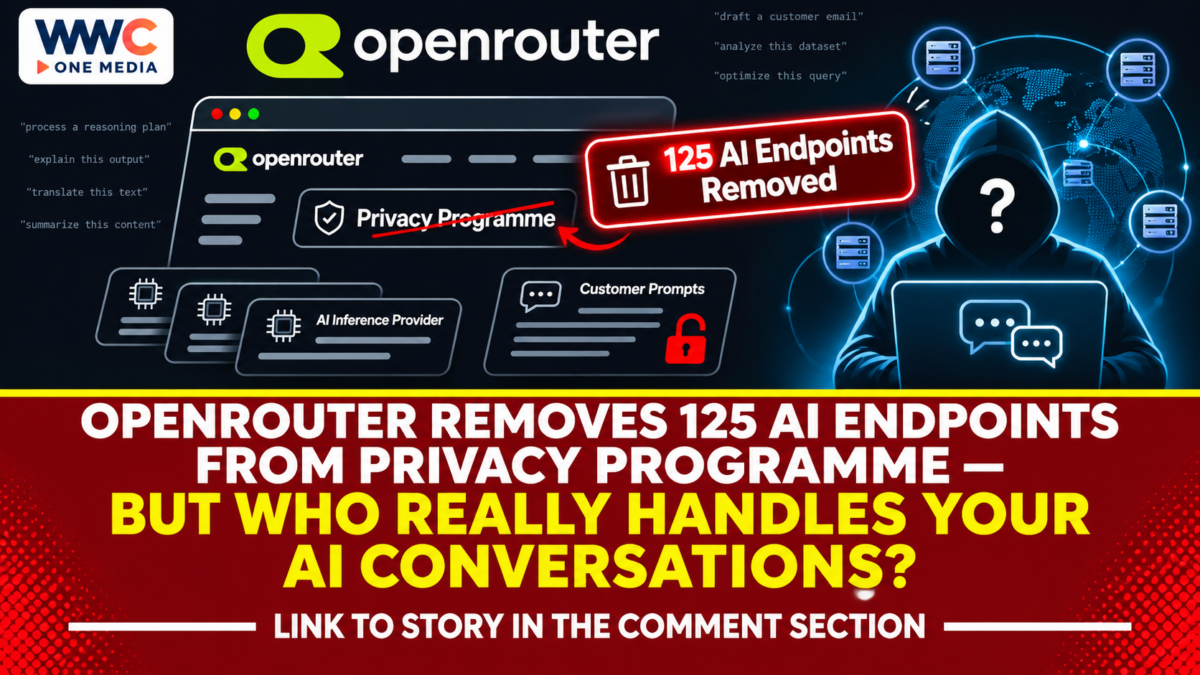
MANILA, Philippines — Artificial intelligence platform OpenRouter announced on Nov. 22, 2026, that it had removed three inference providers and withdrawn Zero Data Retention eligibility from 125 endpoints following investigations into security incidents and provider data-handling practices.
Separate disclosures from AI service providers Novita and Atlas Cloud have also identified concerns involving requests sent to models developed by MiniMax, raising important AI data privacy questions for companies relying on external computing infrastructure.
OpenRouter said the research findings did not demonstrate a breach of its own platform.
Instead, the developments highlight a wider commercial challenge: businesses purchasing AI services may need to evaluate not only the software they use but also the additional companies involved in processing their information.
AI Data Privacy Faces a Supply-Chain Challenge
AI routing platforms provide developers with access to models operated through different computing providers.
An inference provider supplies the infrastructure that processes a user’s request and generates a response. An endpoint is an interface through which an application accesses that service.
These arrangements can provide businesses with flexibility when selecting AI models, managing operating costs and maintaining service availability.
However, they also introduce additional considerations involving the movement and protection of information.
A business may select an AI model without fully understanding which infrastructure provider processes its requests or whether another company subsequently receives the information.
OpenRouter’s latest actions address concerns about the reliability of existing provider privacy commitments.
The company also clarified that some of the 125 endpoints were removed as a precaution. The figure should therefore not be interpreted as confirmation that every affected endpoint experienced unauthorised data access.
Novita and Atlas Cloud Disclose MiniMax-Related Concerns
In a privacy notice published on Nov. 22, Novita confirmed that some requests involving MiniMax models had been forwarded to MiniMax’s official application programming interface instead of being processed on Novita’s own infrastructure.
Novita said it suspended the affected models after investigating the matter.
Atlas Cloud separately disclosed security research findings involving private test links embedded in requests processed through MiniMax’s official API.
The company identified requests involving the MiniMax M3 and M2.7 models during the third quarter and early fourth quarter of 2026.
The disclosures establish concerns about the processing arrangements used for certain requests.
They do not establish that every customer conversation was accessed without authorisation or that all MiniMax services were compromised.
Nor do they independently establish that any government obtained customer information.
For businesses, the important distinction is between the confirmed forwarding of requests, evidence involving controlled security tests and the still-unresolved extent of any exposure of actual customer information.
What Zero Data Retention Actually Means
Zero Data Retention, commonly abbreviated as ZDR, describes an arrangement under which an AI provider processes a request without keeping its contents after the relevant processing has been completed, subject to applicable policy terms.
OpenRouter provides controls allowing customers to restrict requests to eligible providers and establish additional routing requirements.
However, retaining information and processing information are different activities.
An AI service must generally process the information necessary to generate a response. A commitment not to retain that information does not necessarily establish that no additional authorised processor will receive it.
Businesses should therefore examine both retention commitments and the complete processing arrangement.
Questions about subcontractors, geographical processing locations and independent compliance verification can be just as important as the retention period itself.
WWC’s coverage of the US–Malaysia sovereign AI cloud initiative examines a related commercial issue involving control over information and the infrastructure used to process it.
Philippine Businesses Remain Accountable for Personal Information
For Philippine companies, the developments have implications extending beyond technology procurement.
Section 21 of Republic Act No. 10173, otherwise known as the Data Privacy Act of 2012, establishes accountability for personal information transferred to third parties for processing, whether domestically or internationally.
An organisation acting as a personal information controller remains responsible for establishing appropriate protection when another company processes information on its behalf.
The law’s implementing rules also address outsourcing arrangements, including the geographical location of processing and conditions governing the engagement of additional processors.
These requirements make vendor assessment an important part of responsible AI adoption.
For example, a Philippine payroll services company using an external AI system to analyse employee records should assess the safeguards governing that information before incorporating the service into its operations.
This is an illustrative scenario, not an allegation that any Philippine payroll company was affected by the OpenRouter incidents.
WWC previously examined the emerging cybersecurity and privacy risks facing Philippine small businesses adopting AI, highlighting the importance of balancing productivity improvements with information protection.
Businesses Should Review Their AI Security Practices
The OpenRouter disclosures provide an opportunity for organisations to examine their existing AI workflows.
Businesses can begin by identifying which applications transmit confidential information to external services and determining which providers are authorised to process that information.
Where possible, organisations should remove unnecessary personal identifiers and avoid submitting passwords, private access credentials or confidential documents to unapproved systems.
Companies receiving incident notifications should establish which requests were potentially affected and consider replacing exposed credentials where appropriate.
The Philippines’ data privacy implementing rules require notification to the National Privacy Commission and affected individuals within 72 hours when the conditions for mandatory personal data breach notification are met.
This requirement does not mean every technical incident automatically qualifies for mandatory notification. Organisations must assess the circumstances and applicable legal criteria.
WWC’s earlier coverage of Singapore’s warnings concerning AI agents and sensitive account information provides additional context on limiting unnecessary access to confidential information.
What Happens Next?
OpenRouter said it is working on continuous provider testing, examining network processing paths and requiring appropriate validation before restoring the privacy eligibility of affected endpoints.
The next important developments will include additional provider incident reports, confirmation of corrective measures and clearer information about the scope of potentially affected customer requests.
The available disclosures do not establish a comprehensive count of affected individuals or businesses.
For the AI industry, the wider challenge is ensuring that commercial privacy commitments can be independently verified throughout the processing chain.
For businesses, selecting an AI model should involve more than comparing its performance and price. Understanding how confidential information is handled may prove equally important to maintaining operational security and customer trust.
Frequently Asked Questions
Was OpenRouter itself hacked?
OpenRouter stated that the research findings did not establish unauthorised access to its own platform. The investigation concerned specific inference providers.
Why did OpenRouter remove 125 endpoints from its privacy programme?
The company acted following security findings and reviews of provider data practices, including precautionary removals.
Were all MiniMax customer conversations exposed?
The available provider disclosures do not establish that every MiniMax conversation was accessed or compromised.
What does Zero Data Retention mean?
It generally refers to processing information without retaining the request and response contents afterward, subject to the applicable service terms.
What should Philippine businesses do if customer information may have been exposed?
They should assess the incident, involve their data protection and security personnel, take appropriate protective measures and determine whether mandatory breach notification requirements apply.