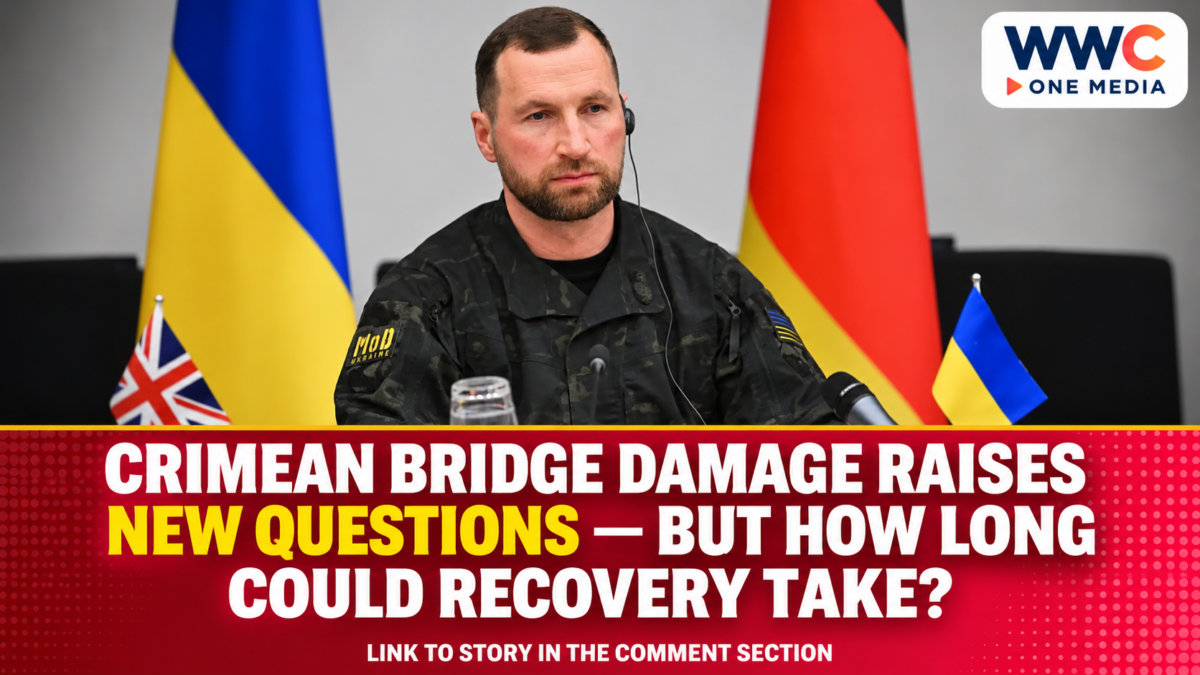
Ukraine’s Ministry of Defence has reported extensive Crimean Bridge damage following a series of military operations in November 2026, including the collapse of part of its road infrastructure and damage to its railway tracks.
The ministry’s November 22 assessment has raised questions about the eventual restoration of the crossing connecting Russia with occupied Crimea, although a definitive reconstruction timetable remains unavailable in the official records reviewed.
Beyond the immediate military developments, the condition of the bridge presents a broader infrastructure challenge: determining how damaged transport facilities can be safely restored while the conflict continues.
The recovery process could have implications for civilian mobility, commercial transportation and the movement of essential supplies.
Crimean Bridge damage: What the official record establishes
Ukraine’s Defence Ministry reported operations against the crossing on November 16, 17 and 19.
Its assessment documented reported structural damage, including the collapse of a road arch and subsequent damage affecting the railway.
These findings represent Ukraine’s official account of the operations rather than an independently conducted engineering assessment.
The distinction is important because confirming that a structure sustained damage does not necessarily establish its remaining load-bearing capacity, the condition of adjacent sections or the amount of work required before normal transportation can resume.
A comprehensive assessment would need to address those questions before a reliable recovery schedule could be established.
Infrastructure disruption has also affected other communities during the conflict, as examined in WWC’s earlier reporting on damage to Kyiv’s critical infrastructure.
Why reconstruction is more complicated than reopening traffic
The recovery of a damaged bridge involves several distinct engineering and administrative decisions.
Restoring limited access, clearing damaged material and completing permanent reconstruction are not necessarily interchangeable milestones.
A transport authority could determine that certain services can operate under restrictions while other sections remain unavailable. Conversely, temporary access would not establish that a structure had returned to its original condition.
For the Crimean Bridge, the reported damage to both road and railway infrastructure makes those distinctions particularly relevant.
The eventual timetable would depend on the findings of qualified engineers, the availability of construction resources and the conditions under which restoration work could proceed.
Without a published technical assessment, assigning a firm completion date would be premature.
The same distinction between partial service availability and full infrastructure recovery is relevant to WWC’s coverage of damaged transport crossings in Kyiv.
Civilian transportation remains an important consideration
Infrastructure damage during armed conflict creates consequences that extend beyond military activity.
For civilians, restrictions affecting transportation can complicate ordinary journeys, access to essential services and commercial deliveries.
Businesses dependent on predictable freight schedules may also face uncertainty when transport arrangements change.
However, the extent of any commercial losses associated with the latest Crimean Bridge damage cannot be reliably calculated without current transportation statistics and financial disclosures.
No precise estimate of additional freight costs, lost commercial activity or reconstruction expenditure has been established in the primary records reviewed.
The wider conflict has also highlighted the vulnerability of passenger transportation, a subject covered in WWC’s earlier report on railway security near the Ukrainian-Polish border.
The wider political significance of Crimea
The bridge’s importance cannot be separated from the international dispute over Crimea.
United Nations General Assembly Resolution 68/262 reaffirmed Ukraine’s sovereignty and territorial integrity within its internationally recognised borders.
Subsequent United Nations resolutions have addressed Russia’s occupation and militarisation of the peninsula.
Ukraine’s Defence Ministry describes the bridge as infrastructure supporting Russian military transportation.
That position explains its prominence in Ukrainian official accounts of the war, but the ministry’s description should not be confused with an independent assessment of every reported incident or its consequences.
For international observers, the crossing remains an infrastructure issue situated within a much larger territorial and security dispute.
What the damage could mean for long-term recovery
From an infrastructure perspective, the most significant uncertainty is whether the reported damage can be addressed through limited repairs or whether more extensive reconstruction will be required.
Those possibilities would carry different financial, engineering and administrative consequences.
The availability of funding alone would not establish how quickly normal operations could return. Decisions about structural safety, regulatory approvals and construction requirements would also influence any recovery programme.
For businesses and travellers, the practical issue is whether transportation can become dependable again.
A public announcement concerning one stage of restoration should therefore be assessed on its own terms rather than interpreted automatically as confirmation that the entire crossing has recovered.
What happens next
The next meaningful developments would be the publication of engineering findings, official reconstruction plans and updated information about transportation services.
A credible recovery timetable would need to distinguish between debris clearance, structural repairs and the restoration of regular operations.
Until such information becomes available, the duration and cost of the recovery remain uncertain.
The central question surrounding the Crimean Bridge is no longer confined to the reported damage itself. It is whether the responsible authorities can establish a safe, measurable and credible path towards restoring the affected infrastructure.