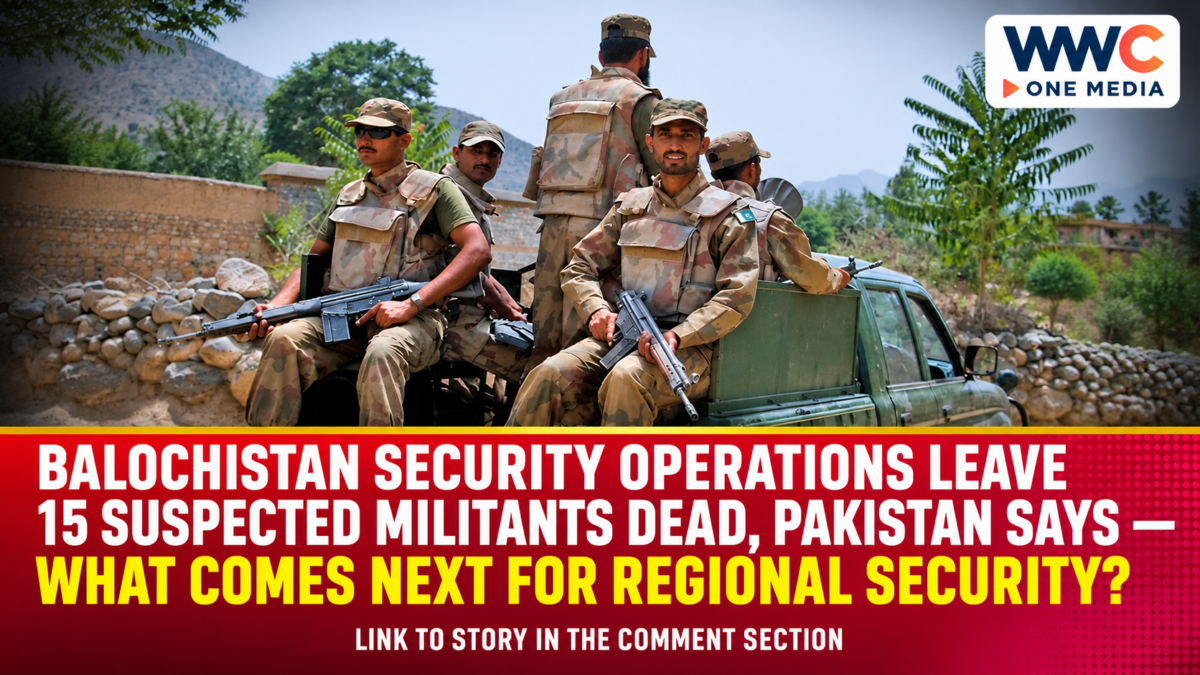
Pakistani authorities reported that 15 suspected militants were killed during two Balochistan security operations in Mastung district, with the announcement made on Nov. 21, 2026. Prime Minister Shehbaz Sharif subsequently reaffirmed his administration’s commitment to combating terrorism across the country.
The announcement places renewed attention on Pakistan’s counterterrorism campaign and the broader challenge of translating security operations into sustainable peace, civilian protection and regional stability.
Although the government has presented the operations as successful, their longer-term consequences remain to be established.
Balochistan security operations highlight Islamabad’s priorities
The operations formed part of a continuing counterterrorism campaign identified by Pakistani authorities as Operation Radd-ul-Fitna-3.
The government identified those targeted as members of a group it calls Fitna al-Hindustan. That designation represents the authorities’ account and should not be interpreted as independently verified evidence of individual affiliations or foreign involvement.
Sharif’s subsequent statement expressed support for security personnel and reiterated the government’s intention to continue addressing terrorism throughout Pakistan.
The announcement follows other security developments elsewhere in the country, including Pakistan’s recently reported counterterrorism operations in Khyber Pakhtunkhwa.
The two developments concern different provinces and separate operations.
Together, they illustrate the continuing prominence of domestic security in Islamabad’s public policy agenda, although they do not establish the overall effectiveness of the country’s counterterrorism strategy.
Why long-term stability matters
Military operations represent one component of a broader security response.
From a public policy perspective, lasting stability also depends on the ability of government institutions to maintain public services, protect communities, uphold legal safeguards and create conditions conducive to legitimate economic activity.
The distinction matters because the immediate outcome of a security operation does not necessarily establish whether underlying threats have been permanently addressed.
A meaningful assessment would require additional information about subsequent security conditions, civilian safety and the effectiveness of government institutions operating in affected communities.
For residents, the practical measures of stability include whether businesses can operate normally, whether children can attend school safely and whether essential public services remain accessible.
These considerations provide a wider framework for evaluating counterterrorism policies without assuming that any particular economic or social disruption occurred during the Mastung operations.
Civilian protection and public accountability remain important
The government announcements reviewed for this report establish the authorities’ stated position on the operations.
However, they do not provide sufficient independently verifiable information to determine the identities of everyone killed, whether civilians were affected or whether nearby communities experienced disruption.
The absence of those details should not be interpreted as evidence that civilian harm occurred. Equally, it does not independently establish that no civilians were affected.
Further official disclosures could help clarify these questions.
The importance of local administrative coordination has also featured in separate developments, including the Battagram security response involving district authorities and police.
That case is unrelated to the Mastung operations but provides a separate example of how local security administration can complement national security policy.
Effective coordination between institutions can be particularly important when authorities need to maintain public order while ensuring that residents retain access to essential services.
The broader economic and regional implications
Security developments can influence economic decisions, particularly when businesses assess potential investments, infrastructure projects and operational risks.
However, it would be premature to conclude that the Mastung operations have directly affected investment flows, employment, transport activity or commercial operations.
No economic assessment establishing such consequences was identified in the government announcements reviewed for this article.
Pakistan’s security policy also extends beyond domestic counterterrorism. Its diplomatic positions on regional instability have been reflected in developments such as Islamabad’s condemnation of the attack on Riyadh’s financial district.
The Riyadh incident and the Mastung operations are separate matters. No direct connection between them has been established.
Nevertheless, both provide context for examining how security concerns feature in Pakistan’s domestic and international policy discussions.
For economic policymakers, the broader challenge is to pursue stability while maintaining public confidence, supporting productive investment and ensuring that development priorities remain responsive to community needs.
What happens next
Sharif’s Nov. 21 statement indicated that the government’s counterterrorism efforts would continue.
Further disclosures from Pakistani authorities could provide additional information about the outcome of the Mastung operations, the security situation in affected communities and any subsequent administrative measures.
For now, the public government account establishes that authorities reported 15 deaths in two operations and that the prime minister expressed support for the continuing campaign.
Whether the operations contribute to a sustained improvement in regional security remains an open question.
The longer-term assessment will depend not simply on official operational announcements, but also on measurable improvements in public safety, institutional accountability and the everyday conditions experienced by local communities.