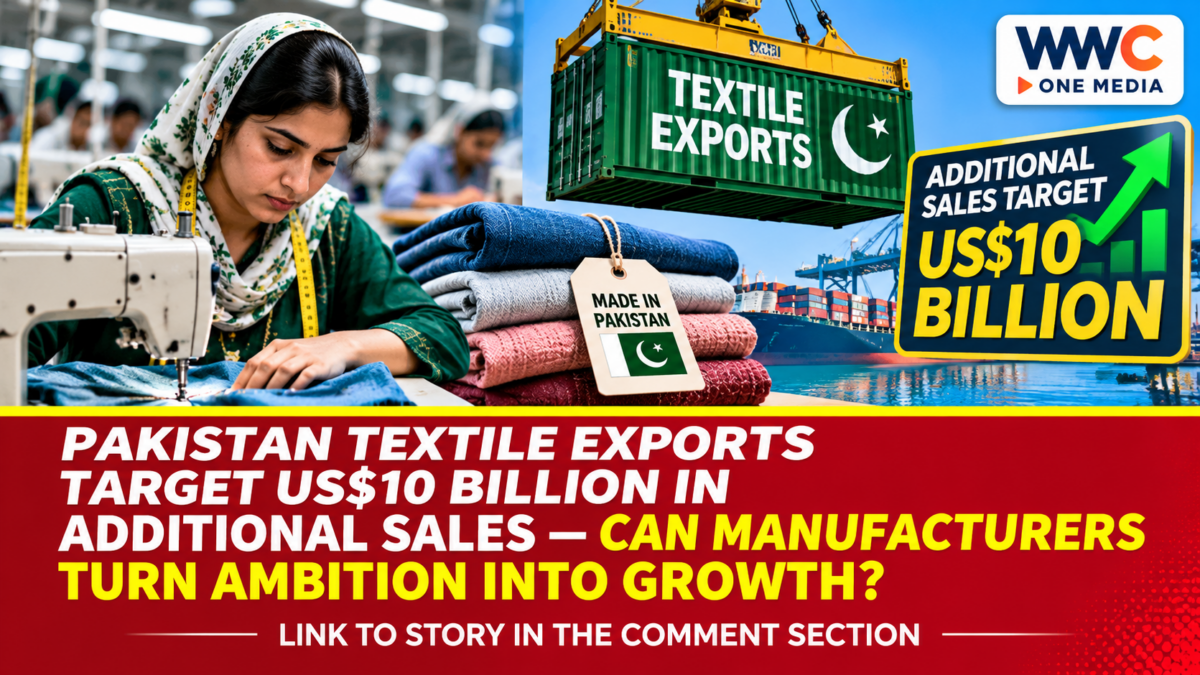
Pakistan’s textile manufacturers are pursuing an ambitious export expansion as the industry seeks to strengthen its position in international markets, including the United States. In an October 2026 policy statement, All Pakistan Textile Mills Association (APTMA) Chairman Asad Shafi outlined the potential for US$10 billion in additional textile exports within two to three years, subject to investment and improved operating conditions.
The ambition comes against a substantial existing commercial relationship with Washington. Bilateral goods and services trade between the United States and Pakistan reached an estimated US$11.5 billion in 2025.
For manufacturers, however, the challenge extends beyond securing additional overseas customers. Sustaining export growth will require competitive production costs, dependable financing and the ability to capture more value from finished consumer products.
Pakistan Textile Exports Show Uneven Growth
Pakistan’s latest official merchandise trade statistics reveal different growth patterns across major textile product categories.
Provisional government figures place the country’s total worldwide merchandise exports at US$11.507 billion between July and October 2026, representing an annual increase of 10.16%.
Textile products remained prominent among the country’s leading export commodities.
In Pakistani rupee terms, ready-made garment exports increased by 11.79% during the four-month period, while knitwear shipments recorded growth of 2.04%.
Cotton yarn exports expanded by 27.91%.
However, cotton cloth exports declined by 6.10%, while bedwear shipments decreased by 2.44%.
These figures cover exports to all international destinations rather than shipments exclusively to the United States.
The uneven performance matters because textile manufacturers serve different markets and operate with different production requirements. An improvement in one category does not necessarily establish that the entire industry is experiencing equivalent growth.
The United States Offers an Established Commercial Market
Official American trade figures show that the United States imported US$5.4 billion in merchandise from Pakistan in 2025, an increase of 5.9% from the previous year.
American merchandise exports to Pakistan reached US$3.1 billion, rising by 48.4%.
These totals cover all merchandise categories and should not be interpreted as textile-specific trade figures.
Nevertheless, the relationship provides useful context for Pakistan’s industrial export ambitions.
A manufacturer seeking additional American customers would need to evaluate product specifications, delivery arrangements, applicable customs requirements and the commercial terms offered by buyers.
Similar considerations arise in Pakistan’s efforts to diversify international economic relationships, including the proposed expansion of business cooperation between Pakistan and ASEAN.
Trade discussions may create opportunities for companies to establish new relationships, but actual export growth depends on commercially viable transactions.
APTMA Wants Manufacturers to Capture More Retail Value
Shafi’s industry strategy extends beyond increasing factory output.
The association wants Pakistani manufacturers to develop stronger commercial capabilities in areas such as product design, brand development and overseas distribution.
For a hypothetical garment manufacturer, supplying clothing to an international retailer provides one source of revenue.
Developing its own consumer brand could provide an additional opportunity to capture value from the finished product.
However, that approach would also introduce new financial responsibilities, including advertising, inventory management, distribution and customer service.
The commercial opportunity must therefore be evaluated alongside the additional risks.
WWC analysis: Manufacturers expanding into retail should distinguish potential revenue growth from sustainable profitability. Building a recognised brand requires investment, and higher selling prices do not necessarily produce higher profits once distribution and marketing expenses are included.
A successful transition would depend on reliable product quality, appropriate market positioning and sufficient working capital.
Production Costs Could Determine Export Competitiveness
APTMA’s policy statement identifies energy and financing expenses as important obstacles to its proposed expansion.
Shafi called for industrial electricity priced at seven US cents per kilowatt-hour, natural gas at US$7 per million British thermal units and financing at an annual rate of 7%.
These figures represent industry policy requests rather than government-approved rates.
The association also requested faster settlement of outstanding tax refunds to improve exporters’ liquidity.
For manufacturers, working capital helps finance raw materials, employee compensation and other operating requirements before customers pay for completed orders.
When financing becomes expensive or payments are delayed, additional export orders may place greater pressure on a company’s available cash.
Production efficiency offers another potential avenue for improving competitiveness.
Developments such as Taiwan’s use of artificial intelligence in textile factories illustrate the types of technological investment that manufacturers could evaluate.
The financial case for such investments would depend on measurable operational improvements rather than technology adoption alone.
What Philippine Exporters Can Learn
Pakistan’s strategy offers a relevant comparison for Philippine companies seeking to expand their participation in international manufacturing and consumer markets.
The opportunity to develop higher-value products must be considered alongside the ability to satisfy overseas customers’ commercial and regulatory requirements.
Philippine manufacturers could evaluate whether investment in specialised products, quality assurance and stronger distribution relationships would improve their competitive position.
These considerations are especially relevant to the wider discussion surrounding Philippine access to the United States market.
Pakistan’s proposed export expansion does not establish that Philippine manufacturers will lose orders or experience weaker demand.
Such conclusions would require separate trade statistics and company disclosures.
Nevertheless, the case illustrates why export competitiveness involves more than offering products at low prices.
What Happens Next?
APTMA’s proposed expansion will need to be assessed against subsequent investment decisions, government policies and actual export performance.
Future merchandise trade releases should provide additional information about whether growth is becoming more consistent across textile categories.
Any new bilateral arrangements with the United States would also require independently documented commercial or government commitments.
The US$10 billion ambition remains conditional rather than an established financial outcome.
For Pakistan’s manufacturers, the decisive test will be whether increased overseas demand can translate into profitable production, sustainable investment and stronger international customer relationships.
Frequently Asked Questions
How much additional textile export revenue is Pakistan targeting?
APTMA’s chairman identified the potential for US$10 billion in additional exports within two to three years, subject to supportive business conditions and investment.
How large is US–Pakistan bilateral trade?
The United States Trade Representative estimates that bilateral goods and services trade reached US$11.5 billion in 2025.
Are all Pakistani textile exports increasing?
No. Official July–October 2026 figures show growth in garments, knitwear and cotton yarn but declines in cotton cloth and bedwear export values.
Has a new US–Pakistan textile trade agreement been confirmed?
No new agreement has been established by the primary records reviewed for this report.
What could help Pakistan’s textile industry grow?
Competitive operating expenses, improved financing, efficient production, dependable customer relationships and stronger value-added manufacturing could support expansion. Actual outcomes remain uncertain.