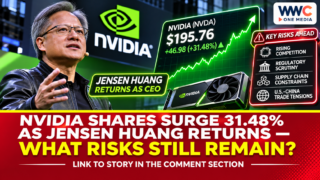
Nvidia announced on Nov. 23, 2026, that Jensen Huang had returned to its top leadership position after a unanimous board decision. A US Securities and Exchange Commission filing dates the reinstatement to Nov. 22, when Huang resumed his roles as president, chief executive and director.
The decision resolves the immediate question of who runs the semiconductor company, but it does not conclude an independent board investigation or remove the need for stronger compliance oversight. For customers and shareholders, the distinction between leadership continuity and corporate accountability is central to understanding the announcement.
Jensen Huang returns to a changed leadership structure
Nvidia had announced Huang’s departure on Nov. 12 and installed finance chief Colette Kress as interim chief executive. At that point, directors intended to consider candidates from inside and outside the company for the permanent position.
The latest filing establishes that the temporary leadership arrangement has ended. Kress retains her finance and executive vice-president responsibilities, while Harvey C. Jones remains board chair.
WWC analysis: The allocation of these responsibilities matters because the return of a familiar executive does not necessarily restore the previous governance arrangements. The chief executive manages the business, while directors must continue to exercise oversight of decisions and risks. Investors should examine how those responsibilities operate in practice rather than assume a change of personnel settles every outstanding question.
The financial implications likewise extend beyond the identity of the chief executive. WWC’s earlier examination of Nvidia’s credit outlook provides background on why creditors and shareholders may evaluate corporate developments differently.
Independent oversight remains on the agenda
The board disclosed that it considered input from senior levels of the US government during its deliberations. Its resulting assessment was that Huang’s return did not pose a national security risk. That assessment is the board’s position; the announcement does not constitute a separate public government clearance.
The company also confirmed that its independent directors’ inquiry would continue, with outside legal assistance. Huang has committed to cooperating. The announcement does not provide a final investigative finding.
The distinction is important: an appointment decision addresses whether an executive should occupy a particular role. An investigation addresses questions within its own remit and may require further examination of evidence. It would be inaccurate to treat reinstatement as proof that the inquiry has ended.
WWC analysis: A credible governance framework must allow directors to obtain information and evaluate concerns even when management is delivering strong financial results. The relevant measure of independence is how oversight is exercised, not simply how committees are described in corporate announcements.
Compliance becomes a separate management priority
Nvidia’s board has established a committee of independent directors responsible for national security and export-control oversight. The company is also beginning recruitment for a chief compliance officer who will report to its nominating and corporate governance committee.
The new recruitment initiative is not an announcement that the position has already been filled. Nor does the creation of an oversight committee establish that any particular regulatory violation occurred.
For a semiconductor business operating internationally, compliance decisions can affect whether commercial opportunities translate into completed transactions. WWC’s previous coverage of US AI chip rules affecting Southeast Asian data centres examines the relevance of these questions to regional customers.
WWC analysis: Philippine infrastructure investors should distinguish Nvidia’s internal governance changes from changes to applicable government rules. A leadership appointment does not itself modify export licensing obligations or guarantee access to particular products.
Financial performance provides a separate benchmark
Nvidia’s Nov. 17 earnings announcement reported revenue of US$115.8 billion for the fiscal quarter ending Oct. 25, an increase of 103% from a year earlier. Its Data Center business generated US$107.6 billion. Net income under US generally accepted accounting principles reached US$65.3 billion.
Those results predate the reinstatement and cannot be attributed to the latest leadership decision. They offer a baseline against which subsequent corporate performance can be assessed.
Management projected fourth-quarter revenue of US$130 billion, with a margin of variation of 3% in either direction. The forecast incorporates an additional reporting week and assumes no Data Center computing revenue from China.
That assumption should not be interpreted as a prediction that every category of sales to China will cease. It describes the basis for a particular financial forecast.
What customers and investors should examine
WWC analysis: Executive continuity may reduce uncertainty over who is responsible for implementing strategy, but the execution of that strategy depends on commercial conditions. Customers still need to assess their own financing, infrastructure requirements and contractual arrangements.
For example, a hypothetical cloud computing company planning a new facility would need to consider whether it can fund construction and obtain the resources required to operate it. A supplier’s leadership appointment would not independently establish that those conditions have been satisfied.
WWC’s earlier analysis of Nvidia’s AI infrastructure investment commitments examines why announced investment ambitions must be distinguished from funding and implementation.
Shareholders likewise have reason to evaluate actual earnings, corporate commitments and governance disclosures separately. None of these measures guarantees a particular share-price outcome.
What happens next
The next meaningful developments include the appointment of a compliance chief, any publicly disclosed findings from the independent inquiry and subsequent financial reporting. The company has not specified a completion date for the inquiry in its reinstatement announcement.
Huang’s return establishes who leads Nvidia today. The continuing review and compliance initiatives leave separate questions about accountability and execution to be addressed through future corporate actions.
Frequently asked questions
Is Jensen Huang back as Nvidia CEO?
Yes. The SEC filing records his reinstatement on Nov. 22, 2026; the public announcement followed on Nov. 23.
What happened to interim CEO Colette Kress?
She continues as executive vice-president and chief financial officer.
Has Nvidia’s independent investigation ended?
No. The board said the inquiry would continue to completion.
Does Huang’s return change US chip export rules?
The reinstatement announcement does not establish any change to those rules.