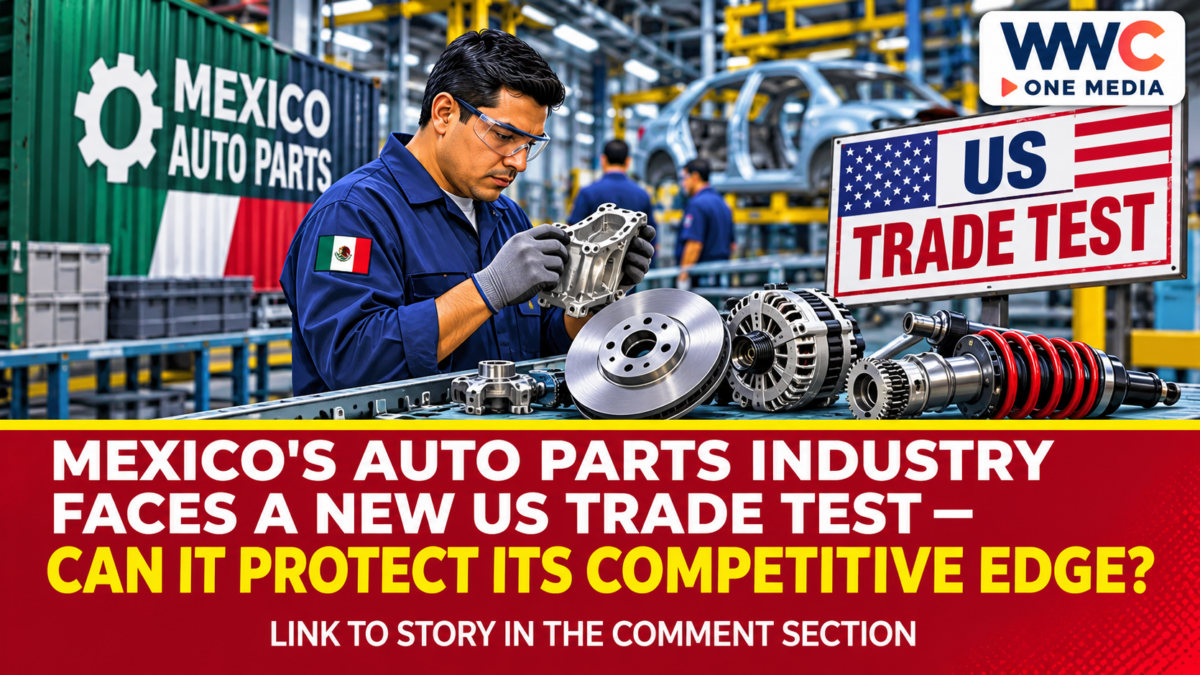
Mexico’s auto parts industry faces a crucial test of its international competitiveness as Washington reassesses the trade arrangements underpinning North American automotive manufacturing. The US government’s July 2026 review of the United States–Mexico–Canada Agreement (USMCA) placed renewed attention on regional production, sourcing requirements and the distribution of manufacturing activity.
For Mexico, the stakes extend across an automotive components industry that generated approximately US$106 billion in worldwide exports in 2024.
Its established manufacturing network provides a substantial commercial foundation, but maintaining access to American customers will depend on more than production capacity.
The challenge is whether Mexican suppliers can remain competitive while adapting to changing trade requirements, controlling manufacturing expenses and preserving relationships with international vehicle manufacturers.
Mexico Auto Parts Suppliers Have a Substantial Industrial Base
Historical industry figures published in the US Department of Commerce’s February 2026 commercial guide place Mexican automotive parts production at US$121.3 billion in 2024, compared with US$92.7 billion in 2021.
Worldwide exports reached approximately US$106 billion in 2024, up from US$78.5 billion in 2021.
Those figures demonstrate the scale of the country’s industrial expansion, although they do not establish its current export performance for 2026.
Mexico has developed manufacturing capabilities across several categories of automotive components, including electrical equipment, seating systems and mechanical assemblies.
Its industrial structure allows vehicle manufacturers to obtain complete systems as well as individual components used in subsequent production stages.
For international buyers, the commercial attraction is not necessarily limited to manufacturing expenses.
Access to established suppliers, engineering capabilities and regional transport networks can also influence decisions about where vehicle components are produced.
Replacing such a manufacturing network would involve assessing alternative suppliers, testing products and reorganising commercial arrangements.
Why American and Mexican Manufacturers Depend on Each Other
The automotive relationship between Mexico and the United States extends in both directions.
Mexico’s automotive parts imports reached approximately US$68.6 billion in 2024, including US$35.8 billion supplied by the United States.
American producers accounted for 52.2% of Mexico’s automotive parts imports during that period.
This means that Mexican automotive manufacturing also provides a significant commercial market for American component suppliers.
Consider a hypothetical vehicle assembly operation that purchases electrical equipment from the United States, incorporates it into a system in Mexico and subsequently delivers the completed system to an American factory.
A change in customs treatment could affect multiple businesses involved in that production arrangement rather than only the company responsible for the final shipment.
This interdependence helps explain the commercial importance of the wider trade negotiations between Washington and Mexico.
For businesses operating across national borders, the economic impact of trade policy must be assessed across the entire manufacturing process.
The USMCA Review Raises New Questions for Suppliers
On July 1, 2026, the United States, Mexico and Canada conducted the agreement’s joint review.
Washington declined to renew the USMCA in its existing form during that review. However, the US trade representative’s announcement made clear that the agreement remained in force at that point.
Failure to obtain renewal during the review did not itself terminate the agreement.
Automotive sourcing requirements had already been discussed during the first bilateral negotiating round between the United States and Mexico, which concluded on May 29.
The discussions also covered steel, aluminium and economic security.
Under the established USMCA automotive framework, qualifying passenger vehicles and light trucks generally face a regional value-content requirement of 75%.
These requirements are intended to determine whether sufficient economic value originates within North America for a vehicle to qualify for preferential treatment.
For component manufacturers, potential changes to sourcing requirements could influence purchasing decisions and production arrangements.
The negotiations also form part of the broader challenge of Mexico balancing its commercial relationships with China and the United States.
A manufacturer’s ability to document the origin of materials could become as commercially important as its ability to produce components at competitive prices.
Market Share Alone Cannot Measure Manufacturing Success
An automotive supplier’s position in an importing market is an important indicator of competitiveness, but it does not provide a complete picture of financial performance.
Consider two hypothetical situations.
A country supplying US$40 billion of a US$100 billion import market would hold a 40% market share.
If its shipments remained unchanged while the overall market contracted to US$80 billion, its market share would increase to 50%, despite generating no additional export revenue.
The distinction becomes even more important when production expenses and profitability are considered.
A supplier could increase its sales while experiencing weaker profit margins if its operating costs rise more rapidly than revenue.
WWC analysis: Assessments of Mexico’s automotive competitiveness should therefore examine export earnings, manufacturing costs, customer concentration and investment activity alongside market-share statistics.
A higher percentage of American imports would not automatically establish that Mexican suppliers are becoming more profitable or that employment is increasing.
The US Department of Commerce’s automotive trade dashboard also identifies a methodological limitation: automotive parts are reported in monetary terms without a common physical-volume measure because the products use different reporting units.
Consequently, changes in shipment values should not automatically be interpreted as equivalent changes in the number of components sold.
What Philippine Manufacturers Can Learn From Mexico
Mexico’s industrial experience offers a relevant comparison for Philippine companies seeking greater participation in international manufacturing networks.
Its proximity to American assembly facilities creates a geographic advantage that Philippine exporters cannot directly replicate.
However, other elements of industrial competitiveness can be developed through investment in engineering, product quality, production reliability and supply-chain documentation.
Philippine electronics and industrial component manufacturers could evaluate opportunities to become specialist suppliers rather than relying exclusively on competition through lower production costs.
The importance of these capabilities also features in WWC’s examination of the Philippines’ trade relationship with the United States.
Manufacturers seeking international contracts must consider the commercial requirements of individual customers alongside applicable customs regulations.
Mexico’s trade position does not establish that Philippine automotive suppliers will gain or lose business. Such developments would require separate investment announcements, company disclosures or official trade statistics.
What Happens Next?
Future assessments of Mexico’s automotive industry will depend on updated export figures, the outcome of trade negotiations and the investment decisions of vehicle manufacturers.
Businesses will also need to evaluate whether their supply arrangements can accommodate any formally adopted changes to regional sourcing requirements.
Mexico’s industrial scale provides an established foundation, but its long-term competitive position will depend on maintaining commercially viable production under changing trade conditions.
Frequently Asked Questions
How large is Mexico’s auto parts export industry?
Its worldwide automotive parts exports reached approximately US$106 billion in 2024.
Is the United States also an automotive parts supplier to Mexico?
Yes. American suppliers accounted for 52.2% of Mexico’s automotive parts imports in 2024.
Did the July 2026 USMCA review terminate the agreement?
No. Washington declined to renew the agreement in its existing form, but the official July announcement confirmed that it remained in force.
Does a rising automotive import market share guarantee higher profits?
No. Market share, export earnings and profitability measure different aspects of business performance.