
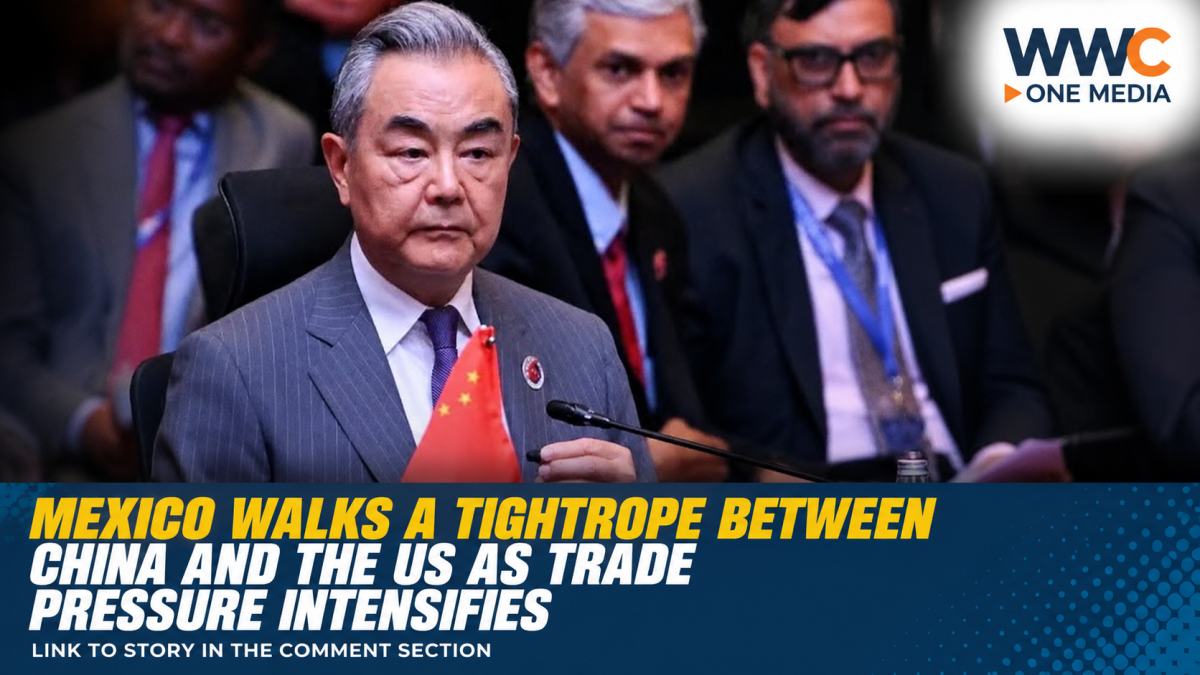
Mexico’s foreign minister is heading to China for talks with Wang Yi as pressure from Washington grows for Mexico to reduce its economic dependence on Chinese goods and investment. The visit puts Mexico at the center of an increasingly important US-China trade battle.
Mexican Foreign Secretary Roberto Velasco Álvarez will visit China on September 6–7, at the invitation of Chinese Foreign Minister Wang Yi, according to China’s Foreign Ministry. Velasco is expected to meet Wang in Beijing before travelling to Chongqing to inaugurate Mexico’s new consulate there.
The timing is significant.
Mexico is simultaneously negotiating with the United States over the future of the US-Mexico-Canada Agreement (USMCA), while Washington is pushing for stronger North American supply chains and less reliance on Chinese products and investment.
Why Mexico is caught in the middle
The United States is Mexico’s overwhelmingly largest trading partner, while China has become its second-largest source of imports.
WTO data shows that China accounted for about 20.1% of Mexico’s imports in 2025, worth roughly US$133.2 billion. By comparison, the United States supplied about 37.7% of Mexico’s imports.
Mexico’s dependence on Chinese goods has therefore become an increasingly sensitive issue in Washington.
During USMCA negotiations, U.S. officials have emphasized reducing what they describe as “free-riding” by countries outside the agreement and strengthening North American manufacturing and supply chains.
Washington is particularly concerned about Chinese companies using Mexico as a manufacturing or investment base while potentially gaining access to the enormous U.S. market.
Mexico has already raised barriers on Chinese goods
Mexico is not entering the talks with Beijing from a position of having done nothing.
At the beginning of 2026, Mexico introduced higher tariffs covering a wide range of products from countries with which it does not have free-trade agreements, including China.
The measures cover sectors including automotive parts, automobiles, steel, textiles, plastics, appliances, toys, furniture, footwear and other manufactured goods. Mexican officials have defended the policy as part of an effort to strengthen domestic manufacturing and protect jobs.
The impact on China has been significant.
Mexico’s Economy Ministry reported that imports from China affected by the new tariffs fell 28% during the first five months of 2026, according to Mexican reporting.
But Beijing has not welcomed the shift.
China previously warned Mexico to reconsider its tariff policy and said it could take measures to protect its interests. Chinese officials have argued that normal trade should not be treated as a security problem simply because the goods originate in China.
Washington wants Mexico closer to North America
The U.S. pressure is occurring alongside the formal review of the USMCA.
U.S. Trade Representative Jamieson Greer and Mexican Economy Minister Marcelo Ebrard have held several rounds of bilateral discussions covering automotive rules of origin, steel and aluminum, agriculture, economic security and supply chains.
The United States has explicitly said it wants the agreement to benefit the three North American partners while addressing what it calls “free-riding” from countries outside the pact.
That puts Mexico in a difficult position.
It wants continued access to the U.S. market while also maintaining commercial relations with China, a major supplier of electronics, machinery, automotive components and other manufactured goods.
China is too important for Mexico to simply walk away
The numbers explain why Mexico cannot easily sever its relationship with China.
In 2026, Mexico imported roughly US$65.8 billion from China through June, according to Mexico’s Data México platform, while exports to China were about US$7.6 billion, leaving a substantial bilateral trade deficit.
Chinese products and components are also increasingly integrated into Mexican manufacturing.
That creates a major dilemma for Mexico.
Reducing Chinese imports may satisfy some U.S. demands and encourage more North American production. But cutting Chinese supply chains too quickly could also increase costs for Mexican manufacturers that rely on Chinese machinery, electronics, components and other inputs.
Mexico’s US relationship is much bigger
The scale of Mexico’s economic relationship with the United States makes Washington’s leverage clear.
U.S. Trade Representative data shows that U.S.-Mexico goods and services trade reached an estimated US$964.1 billion in 2025, while more than 80% of Mexico’s goods exports went to the United States in 2024.
That means Mexico has enormous incentives to preserve favorable access to the American market.
And the pressure is already affecting investment decisions.
A recent Reuters report found that uncertainty surrounding the future of USMCA is causing some companies to reconsider new investment in Mexico, while some businesses are exploring alternatives in Asia and elsewhere.
The China visit is not necessarily a break with Washington
Despite the dramatic timing, Mexico’s decision to send its foreign minister to Beijing should not automatically be interpreted as Mexico choosing China over the United States.
Mexico’s Foreign Ministry describes the visit as an opportunity to strengthen political dialogue and cooperation, while China’s Foreign Ministry says it expects the meeting to deepen political trust and promote steady bilateral relations.
At the same time, Mexico continues negotiating directly with Washington.
Just one day before the China visit was announced, Mexican Economy Minister Marcelo Ebrard met U.S. Commerce Secretary Howard Lutnick to discuss tariffs affecting Mexican automobiles, steel and other areas of bilateral trade.
That simultaneous diplomacy tells the bigger story.
Mexico is trying to keep both doors open.
A new battleground in the US-China rivalry
The dispute is no longer simply about Washington and Beijing imposing tariffs on each other.
It is increasingly about where global supply chains are located.
Mexico has become one of the world’s most important manufacturing hubs for companies seeking access to the U.S. market. At the same time, Chinese companies and suppliers have expanded their presence throughout Mexico.
Washington wants that dependence reduced.
Beijing wants to preserve access to one of Latin America’s biggest economies.
And Mexico wants to benefit from both relationships without becoming trapped in either side’s geopolitical strategy.
What happens next could affect global supply chains
Velasco’s meeting with Wang Yi will therefore be closely watched for signs of where Mexico’s China policy is heading.
Will Mexico deepen economic cooperation with Beijing despite U.S. pressure?
Will it introduce additional restrictions on Chinese imports and investment?
Or will Mexico attempt a middle path — maintaining Chinese commercial ties while gradually increasing North American production?
For now, Mexico is signaling that it does not intend to close either door.
But as Washington pushes harder to reshape North American supply chains, Mexico’s balancing act is becoming increasingly difficult.
The next USMCA negotiations — and whatever emerges from the Velasco-Wang meeting — could determine whether Mexico becomes an even more important bridge between China and the U.S. or a much more tightly integrated part of Washington’s North American economic strategy.
WWC ONE MEDIA J.M.D




Leave a Reply