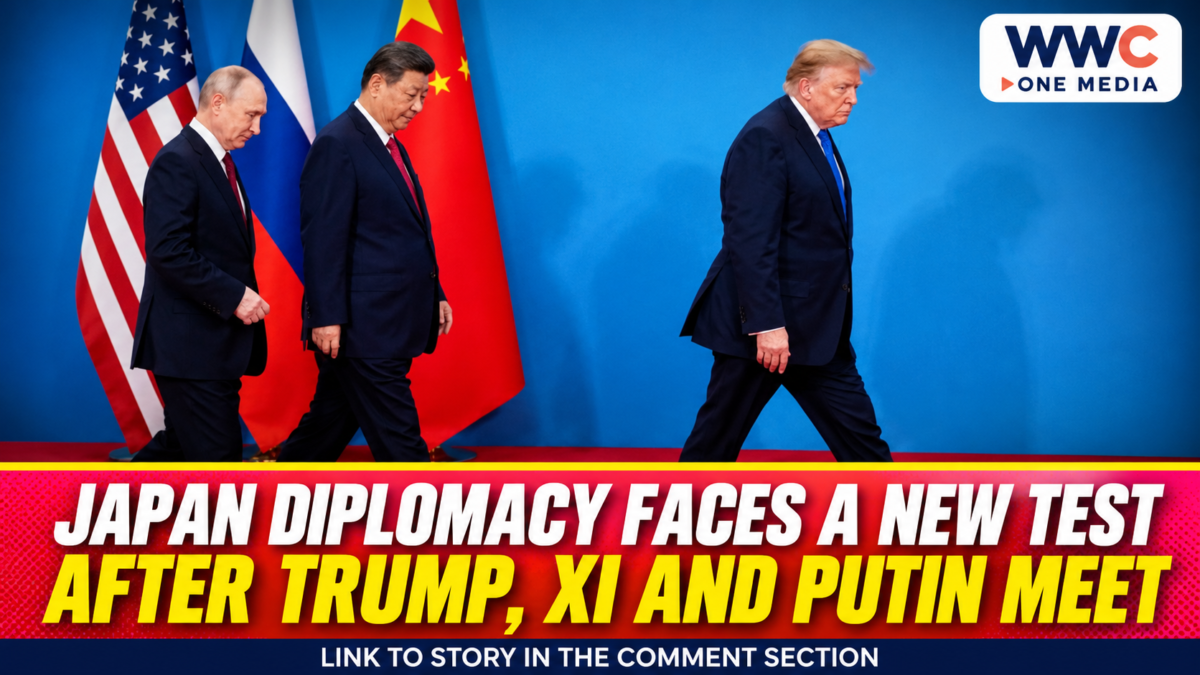
TOKYO — November 24, 2026. Japan is recalibrating its diplomatic position after US President Donald Trump, Chinese President Xi Jinping and Russian President Vladimir Putin held a three-country summit in Shenzhen on November 19, a meeting that produced a joint declaration on international security, energy and nuclear risks. Prime Minister Sanae Takaichi spoke with Trump later that evening, with Japan’s government confirming that the two leaders discussed the summit and agreed to maintain close coordination.
The sequence places Tokyo in a delicate position. Japan must preserve its alliance with Washington while managing its relationship with neighbouring China and Russia, two countries whose policies directly affect Japan’s security and economic interests. The official records point to a clear response: strengthen coordination with allies, maintain regional partnerships and keep diplomatic communication open.
The summit did not produce a publicly announced agreement involving Japan. But its timing, following a major Quad meeting in Manila, highlights the different diplomatic channels now shaping the Indo-Pacific.
Japan Diplomacy Responds to a Summit It Did Not Join
The November 19 meeting brought together Trump, Xi and Putin in Shenzhen. Their governments published a declaration committing the three countries to discussions on United Nations reform, refined petroleum supply, the authority of international institutions and nuclear risk reduction. The White House+1
The declaration is significant because it puts three permanent members of the United Nations Security Council in one diplomatic framework. Their stated priorities include maintaining strategic stability and international security, although the document does not establish a new security alliance or disclose detailed implementation arrangements.
For Japan, the immediate question was how Washington would explain the discussions to its closest regional ally.
That answer came through a telephone conversation between Takaichi and Trump on November 19. Japan’s Foreign Ministry said the call began at 10:30 p.m. and lasted approximately 20 minutes. Trump provided a detailed explanation of the latest US-China and US-China-Russia summits, while the two leaders exchanged views on the Indo-Pacific and Ukraine. They also affirmed that Japan and the United States would work in close coordination. Ministry of Foreign Affairs of Japan
The public record does not show that Japan was asked to approve the trilateral declaration or that Tokyo accepted its provisions. The more limited and verifiable conclusion is that Washington briefed Tokyo after the meeting and reaffirmed its commitment to the bilateral alliance.
Tokyo Had Already Put Its Regional Strategy on Display in Manila
The Shenzhen summit followed another important diplomatic event involving Japan and the United States.
On November 17, Takaichi joined Trump, Australian Prime Minister Anthony Albanese and Indian Prime Minister Narendra Modi for a Quad leaders’ meeting in Manila. The four governments discussed maritime security, economic resilience, critical supply chains, cybersecurity and emerging technologies. Ministry of Foreign Affairs of Japan+1
The joint statement also announced the Indo-Pacific Maritime Surveillance Collaboration. Under the initiative, patrol aircraft from the four countries are scheduled to participate in a maritime exercise in 2027. The leaders also announced enhanced cybersecurity cooperation and an inaugural Quad Business Leaders’ Forum planned for early 2027. The White House
These commitments matter because they show that Japan’s regional strategy is not limited to its relationship with Washington. Tokyo is also investing in cooperation with Australia and India, while supporting a broader regional framework that includes ASEAN.
WWC previously examined the maritime and technology initiatives announced at the Manila Quad summit. The latest developments give that meeting additional context: Japan was participating in a four-country regional framework just two days before Trump met Xi and Putin.
China Remains Both an Economic Partner and a Diplomatic Challenge
Japan’s approach to China is more complicated than simply choosing between engagement and confrontation.
On November 17, Takaichi also attended the 29th ASEAN Plus Three Summit in Manila, which brought together Japan, China, South Korea and ASEAN leaders. Japan’s official account records her support for cooperation in economic and financial matters, supply-chain resilience, food security and regional stability. Two leaders’ statements were adopted, covering maritime trade and logistics connectivity, and energy and food-security resilience. Ministry of Foreign Affairs of Japan
That engagement does not mean Tokyo and Beijing have resolved their disagreements. The summit was a multilateral gathering, and the published record does not establish a new bilateral settlement between the Japanese and Chinese governments.
The distinction is important for businesses. Japan and China are major economic actors in the region, and supply-chain decisions, trade rules and energy arrangements can affect companies operating across both markets. Continued diplomatic communication can help manage uncertainty, but it does not automatically remove political risks.
Japan’s foreign minister had already described the government’s approach before the Shenzhen meeting. At a November 13 press conference, Toshimitsu Motegi said Japan would closely monitor relations among the United States, China and Russia and respond in close coordination with Washington. He also said Tokyo’s basic approach toward China was to build a constructive and stable bilateral relationship through communication. Ministry of Foreign Affairs of Japan
That statement provides useful context for the government’s response after the summit: Tokyo was preparing for the possibility of trilateral diplomacy while maintaining its own channels with the major powers.
Russia Adds Another Layer to Tokyo’s Security Calculations
Japan’s relationship with Russia remains difficult, despite the need for communication between neighbouring countries.
In the same November 13 press conference, Motegi discussed the detention of a Japanese national in Russia and Japan’s diplomatic efforts to secure the individual’s release. He also said Tokyo had lodged a protest over the placement of local Japan Tobacco Group subsidiaries under temporary administration by a Russian company. Ministry of Foreign Affairs of Japan
Those issues illustrate why Japan cannot treat the Moscow relationship as a purely distant geopolitical matter. Bilateral disputes, the treatment of Japanese nationals and the interests of Japanese companies all remain part of the relationship.
The Shenzhen declaration, meanwhile, contains broad commitments on international security and energy but does not resolve Japan’s outstanding bilateral concerns with Russia. Nor does the public document identify any Japanese role in the three-country discussions.
For Tokyo, the practical challenge is to preserve channels for communication without implying that the summit settled matters that remain unresolved.
Why the Philippines Matters in Japan’s Wider Strategy
The November meetings also underline the Philippines’ importance as a venue for regional diplomacy.
Manila hosted the Quad summit attended by Japan and the United States, while Takaichi also participated in ASEAN-related meetings. The Philippines is not a member of the Quad, but its position in the Indo-Pacific makes regional maritime security, supply chains and freedom of navigation important policy concerns.
Japan and the Philippines have also been expanding their own security cooperation. Their defence logistics agreement provides a framework for reciprocal supplies and services during approved activities. Separately, Japan’s financial support for hosting US forces illustrates the scale of Tokyo’s long-running contribution to the US security presence in Japan.
These relationships are not interchangeable, and none means that the Philippines is part of the US-China-Russia summit. But they show why changes in major-power diplomacy matter beyond the countries directly involved.
For Manila, the question is whether regional commitments translate into practical cooperation on maritime awareness, economic resilience and crisis coordination.
What Happens Next
The next indicators will be found in implementation, not summit language alone.
Japan will need to maintain communication with Washington while continuing its work through the Quad, ASEAN-related forums and bilateral diplomatic channels. The 2027 maritime exercise and the planned Quad Business Leaders’ Forum are among the initiatives that can show whether the Manila commitments move forward.
The Shenzhen declaration will also need follow-through if its broad statements on energy and nuclear risk reduction are to produce concrete outcomes. The public document does not provide a detailed timetable or implementation mechanism for those commitments.
For now, Japan’s response is measured rather than dramatic. Tokyo has reaffirmed coordination with Washington, continued regional engagement and kept open the principle of communication with neighbouring powers.
The bigger test will be whether these separate diplomatic tracks can reduce uncertainty without forcing Japan to compromise the interests it has publicly identified as central to its security and regional policy.
Frequently Asked Questions
1. Did Japan participate in the Trump-Xi-Putin summit?
No. The November 19, 2026, summit in Shenzhen involved the leaders of the United States, China and Russia. Japan was not listed as a participant in the joint declaration.
2. Did Donald Trump brief Japan after the summit?
Yes. Japan’s Foreign Ministry said Trump spoke with Prime Minister Sanae Takaichi by telephone on November 19 and provided a detailed explanation of the US-China and US-China-Russia summit meetings.
3. What did the three leaders agree to in Shenzhen?
Their published declaration covered United Nations reform, refined petroleum supply, the role of international institutions and dialogue on nuclear risks and non-proliferation.
4. What is Japan doing with the Quad?
Japan is working with the United States, Australia and India on maritime surveillance, cybersecurity, supply-chain resilience and emerging technologies. The four countries also announced a maritime aircraft exercise planned for 2027.
5. Does the summit mean Japan-China relations have changed?
The published declaration does not establish a new Japan-China agreement. Japan continues to participate in regional forums with China while maintaining its own diplomatic and security priorities.